
Medical Study Abroad (MBBS Abroad): A Complete Guide for Indian Students
Introduction
Becoming a doctor is a dream for millions of Indian students. Every year, lakhs of students appear for the NEET-UG examination, but due to limited government medical seats and the high cost of private medical colleges, many deserving students are unable to secure an MBBS admission in India.
For such students, Medical Study Abroad (MBBS Abroad) has become a popular alternative. Many countries offer quality medical education at affordable tuition fees, modern infrastructure, and excellent clinical exposure. However, choosing the right university requires careful planning. Students should consider factors such as NMC regulations, university recognition, clinical training, internship, FMGE requirements, and future career opportunities before taking admission.
Why Choose MBBS Abroad?
Many Indian students prefer studying medicine abroad because:
- Affordable tuition fees compared to many private medical colleges in India.
- Limited MBBS seats and intense competition in India.
- Internationally recognized medical education.
- Modern laboratories and teaching hospitals.
- Excellent clinical exposure and practical training.
- Global career opportunities.
- Education loan facilities are available for eligible students under applicable bank and government schemes.
Why Don't Many Students Get MBBS Admission in India?
The demand for medical education in India is much higher than the number of available seats. Some major reasons include:
- Limited Government MBBS seats.
- High NEET cut-off scores.
- Expensive private medical colleges.
- Intense competition during counseling.
As a result, thousands of qualified students explore MBBS Abroad every year.
Eligibility for MBBS Abroad
Most universities require students to meet the following eligibility criteria:
- Completion of 10+2 with Physics, Chemistry, and Biology.
- Minimum qualifying marks as per applicable regulations.
- Qualified NEET-UG (required for students who wish to practice medicine in India after graduation).
- Minimum age of 17 years.
- Valid Passport and Student Visa.
- Required academic and visa documents.
Advantages of Studying MBBS Abroad
Studying MBBS abroad offers several benefits:
- Affordable education.
- Internationally recognized degree.
- Better global exposure.
- Advanced clinical training.
- Multicultural learning environment.
- Opportunities for research and international careers.
Challenges of MBBS Abroad
Students should also be aware of certain challenges:
- Living away from family.
- Cultural and language differences.
- Different climatic conditions.
- Living expenses vary by country.
- Choosing an NMC-compliant university is essential.
- Students intending to practice in India must fulfill the applicable NMC licensing requirements, including FMGE, where required.
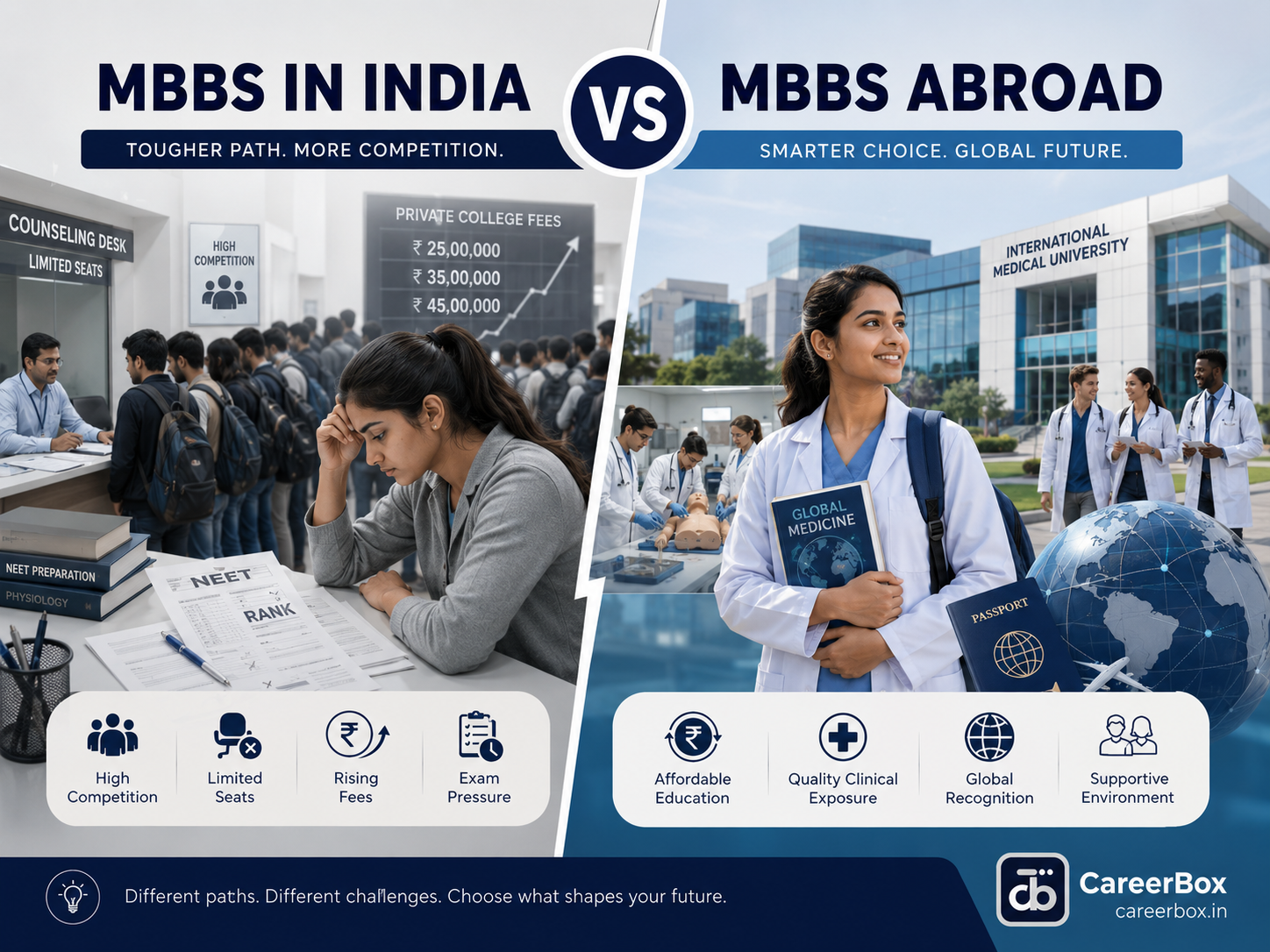
MBBS in India vs MBBS Abroad
| MBBS in India | MBBS Abroad |
|---|---|
| Admission through NEET Merit | Admission depends on country and university |
| Very high competition | Comparatively less competitive |
| Private colleges are expensive | More affordable in many countries |
| 5.5 years including internship | Usually 6 years including internship |
| Direct registration after Indian MBBS | Licensing requirements, including FMGE where applicable |
NMC Guidelines
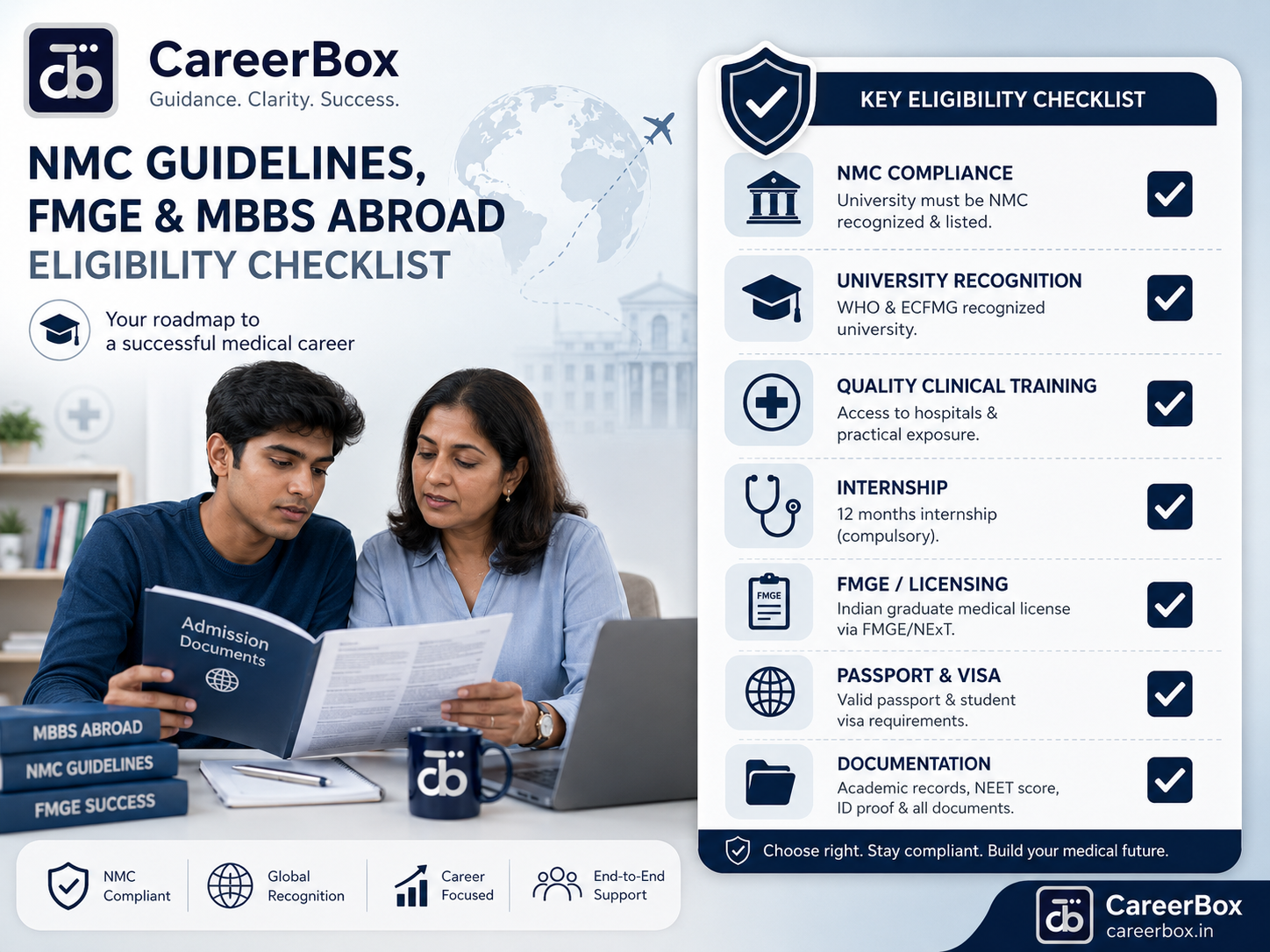
Before taking admission abroad, students should ensure:
- The university complies with applicable NMC regulations.
- The course includes adequate clinical training.
- Internship meets regulatory requirements.
- The university has proper recognition.
Choosing the right university is one of the most important decisions for every medical aspirant.
FMGE and Medical Practice in India
Students who complete MBBS abroad and wish to practice medicine in India must comply with the applicable National Medical Commission (NMC) regulations. Where applicable, graduates are required to qualify the Foreign Medical Graduate Examination (FMGE), complete the required licensing process, and obtain Medical Council registration before practicing in India.
Students should always verify the latest NMC guidelines before taking admission.
Career Opportunities After MBBS Abroad
After completing the applicable licensing requirements and registration, graduates may pursue careers in:
- Government Hospitals
- Private Hospitals
- Multi-Speciality Hospitals
- Medical Colleges
- Research Institutions
- Clinical Practice
- Healthcare Organizations
Students can also become eligible for postgraduate medical education in India after fulfilling the applicable regulatory requirements.
Tips Before Choosing a Medical University Abroad
Before finalizing admission, always verify:
- NMC compliance
- University recognition
- Clinical exposure
- Internship structure
- Medium of instruction
- Total tuition fees
- Hostel and living expenses
- Student safety and support
Conclusion
MBBS Abroad can be an excellent opportunity for Indian students who are unable to secure admission in India. However, success depends on choosing the right university and understanding the applicable NMC regulations, FMGE requirements, licensing process, and future career opportunities.

At CareerBox.in, we help students make informed decisions through professional admission guidance, university selection, documentation support, visa assistance, and complete counseling for MBBS Abroad admissions.
Start your medical career with the right guidance. Choose wisely. Choose CareerBox.
Disclaimer
Admission rules, NMC regulations, FMGE requirements, licensing procedures, and postgraduate eligibility may change over time. Students are advised to verify the latest official guidelines before applying for MBBS Abroad.