
MBBS Abroad: Why a Foreign Medical Degree Is Not the End of the Journey — FMGE, CRMI and Permanent Registration Explained
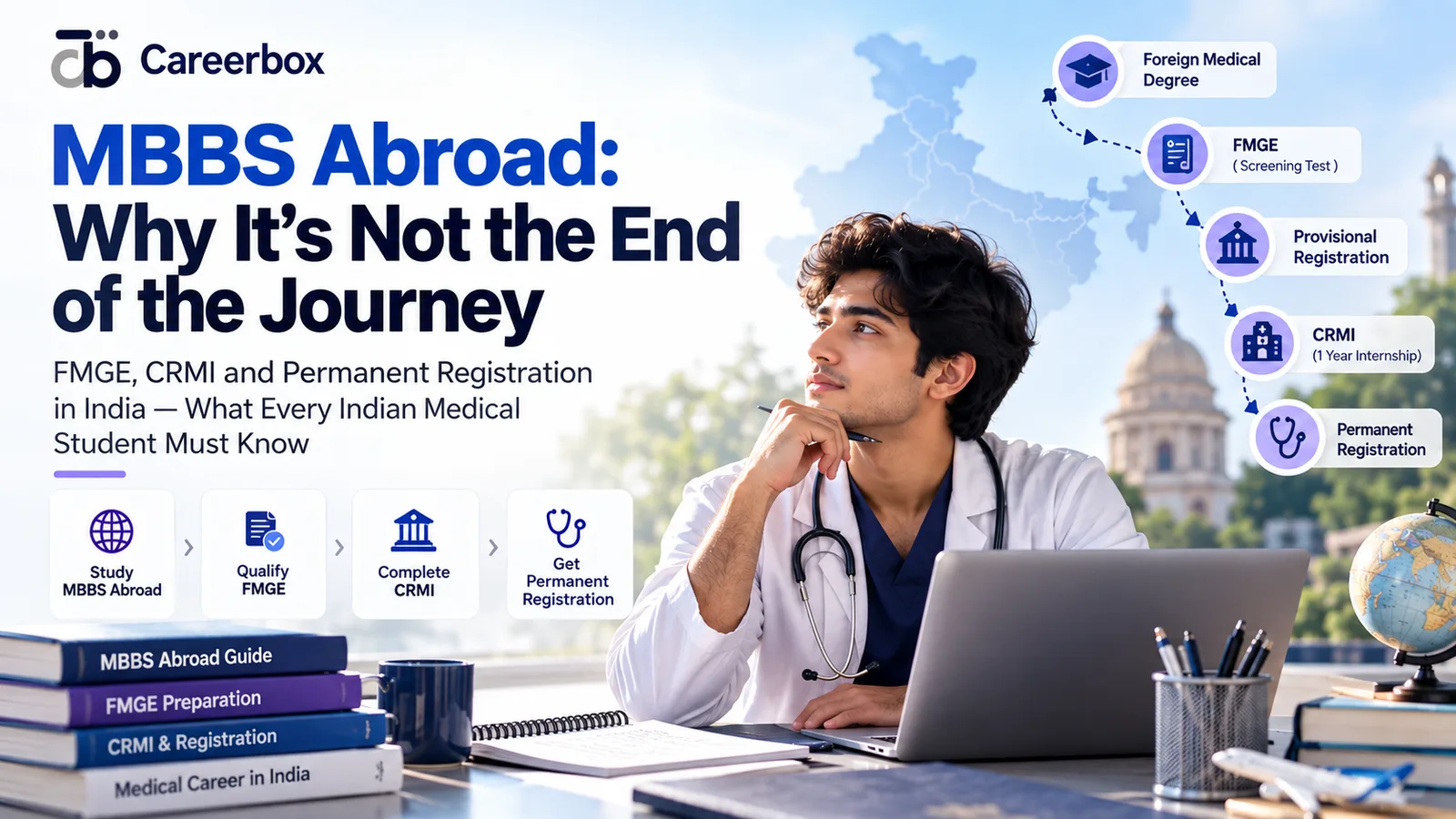
Introduction
Every year, thousands of Indian students take up MBBS or an equivalent medical degree abroad — in Russia, Kyrgyzstan, Georgia, Kazakhstan, the Philippines, China, Uzbekistan and elsewhere — because government seats at home are limited and some private medical colleges in India are expensive.
What often gets missed is this: studying medicine abroad and becoming a registered doctor in India are two different stages. Admission to a foreign university is only the beginning. To practise in India you must meet the National Medical Commission (NMC) rules, clear the licensing test, complete the required internship and get registered with a State Medical Council.
This guide lays out that pathway step by step, using the regulations themselves and, as a worked example, the Gujarat Medical Council's 2026 process.
Key takeaways
- You must qualify NEET-UG before going abroad for MBBS — mandatory since May 2018; the result stays valid for three years.
- If you joined a foreign course on or after 18 November 2021, the FMGL Regulations, 2021 apply: a course of at least 54 months, taught in English, a 12-month internship in the same foreign institution, a licence to practise in that country, and a further 12-month supervised internship in India.
- FMGE is conducted by NBEMS. In December 2025 only 23.94% of candidates passed.
- After FMGE: provisional registration → CRMI → permanent registration with a State Medical Council. CRMI can be 12, 24 or 36 months depending on your case — not always one year.
- Rules change. Check NMC notices and your State Medical Council before you decide.
1. The pathway at a glance
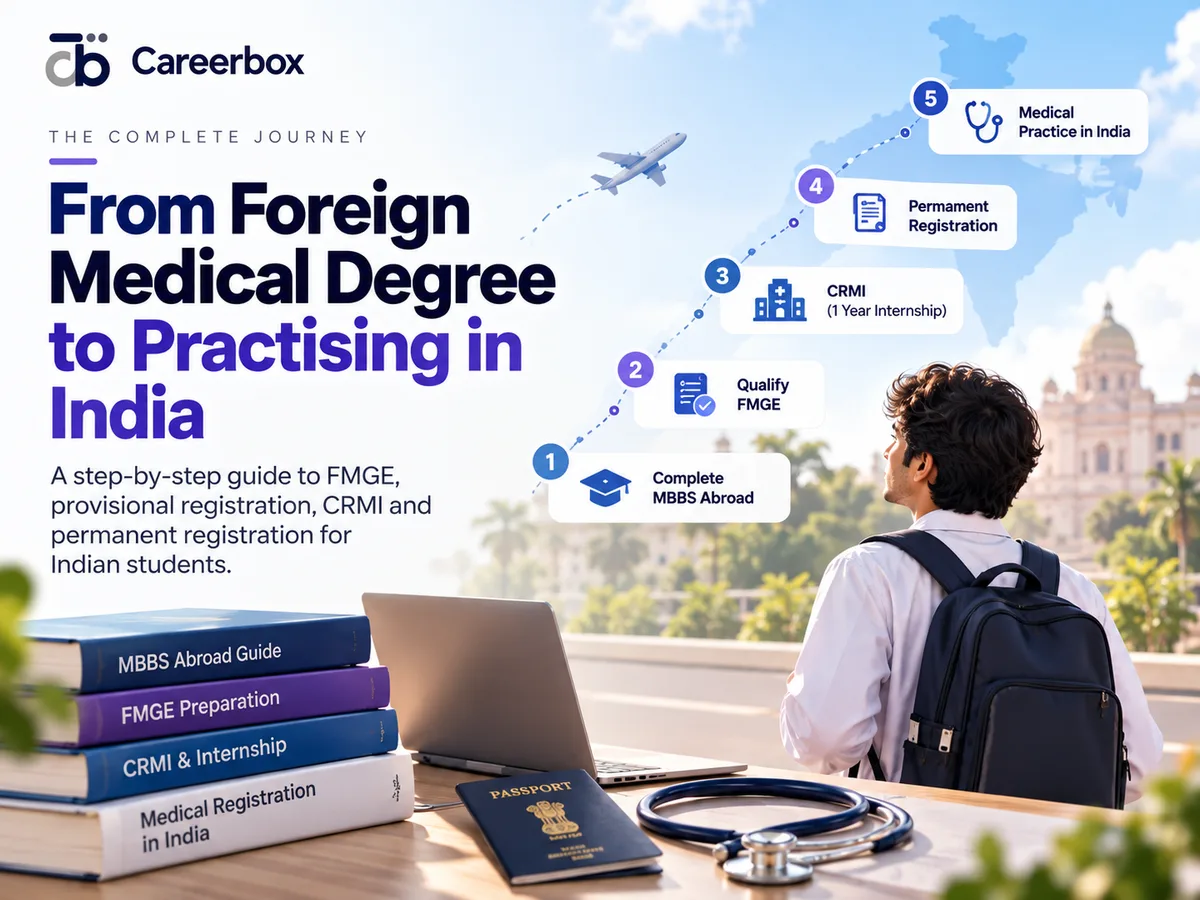
For Indian and OCI candidates with a foreign undergraduate medical qualification, NMC's own summary is that registration is governed by the Foreign Medical Graduate Licentiate (FMGL) Regulations, 2021, the Screening Test Regulations, 2002 and the Eligibility Requirement Regulations, 2002, as applicable. After qualifying the FMG Examination, the candidate approaches the State Medical Council for provisional registration and completion of CRMI, as applicable, and then applies for permanent registration.
In full, the journey looks like this:
NEET-UG → Foreign medical degree (with internship abroad) → FMGE → Provisional registration → CRMI in India, as applicable → Permanent registration → Practice in India
2. Before you go: NEET is compulsory
According to NMC's information desk for students going abroad, any Indian citizen or OCI who wants a primary medical qualification from an institution outside India on or after May 2018 must qualify NEET-UG. The NEET result works as your Eligibility Certificate and is valid for three years from the date the result is declared — including any pre-medical or language year before the MBBS course starts.
If you did not qualify NEET, a foreign MBBS will not lead to Indian registration.
3. What your foreign course must meet (FMGL Regulations, 2021)
The common advice — "check that the university is NMC-approved" — is out of date. NMC does not endorse any list of foreign universities. Instead, the course itself has to meet the conditions in the FMGL Regulations, 2021 (in force from 18 November 2021). Under Regulation 4 and Schedule I, a foreign medical graduate can get permanent registration only if they have:
- completed a course of at least 54 months;
- done an internship of at least 12 months in the same foreign institution;
- studied with English as the medium of instruction;
- studied the mandatory subjects — the course must be commensurate with the Indian MBBS;
- been registered or licensed to practise by the regulator of the country that awarded the degree, on par with that country's own citizens;
- done a supervised internship in India of at least 12 months; and
- cleared the National Exit Test or such other test the NMC mandates — until NExT is notified, that is the FMGE.
Two more conditions that catch students out:
- The whole course, training and internship must be done in the same institution, outside India. No part of it can be done in India or in a third country — so transfers mid-course are a serious risk.
- The course must be completed within 10 years of joining. NMC's FAQ of 8 June 2026 adds that students admitted abroad after 2019 must clear the FMG examination within 10 years of admission.
Who is outside FMGL? Students who had already obtained their degree, or were already studying abroad, before 18 November 2021 are governed by the earlier regulations (mainly the Screening Test Regulations, 2002).
4. What is FMGE?
The Foreign Medical Graduate Examination (FMGE) is the screening test conducted by the National Board of Examinations in Medical Sciences (NBEMS) for Indian and OCI citizens with a foreign primary medical qualification. Bulletins, applications and results are on the NBEMS FMGE page. The test is held twice a year and the qualifying mark is 150 out of 300.
One narrow exemption: under the Screening Test Regulations, candidates who hold an undergraduate medical degree and a postgraduate medical qualification from Australia, Canada, New Zealand, the United Kingdom or the United States, and are recognised to practise there, do not have to take the screening test.
For a detailed look at eligibility, exam pattern and preparation, see our FMGE 2026 guide.
5. FMGE results show why preparation matters

The NBEMS FMGE Performance Report – 2025 puts the numbers plainly:
| Session | Appeared | Passed | Pass rate |
|---|---|---|---|
| June 2025 | 36,037 | 6,709 | 18.62% |
| December 2025 | 42,868 | 10,264 | 23.94% |
So roughly three out of four candidates did not qualify in either session. Results also vary widely by country and by university — the same report lists pass rates university by university, and it is worth reading before you accept an offer. (Candidates from Gujarat, for example, passed at 18.24% in June and 25.91% in December — see our report.)
This does not mean every foreign university teaches poorly. Results depend on preparation, clinical exposure, how closely the curriculum matches India's, and the quality of training — which is exactly why the university matters more than the fee.
6. Passing FMGE is not the final step
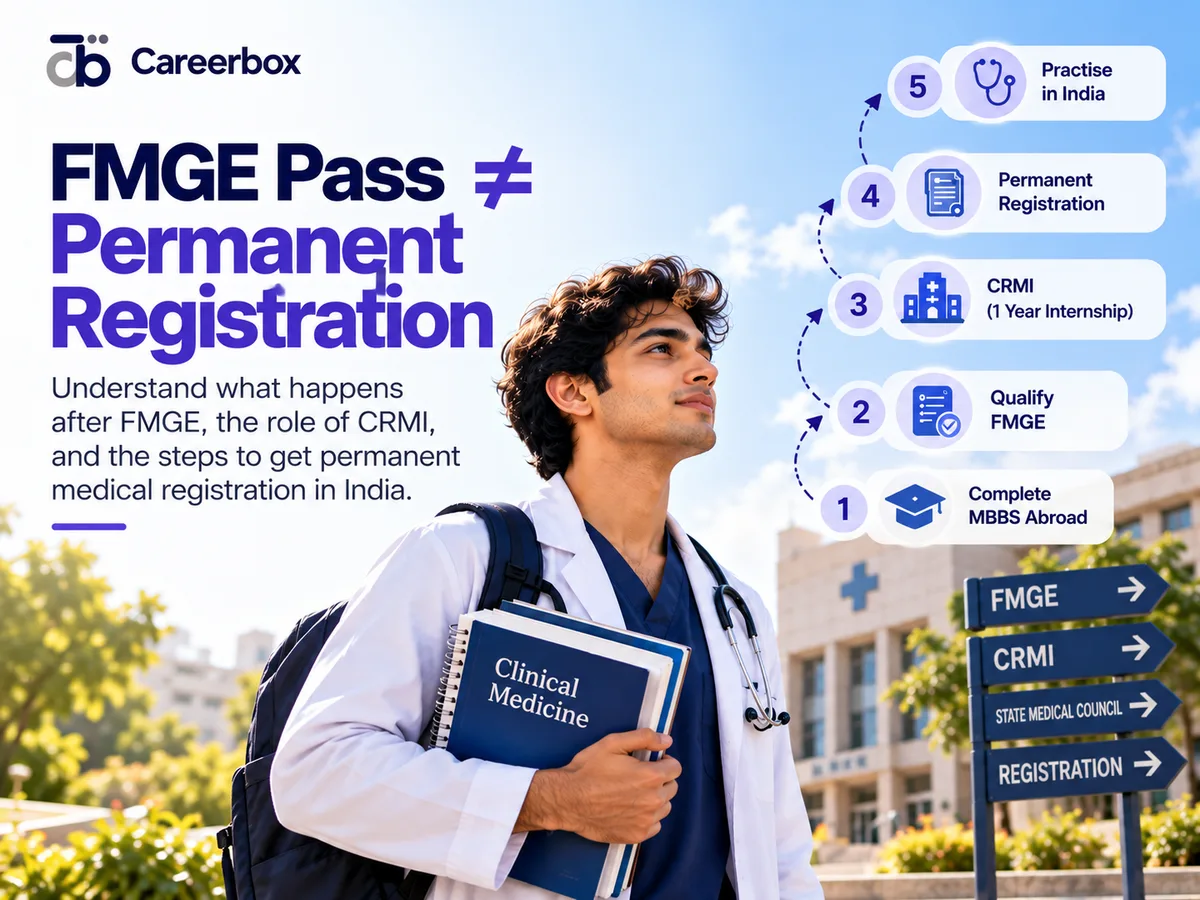
FMGE pass ≠ permanent registration. After qualifying, you still need provisional registration and, in most cases, an internship in India before you can practise independently.
What is CRMI?
CRMI (Compulsory Rotating Medical Internship) is supervised clinical training in NMC-approved medical colleges and hospitals, governed by the NMC CRMI Regulations, 2021. You apply through your State Medical Council after getting provisional registration.
How long is it? It depends on your case
- Admitted abroad on or after 18 November 2021 (FMGL): at least 12 months of supervised internship in India, in addition to the 12 months done abroad.
- Admitted before 18 November 2021: the earlier rules apply. NMC's FAQ of 8 June 2026 says those whose internship abroad is recognised under the Screening Test Regulations, and who completed it offline along with a valid compensation certificate, may be considered for permanent registration without an additional internship in India — decided by the State Medical Council case by case.
- Students whose studies were disrupted by COVID-19 or the Ukraine–Russia war, with parts of the course done online, may be told to do a longer CRMI. That is why Gujarat Medical Council's 2026 notice invites applications for 12, 24 and 36-month CRMI.
So the common shorthand "MBBS abroad = 4.5 years + 1 year internship" is not safe to rely on. Check the rules for your admission year and your own documents.
Online classes and the March 2026 clarification
Under the FMGL FAQs, online classes are acceptable for theory only, supplemented by offline practical and clinical training at the university and its hospital. Any period studied online has to be compensated with physical training.
NMC's Public Notice of 18 March 2026 clarified how that compensatory training is verified, and its FAQ of 8 June 2026 explains it. The main points:
- A compensation certificate or official transcript from the parent foreign university can be accepted as evidence, if it is authenticated and detailed enough for the State Medical Council to verify.
- A compensation certificate does not by itself entitle anyone to registration — the council looks at all the records.
- Training done after the final exam is not rejected merely for its timing; each case is judged on its merits.
- The notice is not retrospective: anyone already allotted a one- or two-year CRMI must complete it.
- FMGs who genuinely completed compensatory training and internship abroad should not ordinarily have to repeat it as clerkship in India.
Be very wary of any university or agent that advertises unusual online arrangements for a medical degree.
7. A worked example: Gujarat Medical Council in 2026
Every state council runs its own process, but Gujarat's is a useful example of what the steps actually involve.
FMG provisional registration and CRMI (August–September 2026 round)
Gujarat Medical Council's notice dated 21 July 2026 laid out the round:
| Step | Dates |
|---|---|
| Online registration on gmconline.co.in | 4 – 31 August 2026 |
| Document verification (in person, by appointment, GMC office, Civil Hospital, Asarwa, Ahmedabad) | 10 August – 7 September 2026 |
| Merit list on the GMC website | 11 September 2026 |
| Online choice filling | 16 – 21 September 2026 |
| Seat allotment displayed | 23 September 2026 |
| Reporting to the allotted institute | 24 – 30 September 2026 |
| Internship begins | 1 October 2026 |
Points worth knowing from the notice:
- You must first apply for FMG (MBBS) provisional registration; only then does the CRMI registration link open.
- The merit list is based on the NBE (FMGE) score. Ties are broken by PCB theory percentage in Class 12, then Biology theory marks, then age (the older candidate ranks higher).
- Seats go first to Gujarat-domicile candidates, then Diu, Daman and Dadra Nagar Haveli domicile, then candidates from other states.
- Candidates from outside Gujarat must deposit a refundable ₹1,00,000 demand draft, returned only after they complete the internship and get permanent registration in Gujarat.
- An allotted internship seat cannot be cancelled. If you do not join, drop out or do not finish, your provisional registration is cancelled, your fees are forfeited, you become ineligible for internship again and for permanent registration, and the matter is reported to NMC.
For scale: the provisional merit lists published on 11 September 2026 had 179 Gujarat-domicile and 40 non-domicile candidates for this round.
Documents Gujarat asks for
On its registration pages, GMC lists for FMG registration: the signed application printout and payment appointment slip, proof of birth date, photo ID, all documents from the foreign university in the original language and in English, Class 10–12 marksheets, the FMGE ("MCI Screening Test") result, the eligibility certificate, and a name-change document if relevant. For provisional registration you need the 12-month internship order; for permanent registration, the 12-month internship completion certificate, plus a no-objection certificate if you are registered with another state council.
The fees listed on those pages are ₹8,300 for provisional registration and ₹10,800 for permanent registration, and the certificate is posted within 20–25 days. Check the portal for current amounts before you pay.
8. Keep your documents in order from day one
Students often ask "which country has the lowest fees?" A better question is "will my qualification and training satisfy the Indian regulations?" Keep these safe, and get certified English translations as you go:
- Your primary medical qualification (degree) and full transcripts
- Internship records and the completion certificate from the foreign institution
- Proof of clinical training and, where relevant, compensation certificates for any online period
- Your licence or registration to practise in the country of study
- Passport (with all entry–exit stamps — councils cross-check dates against it)
- NEET-UG scorecard, Class 10–12 marksheets and birth-date proof
- FMGE scorecard and pass certificate
9. MCI or NMC?
Many students and parents still say "MCI". The Medical Council of India was replaced by the National Medical Commission under the NMC Act, 2019. Always follow current NMC regulations and notices, listed on the NMC regulations page — not old MCI rules or social-media posts. (Some state council forms still use older labels such as "MCI Screening Test Result"; that simply means your FMGE result.)
10. What to check before choosing a university abroad
- Your NEET-UG result is valid for the year you will join.
- Course length is at least 54 months, plus a 12-month internship at the same university.
- Medium of instruction is English — ask for it in writing.
- Clinical exposure: affiliated hospitals, patient load, rotations and hands-on training.
- Licence to practise in that country is actually available to foreign graduates after the course.
- University-wise FMGE results in the NBEMS performance report.
- Documentation: the university issues complete, verifiable transcripts and internship records.
- Current NMC rules for your admission year — they have changed several times since 2021.
11. The real cost is more than tuition
When comparing universities, add up everything:
Tuition + hostel + food + travel + visa + insurance + local expenses + FMGE preparation + registration fees + the time and cost of CRMI in India — and, for students from other states applying in Gujarat, the ₹1 lakh refundable deposit.
A cheaper tuition fee does not mean a cheaper degree, and a higher fee does not mean a better one. Judge the whole academic, clinical and regulatory pathway.
12. Roadmap at a glance
Before admission — Qualify NEET-UG → check the course against FMGL (54 months, English, internship, licence) → verify the university and its FMGE results
During MBBS abroad — Study → clinical training → 12-month internship at the same university → licence to practise there → keep every document
After graduation — Qualify FMGE
After qualifying — State Medical Council → provisional registration → CRMI (12, 24 or 36 months, as applicable)
Final stage — Permanent registration → practise medicine in India
Conclusion
MBBS abroad can be a genuine route into medicine, but it is not simply an overseas admission. The real journey is NEET → a course that meets the FMGL rules → FMGE → provisional registration → CRMI where applicable → permanent registration, and each step has conditions that can stop you if they are ignored.
NMC has issued several clarifications and FAQs for foreign medical graduates, and state councils such as the Gujarat Medical Council publish their own schedules. Check the latest NMC and State Medical Council requirements before you choose a university or a country.
Official references
- National Medical Commission — Rules & Regulations (FMGL Regulations 2021, CRMI Regulations 2021, FAQs of 22 February 2022 and 8 June 2026)
- NMC — For Students to Study Abroad
- NMC — Equivalence of Foreign Medical Qualification
- NBEMS — FMGE (information bulletins, results, performance reports)
- Gujarat Medical Council (FMG registration, CRMI notices and merit lists)
Disclaimer
This article is for general educational purposes. FMGE, NMC, internship and registration requirements change. Verify the latest official notifications from NMC, NBEMS and your State Medical Council before making an admission or career decision.