
FMGE 2026: Complete Guide for Indian Students Who Studied MBBS Abroad
Introduction
Every year, thousands of Indian students choose to study MBBS abroad because medical seats in India are limited and private medical education is expensive. For those who want to come back and practice in India, FMGE 2026 is one of the most important steps on that road.

Completing an MBBS degree at a foreign medical university is only one part of the journey. Foreign Medical Graduates (FMGs) must also meet the National Medical Commission (NMC) regulations and licensing requirements.
For Indian and OCI students with a foreign undergraduate medical qualification, the key step is the Foreign Medical Graduate Examination (FMGE), conducted by the National Board of Examinations in Medical Sciences (NBEMS). This guide explains what the FMGE exam is, who needs it, how to prepare and what happens after you pass.
Key takeaways
- FMGE is the screening test that Indian/OCI candidates with a foreign primary medical qualification must qualify to register as doctors in India, subject to NMC rules and exemptions.
- It is conducted by NBEMS. The official FMGE page currently lists June 2026 and October 2026 sessions.
- After FMGE comes provisional registration with the State Medical Council, CRMI (as applicable) and then permanent registration.
- Choose your foreign university on course structure, clinical training and internship — not on fees alone.
- Rules can change. Always check the latest NBEMS information bulletin and NMC notices.
What is FMGE?
FMGE stands for Foreign Medical Graduate Examination. It is also known as the Screening Test for Foreign Medical Graduates and was introduced through the Screening Test Regulations, 2002.
NBEMS conducts it for Indian citizens and Overseas Citizens of India (OCI) who obtained their primary medical qualification from a medical institution outside India and want to register to practice medicine in India.
Candidates who qualify receive a Screening Test Pass Certificate from NBEMS after in-person verification of their documents and biometric/face ID. According to NMC, they can then proceed to registration with the concerned State Medical Council.
Who Needs to Qualify FMGE?
FMGE applies to Indian/OCI candidates who hold a primary medical qualification from a foreign medical institution and want to register to practice medicine in India.
NMC's current guidance is direct: Indian/OCI candidates with a foreign undergraduate medical qualification must qualify the FMG Examination conducted by NBEMS, and then complete the registration process. This is governed by NMC regulations, including the FMGL Regulations, 2021 and the Screening Test Regulations, 2002.
As per the official NBEMS FMGE page, a candidate can appear only if:
- their primary medical qualification is confirmed by the concerned Indian Embassy as recognised for enrolment as a medical practitioner in the country where it was awarded;
- the result of their final examination was declared on or before the cut-off date for that FMGE session; and
- they hold the Eligibility Certificate (if applicable) and the Provisional Pass Certificate or Degree Certificate of their primary medical qualification.
Some regulatory provisions and exemptions apply in specific circumstances, so verify your individual eligibility under the latest NMC rules.
Why is FMGE Important?
A foreign MBBS degree by itself does not give you permission to practice medicine in India. You must first complete the regulatory requirements and obtain medical registration.
That is why students planning to study MBBS abroad should think about FMGE and the Indian licensing pathway before selecting a university — not just compare tuition fees.
FMGE 2026: Examination Authority
FMGE is conducted by the National Board of Examinations in Medical Sciences (NBEMS).
NBEMS publishes the FMGE information bulletin, application links, notices and results on its official FMGE page. The page currently lists information for the June 2026 and October 2026 sessions.
Always follow the latest NBEMS notification for exam dates, eligibility, application requirements, fee, syllabus and other instructions.
FMGE 2026 Examination Pattern
The exact exam scheme, eligibility requirements and other conditions are set out in the latest FMGE Information Bulletin issued by NBEMS — always check it before you plan. For a quick overview, see our FMGE exam page.
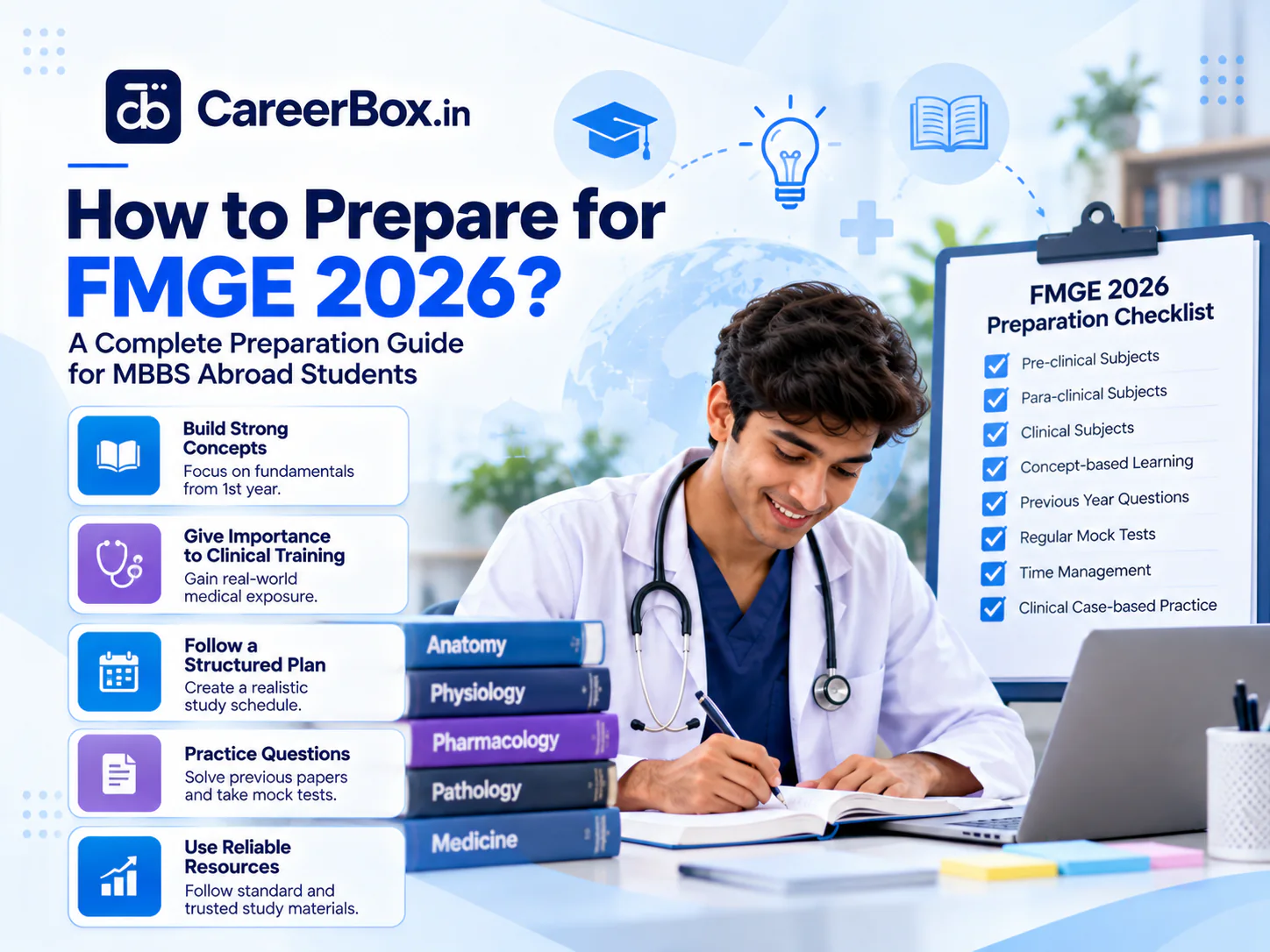
While preparing, focus on:
- Pre-clinical subjects
- Para-clinical subjects
- Clinical subjects
- Concept-based learning
- Previous examination questions
- Regular mock tests
- Time management
- Clinical case-based preparation
A strong grasp of medical concepts from the first year of MBBS makes later FMGE preparation far more structured.
How Should MBBS Abroad Students Prepare for FMGE?
1. Build Strong Concepts During MBBS
Do not wait until the final year. Build strong fundamentals in Anatomy, Physiology, Biochemistry, Pathology, Pharmacology, Microbiology and the clinical subjects throughout the course.
2. Give Importance to Clinical Training
Clinical exposure is how you learn real-world medicine. Take your hospital training and internship seriously.
3. Follow a Structured Study Plan
Make a realistic schedule that covers all major subjects, and revise regularly.
4. Practice Questions
Regular question-solving shows you your weak areas and improves your speed in the exam.
5. Use Reliable Study Resources
Rely on standard textbooks, trusted preparation resources and official examination information.
FMGE and MBBS Abroad: Why University Selection Matters
Low fees alone should never decide which foreign medical university you join.

Before admission, check these carefully:
- NMC regulatory requirements
- Course duration
- Curriculum
- Clinical training
- Internship structure
- Hospital facilities
- Medium of instruction
- University recognition
- Student support
- Total education and living costs
When it comes to NMC rules for MBBS abroad, NMC advises students to get details such as course structure, duration, internship and fees directly from the foreign institution. It also states that it does not endorse any list of foreign medical universities.
For a wider look at countries, eligibility and costs, read our complete guide to MBBS abroad for Indian students.
What Happens After Passing FMGE?
Passing FMGE is a major step, but you must still complete the registration and internship requirements.
According to NMC's current information on foreign medical qualifications, after qualifying the FMG Examination the candidate approaches the concerned State Medical Council for provisional registration and completion of the Compulsory Rotating Medical Internship (CRMI), as applicable. After that, they can apply for permanent registration.
The exact process can depend on your circumstances and the regulations in force at the time.
Can an FMG Pursue Postgraduate Medical Education in India?
Yes — foreign medical graduates who complete the licensing and registration requirements may pursue postgraduate medical education in India, subject to the eligibility criteria and admission rules in force at the time.
If you are interested in MD/MS or other postgraduate programs, check the latest NEET-PG and NMC regulations before applying.
Common Mistakes Students Should Avoid
Choosing a University Only Because of Low Fees
Low tuition fees do not always mean better value. Course quality and clinical exposure matter just as much.
Ignoring NMC Regulations
Understand the NMC rules that apply to you before paying any admission fee.
Neglecting Clinical Training
Practical medical knowledge is essential — for your professional growth and for future licensing requirements.
Depending Completely on an Agent
Students and parents should independently verify the university, course, fee and regulatory information before admission.
Starting FMGE Preparation Too Late
Steady preparation throughout MBBS works better than trying to cover the whole syllabus shortly before the exam.
FMGE: A Simple Roadmap for Indian Students
- Qualify NEET-UG
- Take admission to a suitable foreign medical university
- Complete MBBS / your primary medical qualification
- Complete the required internship and training
- Qualify FMGE, where applicable
- Obtain provisional registration and complete CRMI, as applicable
- Obtain permanent medical registration
- Practice medicine or pursue further studies in India
This is a simplified roadmap. Actual requirements depend on the regulations in force and your individual circumstances.
Final Advice for Students and Parents
MBBS abroad can open the door to a medical career, but decide only after evaluating the complete career pathway — including FMGE 2026 and registration in India — not just admission fees.
Before selecting a university, verify its course structure, clinical training, internship, regulatory requirements and long-term suitability.
Most importantly, stay updated with the latest information from NMC and NBEMS, because medical education and licensing regulations can change.
Choose Your MBBS Abroad Journey Carefully
CareerBox.in guides students and parents through MBBS abroad admissions, university selection, documentation, counselling and the overall admission process. Talk to a CareerBox counsellor.
Make an informed decision. Plan your medical career with the right guidance.
Related reading
- Medical Study Abroad (MBBS Abroad): A Complete Guide for Indian Students
- MBBS Course in India: Eligibility, NEET UG and Admission
- NEET UG 2026 Counselling: Complete Guide to MCC & State Counselling
- FMGE — Eligibility, Exam Pattern and Syllabus
Frequently Asked Questions
Is FMGE required after MBBS abroad?
For Indian/OCI graduates with a foreign undergraduate medical qualification who want to register in India, yes — the FMG Examination must be qualified under the prevailing NMC regulations, subject to applicable provisions.
Who conducts FMGE?
FMGE is conducted by the National Board of Examinations in Medical Sciences (NBEMS).
Can I practice in India immediately after completing MBBS abroad?
No. A foreign MBBS degree alone does not authorise practice in India. You must first complete the required examination, registration, internship and licensing steps.
Can an FMG do PG in India?
Yes, subject to the prevailing eligibility and admission rules. Foreign medical graduates who meet the licensing and registration conditions can pursue postgraduate medical education in India.
Where can I check official FMGE information?
Refer to the official NBEMS FMGE examination page and the latest NMC regulations and notices for current requirements and updates.
Disclaimer
This article is for general educational and informational purposes. FMGE, NMC, internship, registration and postgraduate admission requirements may change. Verify the latest official notifications and regulations issued by NMC, NBEMS and the concerned State Medical Council before making an admission or career decision.