
NTA paper leak steps 2026: vetted expert panel, AI translation, item bank and the tougher Public Examinations Act
What NTA changed after NEET UG 2026: a three-year expert panel with no coaching links, AI translation checked one question at a time, a guarded Minto Road facility, and the 2026 law with 5 to 10 years for paper leaks.

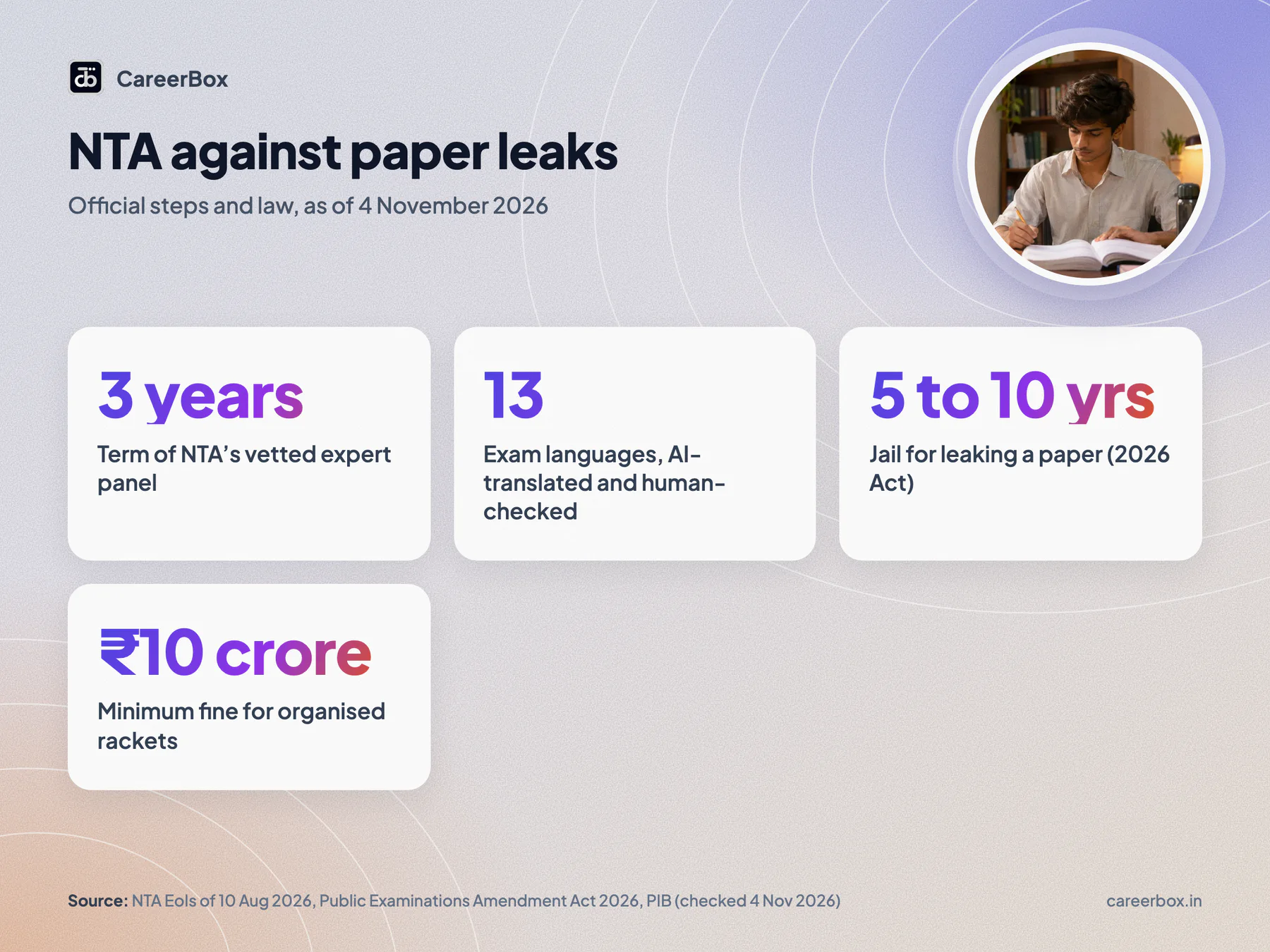
Quick answer: After NEET UG 2026 was cancelled and held again, the National Testing Agency (NTA) has changed who writes and translates its papers and where that work happens. On 10 August 2026 it invited applications for a three-year panel of Subject Matter Experts who must have no link with any coaching institute, and for Translation Reviewers who will check papers translated by an air-gapped AI platform, seeing one question at a time and never the full paper. Its confidential work has moved to a guarded 55,524 sq. ft. government facility on Minto Road, New Delhi. The law is tougher too: the Public Examinations (Prevention of Unfair Means) Amendment Act, 2026 (assent 31 July 2026) raises jail terms for those who leak papers to 5 to 10 years and fines for organised rackets to at least ₹10 crore. Candidates are not prosecuted under this law; they are covered by NTA's own unfair means rules. Checked 4 November 2026.
Why NTA is changing how papers are made
NEET UG 2026 was held on 3 May 2026. On 12 May 2026, NTA, with the approval of the Government of India, cancelled that exam, and the matter went to the CBI. The re-exam was held on 21 June 2026, with a longer 195-minute window and four rough-work pages instead of two (NTA notice of 12 June 2026). Our NEET UG 2027 guide has the full timeline.
The changes below are about the stage before exam day: who sees a question, in what form, and where.
Step 1: a new, vetted panel of question setters
NTA's Expression of Interest for Subject Matter Experts (reference NTA/Exam/Empanelment/SME/2026/02, issued 10 August 2026) asks academics, scientists, researchers and teachers to join a panel for three years. NTA says it runs "some of the largest and most high-stakes examinations in the country", naming JEE (Main), NEET (UG), UGC-NET, CUET (UG and PG), CMAT and GPAT. The last date was extended to 9 October 2026 by a corrigendum of 8 September 2026.
Panel members may set questions, vet them, translate, moderate papers, check answer-key challenges and look after NTA's "secure item banks", which includes the "retirement of over-exposed items". A large item bank means a paper is built from a pool, so no single setter knows which questions will appear.
The eligibility rules are strict:
- A master's degree with at least 60% (55% for reserved categories), and at least 8 years of teaching, research or professional work.
- No link, direct or indirect, with any coaching institute, test-prep company or tutoring platform: no job, ownership, equity, royalty or content work.
- No coaching books, mock tests or question banks for NTA-type exams in the last 5 years.
- No immediate family member taking an NTA exam in the years of empanelment, or the expert must declare it and step aside.
- No pending criminal case, vigilance enquiry or past blacklisting by an exam body.
Selection runs in four stages: document check, evaluation by a subject expert committee, background and integrity verification, then empanelment. Experts sign a non-disclosure agreement and re-affirm it at the start of every assignment. They may not work for coaching bodies for 2 years after their last assignment. A breach can lead to blacklisting and prosecution under the Public Examinations Act, 2024, the Bharatiya Nyaya Sanhita, 2023 and the IT Act, 2000.
Step 2: AI translation, checked one question at a time
The old system gave individual translators whole question papers to translate. NTA's Expression of Interest for Translation Reviewers (reference NTA/Exam/Empanelment/Translation-Reviewers/2026/01) says this "has structural weaknesses that adversaries can exploit".
Under the new process:
- Most translation is done by an air-gapped AI translation platform on NTA's own premises.
- Human reviewers then check each translated item and mark it accepted, accepted with corrections, or rejected.
- Reviewers see one item at a time, in random order, and "shall not, at any point, see the assembled paper".
- They work only at NTA's secure facility, with no personal devices, under CCTV with AI-based behaviour analytics. Every action is logged per second and kept for 7 years.
- Their non-disclosure agreement runs for 10 years after the engagement ends.
NTA says it conducts NEET-UG, JEE Main, CUET-UG, CUET-PG, UGC-NET and other exams at more than 5,000 centres in 13 languages.
The Gujarat angle: Gujarati is one of the 13 languages. The EoI asks for 6 Gujarati reviewers per subject domain for NEET-UG, JEE Main and CUET, the same as Marathi, Tamil and Bengali. Gujarat students who choose Gujarati as their paper language will get questions translated through this AI-plus-review process.
Step 3: a guarded office for confidential work
By a public notice of 14 September 2026, NTA moved its office to the 5th Floor, Government of India Press Building, Minto Road, New Delhi 110002. In the Supreme Court on 18 September 2026, the government's affidavit, quoted in the court's record of proceedings, said confidential operations had moved to "a dedicated 55,524 sq. ft. government facility at Minto Road, New Delhi, protected by 39 CISF personnel, X-Ray screening, metal detectors and strict access control protocols". The same affidavit says NTA now has a Secretary-level officer as Director General and is hiring specialists in security, HR and research.
The law: what a paper leak costs now
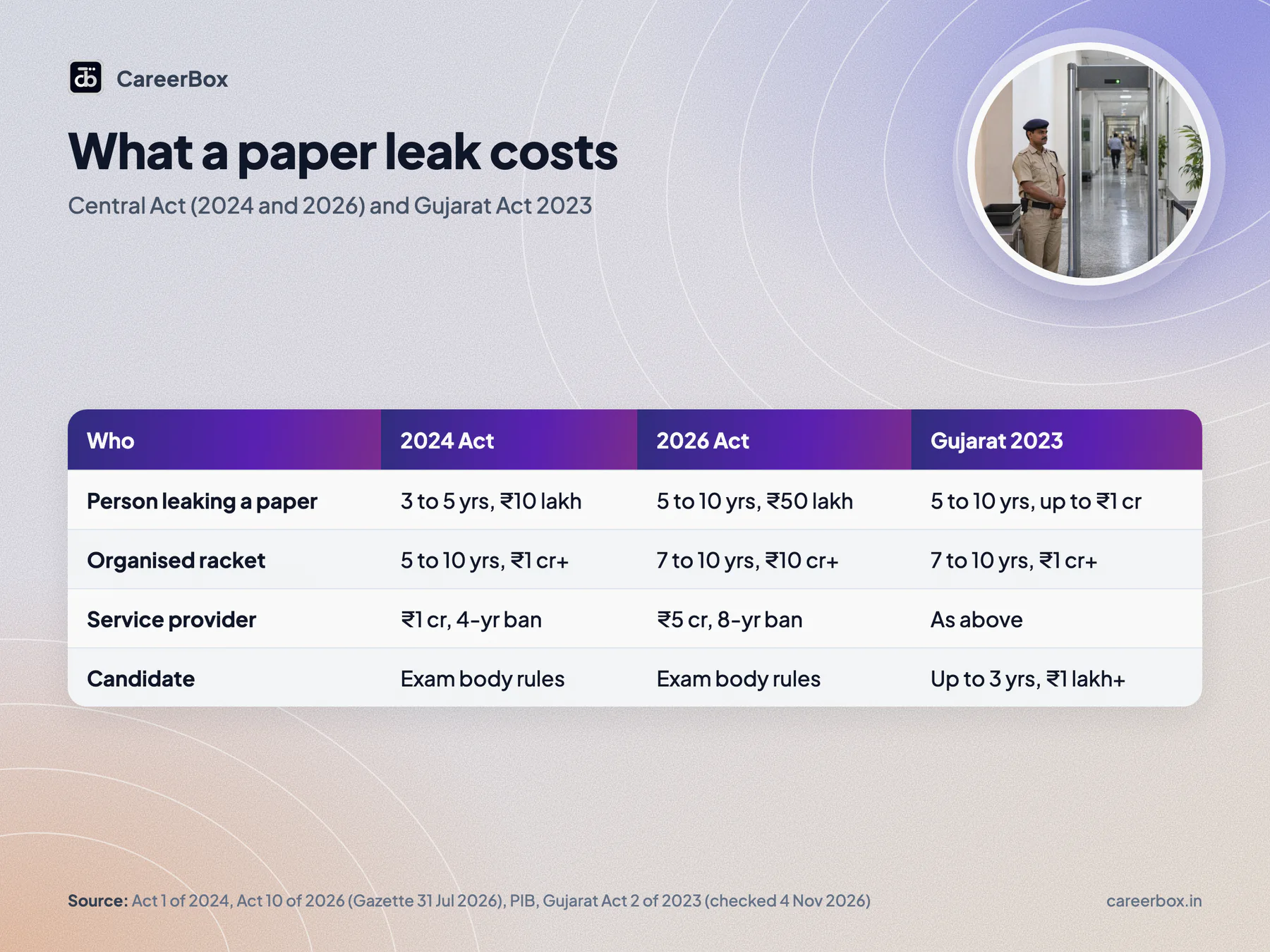
The Public Examinations (Prevention of Unfair Means) Act, 2024 came into force on 21 June 2024. It covers exams run by UPSC, SSC, the Railway Recruitment Boards, IBPS, NTA and central ministries. All offences are cognizable, non-bailable and non-compoundable. The government told the Lok Sabha on 29 July 2026 that 52 FIRs had been registered under it (PIB).
Parliament then passed the Amendment Act, 2026 (Lok Sabha 29 July, Rajya Sabha 30 July); it received the President's assent on 31 July 2026 as Act No. 10 of 2026. The changes, as summarised in PIB's factsheet:
- People who use unfair means, such as leaking a paper: jail of 5 to 10 years (was 3 to 5) and a fine up to ₹50 lakh (was ₹10 lakh).
- Service providers hired to run exams: fine up to ₹5 crore (was ₹1 crore) and a ban from public exams for 8 years (was 4).
- Directors and senior managers of such firms: 5 to 10 years in jail and up to ₹5 crore.
- Organised rackets: 7 to 10 years in jail (was 5 to 10) and a fine of at least ₹10 crore (was ₹1 crore).
- A Special Task Force can take over investigations, which must finish within 2 months. States must name Special Fast Track Courts that hear cases day to day and finish trials within 3 months of the chargesheet.
Are students punished under this law? No. When the 2024 Bill was introduced, the government said candidates "shall not be liable for action within the purview of the Bill" and stay under the exam body's own unfair means rules (PIB, 5 February 2024). That still means cancellation of your result or a ban from NTA exams if you are caught cheating.
Gujarat has its own, older law
Gujarat passed the Gujarat Public Examination (Prevention of Unfair Means) Act, 2023 (Gujarat Act 2 of 2023, gazetted 3 March 2023). It covers GPSC, the Gujarat High Court, GSSSB, the Gujarat Panchayat Service Selection Board, state universities and the Gujarat Secondary and Higher Secondary Education Board, so GSEB board exams and GUJCET, which GSEB conducts, fall under it.
Unlike the central law, the Gujarat Act also punishes the examinee: up to 3 years in jail and a fine of at least ₹1 lakh for using unfair means, and a 2-year ban from public exams after conviction. Anyone who leaks or helps solve a paper faces 5 to 10 years and a fine of ₹10 lakh to ₹1 crore; organised crime carries 7 to 10 years and at least ₹1 crore.
What changes for you on exam day
For candidates, the new steps work behind the scenes. NTA has not announced any new exam-day rule from these reforms. You will still get your admit card from the exam's official NTA site and follow the instructions printed on it. The next NTA exams on its calendar are UGC NET from 14 December 2026 (our guide) and JEE Main Session 1 from 20 January 2027 (our guide).
What you should do:
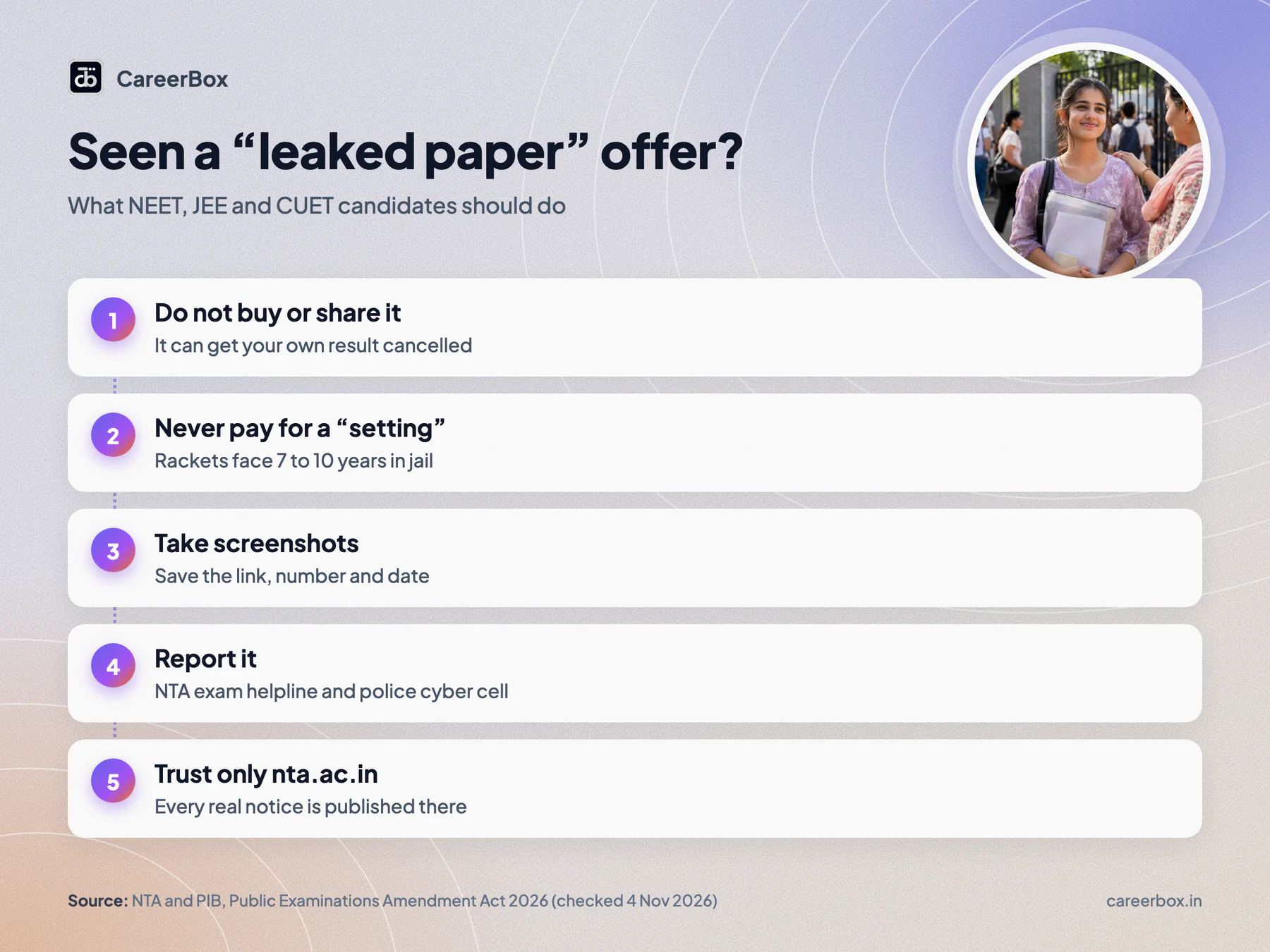
- Ignore "leaked paper" offers on Telegram, WhatsApp or Instagram. Most are scams, and buying one can get your result cancelled.
- Never pay for an "assured seat" or "setting". Under the 2026 law, those running such rackets face 7 to 10 years in jail.
- Report it. Send screenshots and links to NTA's helpline for that exam, listed on nta.ac.in, and to the police cyber cell.
- Read only official notices. NTA publishes every change on nta.ac.in and the exam's own site. If a "notice" is not there, it is not real.
- Keep preparing for the same syllabus. These reforms change who sets the paper, not what is asked.
Frequently asked questions
What new step has NTA taken against paper leaks?
NTA invited applications on 10 August 2026 for a three-year panel of vetted Subject Matter Experts with no coaching links, and for Translation Reviewers who check AI-translated questions one at a time in a secure facility. It is also building a large secure item bank and has moved confidential work to a guarded Minto Road facility.
Which exams do NTA's new measures cover?
NTA's EoIs name JEE (Main), NEET (UG), UGC-NET, CUET (UG and PG), CMAT, GPAT and its other exams. The translation review covers NEET-UG, JEE Main and CUET in 13 languages, including Gujarati.
What is the punishment for paper leak in India now?
Under the Public Examinations Act as amended in 2026, a person who leaks a paper faces 5 to 10 years in jail and a fine up to ₹50 lakh. Organised rackets face 7 to 10 years and a fine of at least ₹10 crore.
Will a student be jailed under the Public Examinations Act?
No. The central law exempts candidates; they face action under NTA's own unfair means rules, such as cancellation or debarment. Gujarat's 2023 state law is different and can jail an examinee for up to 3 years.
When did the Public Examinations Amendment Act, 2026 come into force?
It received the President's assent on 31 July 2026 and was published in the Gazette of India that day as Act No. 10 of 2026.
Will NEET UG 2027 be computer based?
Not decided. The government told the Supreme Court in September 2026 that a move to computer-based testing is under consideration. See our NEET UG 2027 guide for the latest.
How many experts are on NTA's new panel?
NTA has not published a number. Some news reports give a figure, but it does not appear in any NTA notice.
Who can apply to NTA's expert panel?
Subject experts with a master's degree (60% marks, 55% for reserved categories), at least 8 years of experience and no coaching links in the last 5 years. The translation reviewer panel is for people aged 25 to 65 with bilingual skills.
Sources
- NTA: EoI for empanelment of Subject Matter Experts (10 Aug 2026) and corrigendum (8 Sep 2026) (checked 4 November 2026)
- NTA: EoI for empanelment of Translation Reviewers (10 Aug 2026) and corrigendum (8 Sep 2026) (checked 4 November 2026)
- NTA: public notice on relocation of NTA office (14 Sep 2026) (checked 4 November 2026)
- Supreme Court record of proceedings, W.P.(C) 651/2026 (18 Sep 2026), on nta.ac.in (checked 4 November 2026)
- NTA: examination calendar, December 2026 cycle onwards (checked 4 November 2026)
- NTA: press release cancelling the NEET (UG) 2026 exam of 3 May (12 May 2026) (checked 4 November 2026)
- NTA: student-friendly measures for NEET (UG) 2026 re-exam (12 Jun 2026) (checked 4 November 2026)
- PIB: Public Examinations (Prevention of Unfair Means) Bill, 2024 introduced (5 Feb 2024) (checked 4 November 2026)
- PIB: Amendment Bill, 2026 introduced in Lok Sabha (27 Jul 2026) (checked 4 November 2026)
- PIB: Lok Sabha passes Amendment Bill, 2026 (29 Jul 2026) (checked 4 November 2026)
- PIB: Rajya Sabha passes Amendment Bill, 2026 (30 Jul 2026) (checked 4 November 2026)
- PIB factsheet: Stronger Law, Safer Exams (31 Jul 2026) (checked 4 November 2026)
- India Code: Public Examinations (Prevention of Unfair Means) Act, 2024 (checked 4 November 2026)
- Gazette of India text: Public Examinations (Prevention of Unfair Means) Amendment Act, 2026 (Act 10 of 2026) (checked 4 November 2026)
- India Code: Gujarat Public Examination (Prevention of Unfair Means) Act, 2023 (checked 4 November 2026)
More to read
All articles
NEET UG 2026 special stray round: 946 MBBS seats, 2 at AIIMS, 207 BDS and 66 nursing seats, dates and how to choose
Nov 4, 20268 min read
New Zealand warehouse and packing jobs for Indians: AEWV rules, pay, English and the checks to make (2026)
Nov 3, 202611 min read
Gujarat universities list 2026: NAAC grade and NIRF rank of all 100, from official records
Nov 3, 202626 min read
GPSC result 2026: every final result, select list and cut-off
Nov 3, 202623 min read
NIRF Medical ranking 2025: AIIMS and the top 50 medical colleges compared (MBBS seats, median salary, score)
Nov 2, 202633 min read
GSSSB result 2026: every final result, select list, waiting list and cut-off
Oct 30, 202613 min read