
UGC NET December 2026: exam dates, application, syllabus, eligibility, cut-offs and how JRF works
UGC NET December 2026 explained from NTA’s own documents: apply by 28 October, exam 14 to 19 December, fees, 55% eligibility, JRF age limit, the 40%/35% qualifying rule, June 2026 cut-offs and the ₹37,000 JRF.

UGC NET December 2026 is the second cycle this year. Clearing it can make you eligible for a Junior Research Fellowship (JRF), for appointment as Assistant Professor, or for PhD admission. Below are the dates, the rules and last June's cut-offs, so you know the target before you pay.
Key takeaways
- Last date: 28 October 2026 (11:50 pm) for the form and the fee. After that, you can apply until 31 October with a ₹500 late fee.
- Exam: 14 to 19 December 2026 (20 and 21 December are buffer days). Admit card dates are not announced as of 15 October 2026.
- Paper pattern: Paper 1 (50 questions, 100 marks) and Paper 2 (100 questions, 200 marks) in one 3-hour sitting with no break. Each question carries 2 marks and there is no negative marking.
- JRF age limit: 30 years as on 1 December 2026, with up to 5 years' relaxation for some groups. There is no upper age limit for Assistant Professor or PhD admission.
- Minimum to be considered: 40% aggregate across both papers for General and General-EWS, 35% for reserved categories. The real cut-off is higher, because only the top 6% of candidates who appear qualify for Assistant Professor.
- JRF pays ₹37,000 a month for the first two years and ₹42,000 as SRF after that, according to UGC's JRF scheme page (checked 15 October 2026).
UGC NET December 2026 exam dates and fee
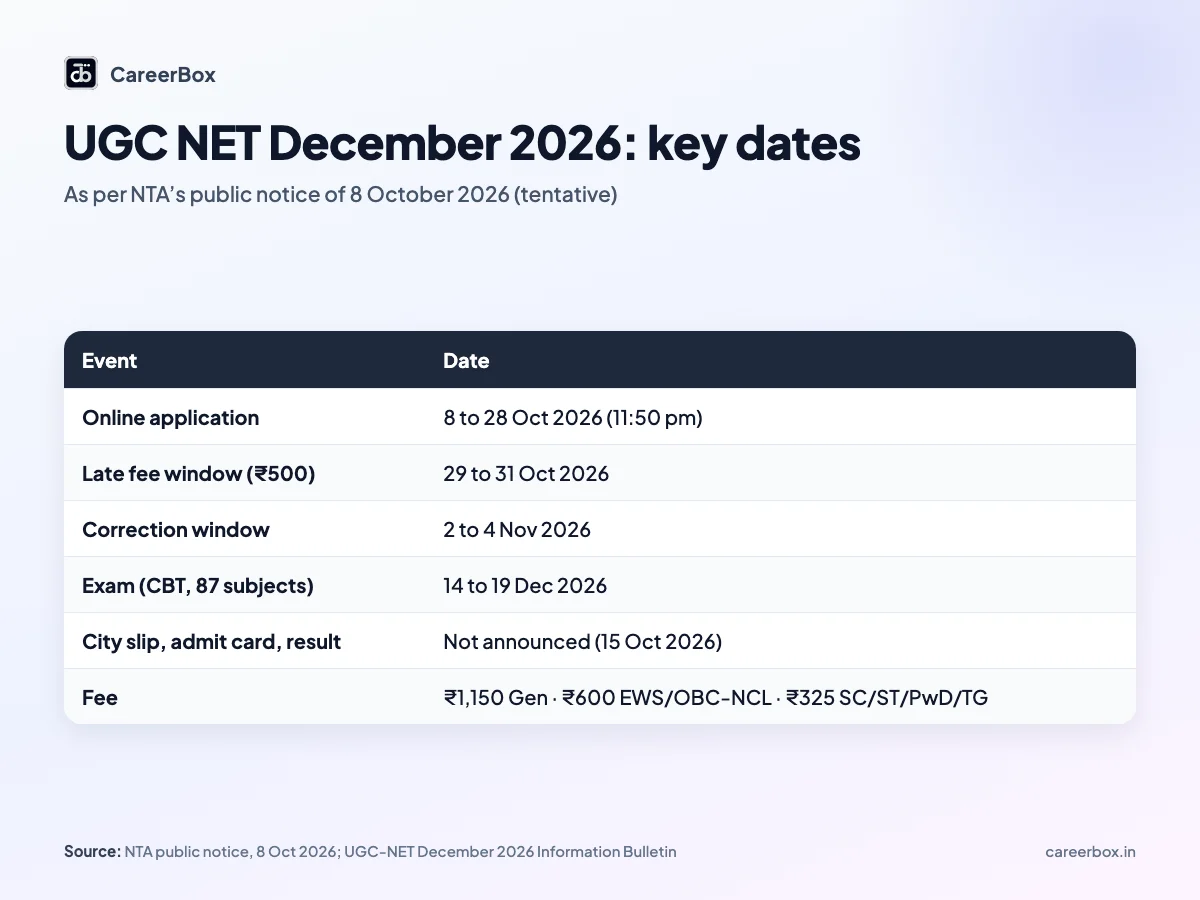
| Event | Date (as per NTA's notice of 8 October 2026) |
|---|---|
| Online application | 8 October to 28 October 2026 (up to 11:50 pm) |
| Last date to pay the fee | 28 October 2026 (up to 11:50 pm) |
| Late application, ₹500 late fee | 29 October to 31 October 2026 (up to 11:50 pm) |
| Correction window | 2 November to 4 November 2026 (up to 11:50 pm) |
| Exam city slip | Not announced as of 15 October 2026 |
| Admit card | Not announced as of 15 October 2026 |
| Exam | 14 December to 19 December 2026 (buffer: 20 and 21 December) |
| Answer key and result | Not announced as of 15 October 2026 |
Application fee: ₹1,150 (General/Unreserved), ₹600 (General-EWS and OBC-NCL), ₹325 (SC, ST, PwD/PwBD and third gender). Bank charges and GST are extra.
Read our news report from the day the form opened: UGC-NET December 2026 is open: apply by 28 October.
How to fill the UGC NET December 2026 application form
- Go to ugcnet.nta.nic.in and download the Information Bulletin. Read the eligibility chapter before you start.
- Register with your own email ID and mobile number. NTA has enabled sign-in through Meri Pehchaan, the government's single sign-on, and advises you to use Aadhaar verification because it also helps later when your JRF is processed.
- Fill in the form and note the application number. You need a live photo by webcam or phone, a recent photo (10 kb to 200 kb, white background) and your signature (10 kb to 50 kb).
- Pick your subject, the medium (English or Hindi; you cannot change it later) and four exam cities.
- Pay the fee by card, net banking or UPI by 28 October, then download the confirmation page.
Only one application per candidate is allowed. If a payment fails, call your bank's helpline and then NTA (011-40759000) before paying again.
Who is eligible: master's marks and age limit
Marks. General, Unreserved and General-EWS candidates need at least 55% in a master's degree or equivalent from a UGC-recognised university, without rounding off. OBC-NCL, SC, ST, PwD/PwBD and third gender candidates need 50%. Final-year master's students can apply, but must pass with the required marks within two years of the NET result.
Four-year graduates. If you hold a four-year (eight-semester) bachelor's degree, you need 75% aggregate, with a 5% relaxation for reserved categories under UGC's 2022 PhD regulations. You may take NET in the subject you want to research, whatever your undergraduate discipline. There is a catch: a NET qualified on a four-year degree makes you eligible for JRF and PhD admission, but not for Assistant Professor. Our story on Delhi University's direct PhD route for four-year graduates shows how universities are using this.
Age. For JRF, you must not be older than 30 years on 1 December 2026. OBC-NCL, SC, ST, PwD/PwBD, third gender and women candidates get up to 5 years' relaxation. Research experience, an LL.M. and armed forces service also earn relaxation, but the total cannot go past five years. For Assistant Professor and PhD admission there is no upper age limit.
UGC NET syllabus and exam pattern
NTA does not send the syllabus. The bulletin points you to the UGC syllabus page at ugcnetonline.in, where each subject's syllabus can be downloaded.
| Part | Questions | Marks | What it tests |
|---|---|---|---|
| Paper 1 (compulsory for all) | 50 | 100 | Teaching and research aptitude: reasoning, reading comprehension, divergent thinking, general awareness |
| Paper 2 (your subject) | 100 | 200 | Domain knowledge in the subject you choose |
| Total | 150 | 300 | 3 hours (180 minutes), no break, all questions compulsory |
Every correct answer gets 2 marks. A wrong answer costs nothing and an unanswered question gets zero, so do not leave anything blank. If you challenge the provisional answer key, it costs ₹200 per question, and the fee is not refunded.
Paper 1 is the same for everyone across all 87 subjects, and it counts for a third of your total. Do not treat it as a warm-up.
What is the passing score? Qualifying marks and how NTA sets cut-offs
There is no fixed pass mark. NTA's bulletin sets the result in five steps:
- The number of candidates who qualify for Assistant Professor is set at 6% of the candidates who appeared in both papers (on the basis of a master's degree).
- Those slots are shared out among categories according to the Government of India's reservation policy.
- To be counted at all, you must appear in both papers and score at least 40% aggregate (120 out of 300) if you are General or General-EWS, or 35% (105 out of 300) if you are SC, ST, OBC-NCL, PwD/PwBD or third gender.
- The slots are split by subject. The aggregate score at which a subject's slots fill up becomes that subject's cut-off for that category.
- JRF slots are then allocated across categories in the same way.
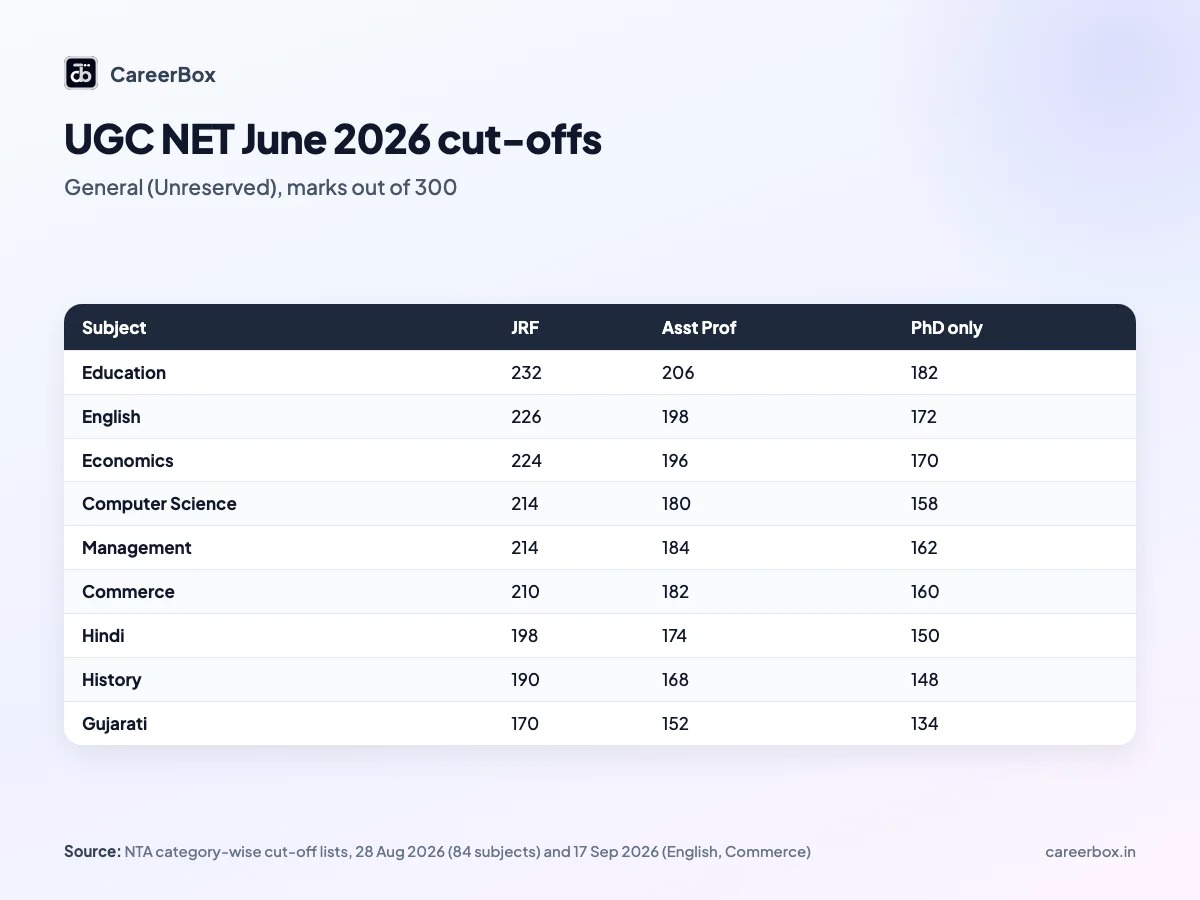
So 120 marks is only the entry ticket. Look at the June 2026 numbers below: the Assistant Professor cut-off for General candidates ranged from 152 to 206 out of 300 in these subjects.
UGC NET June 2026 cut-offs and result: what to aim for
| Subject (General/Unreserved) | JRF | Assistant Professor | PhD only |
|---|---|---|---|
| Education | 232 | 206 | 182 |
| English | 226 | 198 | 172 |
| Economics | 224 | 196 | 170 |
| Computer Science and Applications | 214 | 180 | 158 |
| Management | 214 | 184 | 162 |
| Commerce | 210 | 182 | 160 |
| Hindi | 198 | 174 | 150 |
| History | 190 | 168 | 148 |
| Gujarati | 170 | 152 | 134 |
Cut-offs are out of 300. English and Commerce were re-examined on 9 and 10 September 2026, and their cut-offs come from NTA's list of 17 September. Reserved-category cut-offs are lower: in Education, OBC-NCL needed 192 for Assistant Professor. Treat them as a guide for December, not a promise.
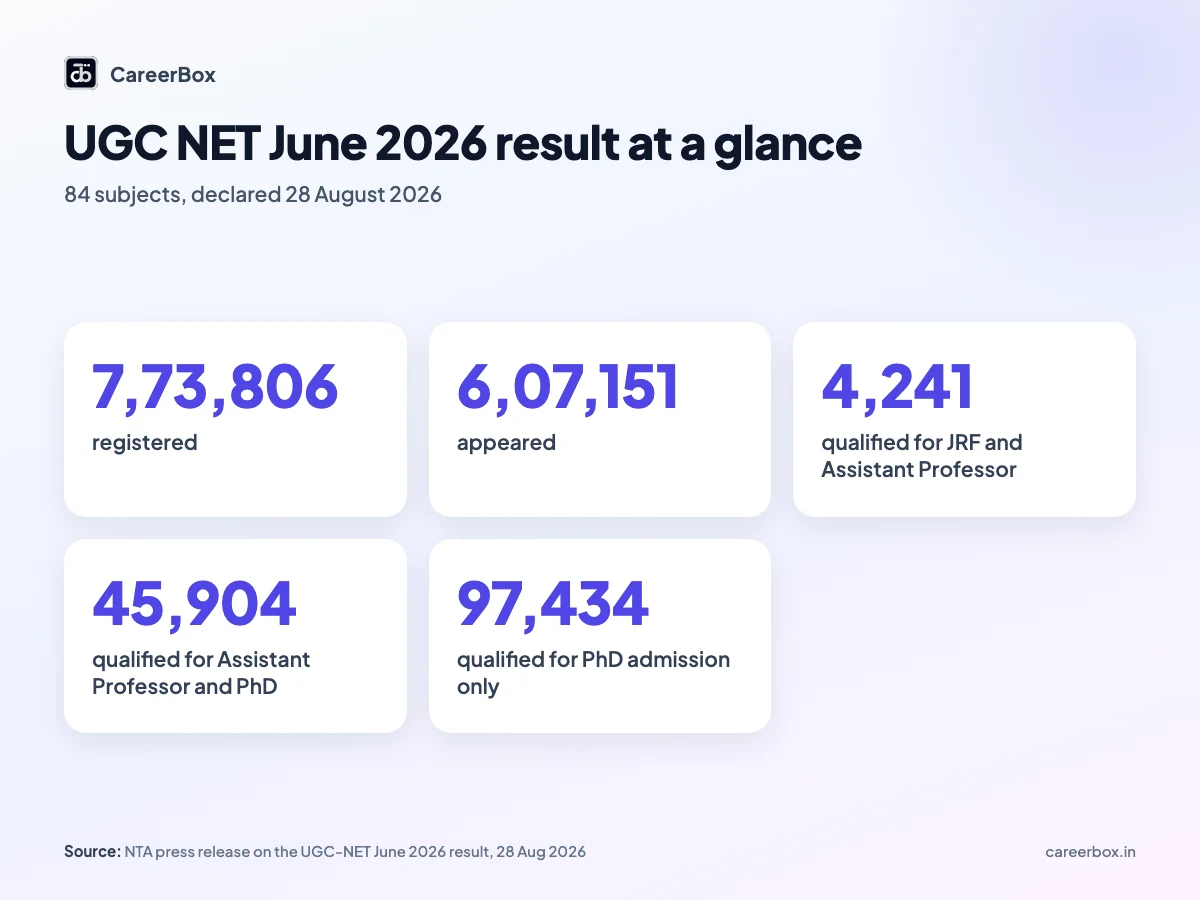
NTA's press release of 28 August 2026 gives the scale of the June cycle. In 84 subjects, 7,73,806 registered and 6,07,151 appeared. Of these, 4,241 qualified for JRF and Assistant Professor, 45,904 for Assistant Professor and PhD admission, and 97,434 for PhD admission only. Our report on the June 2026 re-exam results has the subject detail, and the June 2026 e-certificates are already out.
How JRF works, and what the three NET categories mean
NET now has three outcomes. The bulletin's table is simple:
| You qualify for | JRF | Assistant Professor | PhD admission |
|---|---|---|---|
| Category 1: JRF and Assistant Professor | Yes | Yes | Yes |
| Category 2: Assistant Professor and PhD admission | No | Yes | Yes |
| Category 3: PhD admission only | No | No | Yes |
JRF candidates are admitted to a PhD through an interview under the UGC (Minimum Standards and Procedures for Award of Ph.D. Degree) Regulations, 2022. The JRF offer is valid for three years from the date of the JRF award letter, and the fellowship is paid only once you find a place at a university, IIT or institution. UGC's JRF scheme page lists ₹37,000 a month for the first two years and ₹42,000 a month as SRF for the rest of the tenure, which is five years or until the thesis is submitted, whichever comes first.
Category 2 and 3 candidates can use NET in place of a university's own PhD entrance test. The NET marks carry 70% weightage and the university's interview carries 30%. These marks stay valid for PhD admission for one year from the result.
UGC NET and the Assistant Professor job
NET is an eligibility, not a job. UGC's 2018 regulations on minimum qualifications for teachers say an Assistant Professor in arts, commerce, humanities, education, law, social sciences, sciences and languages needs a master's degree with 55% in a relevant subject, plus NET (by UGC or CSIR) or an accredited SET/SLET, or a PhD awarded under UGC's PhD regulations. The December 2026 bulletin adds that hiring then follows the rules of the university, college or state government that advertises the post.
Gujarat: exam cities and GSET
The December 2026 bulletin lists 13 exam cities in Gujarat: Ahmedabad, Anand, Bardoli, Bhuj, Gandhinagar, Jamnagar, Junagadh, Mehsana, Modasa, Rajkot, Surat, Vadodara and Vapi. Gujarati is one of the 87 subjects (subject code 37). In June 2026 its General cut-offs were 170 for JRF and 152 for Assistant Professor, the lowest in the table above.
Gujarat also runs its own test, the Gujarat State Eligibility Test (GSET), conducted by The Maharaja Sayajirao University of Baroda. GSET 2026 is on 29 November 2026, and its hall ticket goes live on 22 November, according to gujaratset.ac.in. Keep the difference in mind: under the rule quoted in NTA's bulletin, a SET cleared after 1 December 2002 makes you eligible only in universities and colleges of that state, while NET is valid across India. Only NET can give you a JRF.
UGC NET or CSIR NET: which one is yours?
Postgraduates in chemistry, physics, mathematics, life sciences and earth sciences take the Joint CSIR-UGC NET instead of UGC NET. Its December 2026 form is open until 5 November 2026, and the exam is on 19, 22 and 27 December (NTA notice of 7 October 2026). See our CSIR-UGC NET exam guide and the news report on the CSIR NET December 2026 form.
After NET, look at research options on CareerBox: PhD in arts and humanities and PhD in science. Follow results and answer keys on CareerBox News.
Frequently asked questions
Is the UGC NET form out for 2026?
Yes. The UGC NET December 2026 form opened on 8 October 2026 at ugcnet.nta.nic.in. The last date is 28 October 2026 (11:50 pm), or 31 October with a ₹500 late fee.
What is the UGC NET passing score?
To be considered, General and General-EWS candidates need 40% aggregate across both papers (120 of 300), and reserved categories need 35% (105 of 300). Only the top 6% of candidates who appear qualify for Assistant Professor, so the real cut-off is higher. In June 2026 it was 206 out of 300 for General candidates in Education.
What is the UGC NET salary per month?
NET is an eligibility test and has no salary. If you qualify for JRF and join a PhD, UGC's JRF scheme page (checked 15 October 2026) lists a fellowship of ₹37,000 a month for two years and ₹42,000 a month as SRF after that. An Assistant Professor's pay is set by the employer under its pay rules.
Which is better, B.Ed. or UGC NET?
They lead to different jobs. A B.Ed. (plus CTET or a state TET) is for teaching in schools. UGC NET is for teaching in colleges and universities, a JRF and PhD admission. See our B.Ed admission 2026 guide if you are weighing school teaching.
Is UGC NET held two times a year?
Yes. NTA holds a June cycle and a December cycle. The June 2026 exam ran from 22 June to 5 July 2026, and the December 2026 exam is scheduled for 14 to 19 December 2026.
When will the UGC NET December 2026 admit card come?
NTA has not announced the admit card or city slip dates as of 15 October 2026. Both will be posted on ugcnet.nta.nic.in.
Sources
- NTA public notice: UGC-NET December 2026 application portal opens (8 October 2026) (checked 15 October 2026)
- UGC-NET December 2026 Information Bulletin (eligibility, age, pattern, result method) (checked 15 October 2026)
- NTA press release: declaration of UGC-NET June 2026 results (28 August 2026) (checked 15 October 2026)
- NTA: UGC-NET June 2026 subject and category-wise cut-off marks (84 subjects) (checked 15 October 2026)
- NTA press release: UGC-NET June 2026 results for English, Commerce and Sociology (17 September 2026) (checked 15 October 2026)
- NTA: UGC-NET June 2026 cut-off marks for English, Commerce and Sociology (checked 15 October 2026)
- NTA public notice: Joint CSIR-UGC NET December 2026 applications (7 October 2026) (checked 15 October 2026)
- UGC: subject-wise UGC NET syllabus (checked 15 October 2026)
- UGC: Junior Research Fellowship scheme page (fellowship rates and tenure) (checked 15 October 2026)
- UGC (Minimum Qualifications for Appointment of Teachers and Other Academic Staff) Regulations, 2018 (checked 15 October 2026)
- Gujarat State Eligibility Test (GSET) 2026, The Maharaja Sayajirao University of Baroda (checked 15 October 2026)
More to read
All articles
CLAT 2027: exam date, registration last date, eligibility, pattern, syllabus and how NLU counselling works
Oct 15, 202613 min read
CAT exam 2026: date, admit card, pattern, syllabus, fees, eligibility and what happens after the exam
Oct 15, 202613 min read
B.Ed admission 2026: entrance tests, eligibility, the new 4-year ITEP and IGNOU B.Ed, state by state
Oct 14, 202613 min read
B.Pharm vs D.Pharm vs Pharm.D in 2026: Course, Duration, Eligibility, Syllabus, Fees and Careers
Oct 14, 202612 min read
MBBS admission 2026 in India: from NEET UG to your seat, with AIQ, state quota and the Gujarat process step by step
Oct 14, 202612 min read
NEET PG Counselling 2026: MCC Schedule, Rounds, Registration, Security Deposit and State Quota Explained
Oct 14, 202613 min read