
B.Pharm vs D.Pharm vs Pharm.D in 2026: Course, Duration, Eligibility, Syllabus, Fees and Careers

Quick answer: D.Pharm (Diploma in Pharmacy) is a two-year diploma plus 500 hours of practical training. B.Pharm (Bachelor of Pharmacy) is a four-year degree. Pharm.D (Doctor of Pharmacy) takes six years: five years of study and a one-year internship in a hospital. All three start after 10+2 science and can lead to registration as a pharmacist.
Key takeaways
- The Pharmacy Council of India (PCI) sets the course rules under the Pharmacy Act, 1948. Your State Pharmacy Council handles registration.
- D.Pharm: 2 academic years plus at least 500 hours of practical training spread over at least 3 months (Education Regulations, 2020).
- B.Pharm: 4 academic years (8 semesters), including 150 hours of practical training. D.Pharm holders can join directly in the second year.
- Pharm.D: 6 years including a 1-year internship. B.Pharm graduates can take Pharm.D (Post Baccalaureate), which runs 3 years.
- The D.Pharm exit exam (DPEE) was notified in February 2022 but, as of 14 October 2026, has not been held. PCI has told State Councils to register the affected batch until it is conducted.
- PCI does not fix one national fee. In Gujarat, the state fee committee's 2026-27 B.Pharm fees range from ₹52,479 to ₹1,47,000 a year.
- Join only a PCI-approved institution. If the institution is not approved, your qualification cannot be registered.
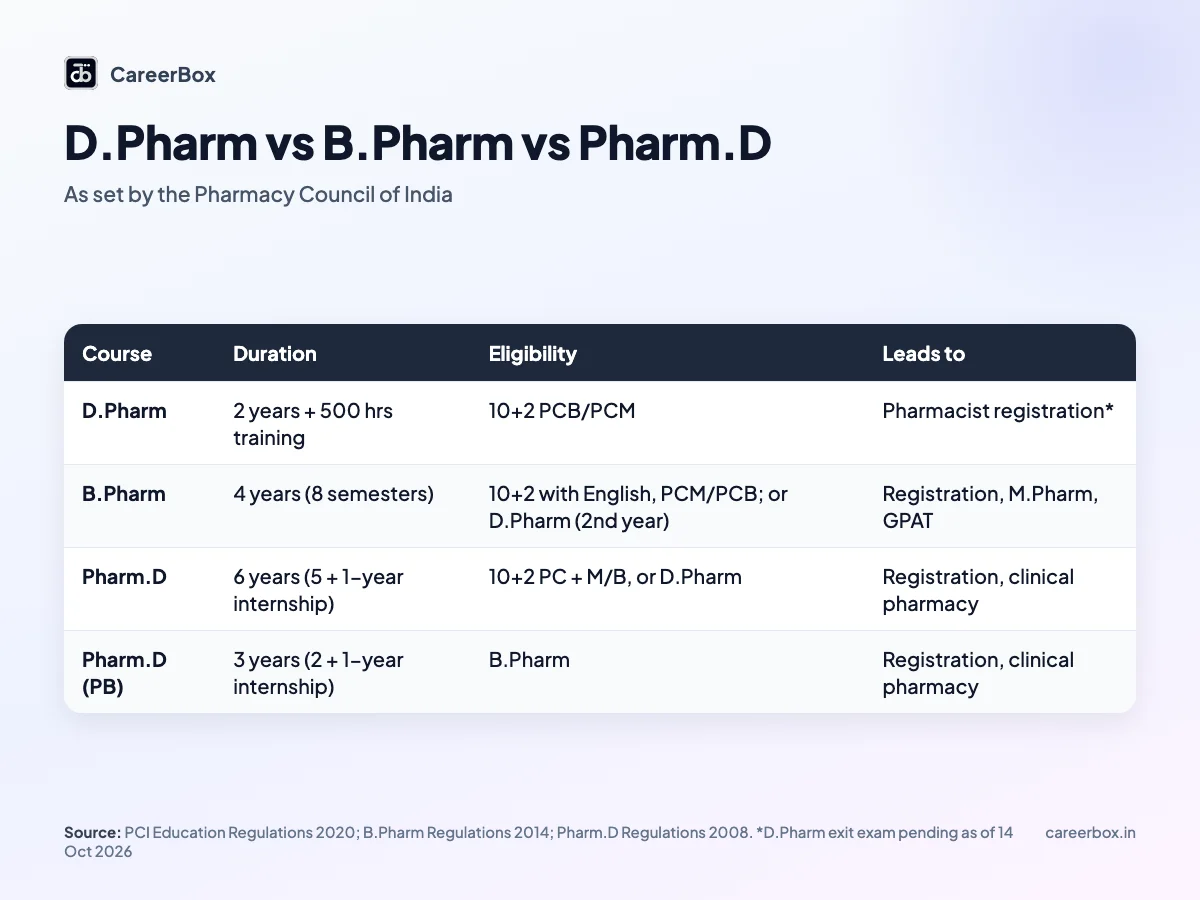
B.Pharm vs D.Pharm vs Pharm.D at a glance
| D.Pharm | B.Pharm | Pharm.D | Pharm.D (Post Baccalaureate) | |
|---|---|---|---|---|
| Full form | Diploma in Pharmacy | Bachelor of Pharmacy | Doctor of Pharmacy | Doctor of Pharmacy (Post Baccalaureate) |
| Duration | 2 years + 500 hours practical training (at least 3 months) | 4 years (8 semesters), including 150 hours of training | 6 years (5 study + 1 internship/residency) | 3 years (2 study + 1 internship/residency) |
| Minimum eligibility | 10+2 science with Physics, Chemistry and Biology or Maths | 10+2 with English, Physics, Chemistry, and Maths or Biology; age 17 by 31 December | 10+2 with Physics and Chemistry plus Maths or Biology, or D.Pharm; age 17 by 31 December | B.Pharm from a PCI-approved institution |
| Entry route | State counselling (e.g. ACPC Gujarat, JEECUP in UP) | State CETs and counselling; lateral entry for D.Pharm holders | State or institute admission | Institute admission |
| Approved by | PCI (course and institution), state examining authority | PCI and the affiliating university | PCI and the university | PCI and the university |
| Qualifies you for | Registration as a pharmacist (after the exit exam, once it runs) | Registration; M.Pharm; GPAT | Registration; clinical pharmacy roles | Registration; clinical pharmacy roles |
PCI's advisory to students warns that qualifications from institutions without PCI approval cannot be registered. Before you pay any fee, check PCI's lists of approved degree institutions and approved diploma institutions.
D.Pharm (Diploma in Pharmacy)
What it is: the shortest route to becoming a pharmacist, governed by the Education Regulations, 2020 (Gazette, 16 October 2020). See our D.Pharm course page.
Duration: two academic years of at least 180 working days each, then Part III: 500 hours of practical training over at least 3 months, including 250 hours of dispensing, in a government hospital or dispensary or a licensed pharmacy with registered pharmacists.
Eligibility: 10+2 science with Physics, Chemistry and Biology or Mathematics.
Subjects (minimum 75 theory hours each):
- Part I: Pharmaceutics, Pharmaceutical Chemistry, Pharmacognosy, Human Anatomy & Physiology, Social Pharmacy.
- Part II: Pharmacology, Community Pharmacy & Management, Biochemistry & Clinical Pathology, Pharmacotherapeutics, Hospital & Clinical Pharmacy, Pharmacy Law & Ethics.
- Part III (training): stocking drugs and medical devices, inventory control, handling prescriptions, dispensing and patient counselling.
You need 75% attendance to sit exams and 40% in each theory and practical paper to pass.
D.Pharm exit exam (DPEE): status on 14 October 2026
The DPEE Regulations, 2022 (24 February 2022) set three three-hour MCQ papers in English; you need 50% in every paper in one attempt, with unlimited attempts. Under them, D.Pharm holders can register only after passing it. Pharmacists already registered are not affected.
The exam has not been held yet:
- 27 September 2024: PCI deferred the DPEE that was scheduled for 3 to 5 October 2024. A change in the exam scheme was waiting for Health Ministry approval.
- 31 December 2024: a PCI circular said PCI had proposed amending regulation 6 to hold one paper instead of three, and that Ministry approval was still awaited. Students admitted in 2022-23 were to get registration for one year, on an affidavit.
- 8 December 2025: PCI asked all State Pharmacy Councils to issue registration certificates to the passed-out 2022-23 admitted batch "till the exit exam conducted".
We found no newer PCI notice on 14 October 2026, and the NBEMS DPEE page lists only the 2024 cycle.
B.Pharm (Bachelor of Pharmacy)
What it is: a four-year degree under the B.Pharm Course Regulations, 2014 (Gazette, 11 December 2014), and the usual route into industry, M.Pharm and research. See our B.Pharm course page.
Duration: four academic years (eight semesters); three for lateral entry. It includes 150 hours of practical training over at least one month after the second year, in a hospital or community pharmacy or in industry.
Eligibility: 10+2 with English, Physics, Chemistry, and Mathematics or Biology; age 17 by 31 December of the admission year. D.Pharm holders from PCI-approved institutions can join the third semester (lateral entry).
Syllabus: PCI's current semester scheme (in force from 2016-17) requires at least 208 credits. It runs from Human Anatomy & Physiology, Pharmaceutical Analysis and Pharmaceutics (Semester I) through Medicinal Chemistry, Pharmacology, Pharmacognosy, Industrial Pharmacy and Jurisprudence, to Practice School (150 hours, Semester VII) and a Project with electives such as Pharmacovigilance and Regulatory Science (Semester VIII). The pass mark is 50% per subject.
What is changing: PCI has published a new NEP-2020 B.Pharm syllabus (2026), proposed for implementation from 2026-27. It keeps eight semesters, adds a 120-hour internship and AI and digital tools. Ask your university which scheme your batch follows.
Pharm.D (Doctor of Pharmacy)
What it is: a six-year clinical programme under the Pharm.D Regulations, 2008. Course details are on our Pharm.D course page.
Duration: five years of study plus a sixth-year internship or residency (six months in General Medicine, two months each in three other specialties). Year 5 adds hospital postings, clerkship and a six-month project.
Eligibility: 10+2 with Physics and Chemistry plus Mathematics or Biology, or D.Pharm; age 17 by 31 December. Pharm.D (Post Baccalaureate) takes B.Pharm graduates for three years (two of study, one of internship).
Subjects: from Anatomy, Biochemistry and Pharmaceutical Chemistry (Year 1) through Pharmacology and Pharmacotherapeutics I–III to Clinical Pharmacy, Clinical Toxicology, Clinical Research and Therapeutic Drug Monitoring.
Who can offer it: only B.Pharm-approved institutions, with 30 seats (Pharm.D) and 10 (Post Baccalaureate), and an attached hospital. A 2019 amendment allows district-hospital tie-ups in the North-East and hilly regions.
How to become a registered pharmacist in India
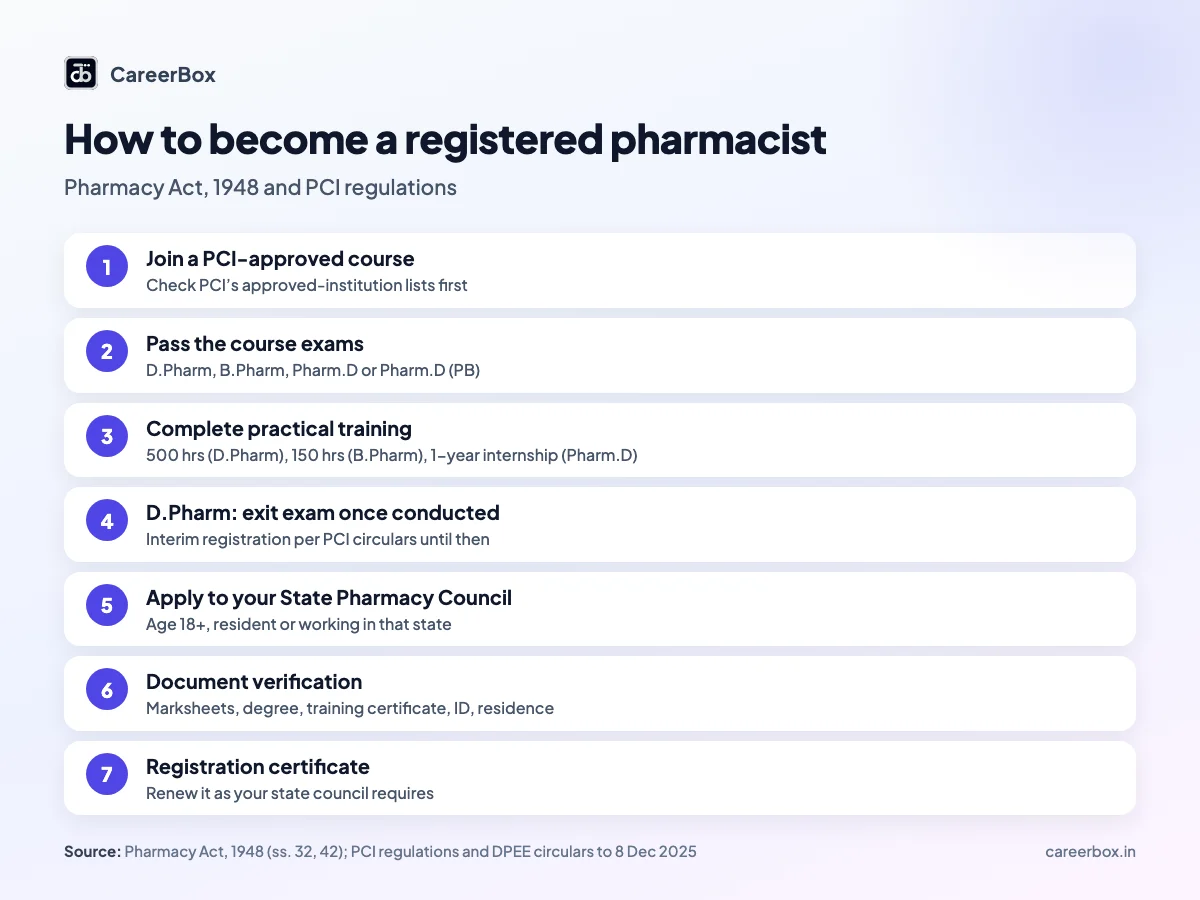
Under section 42 of the Pharmacy Act, 1948, only a registered pharmacist may compound, prepare, mix or dispense medicine on a doctor's prescription. Section 32(2) lets you register if you are at least 18, have passed an approved examination, and live or work in pharmacy in that state.
- Choose a PCI-approved course and institution. Check the PCI lists before admission.
- Pass the course and finish the practical training: 500 hours for D.Pharm, 150 hours for B.Pharm, or the internship year for Pharm.D.
- D.Pharm only: clear the exit exam once it is held. Until then, follow the interim registration in PCI's circulars.
- Apply online to your State Pharmacy Council. Upload your marksheets, degree or provisional certificate, training certificate, and proof of identity and residence.
- Attend document verification. Some councils ask you to book an appointment.
- Receive your registration certificate and keep it renewed.
Each state's council and its contact details are on PCI's State Pharmacy Councils list.
Fees: what is actually known
PCI publishes no national fee; fees vary by state and college. The reliable source is your state's fee-regulatory body. Gujarat publishes its figures:
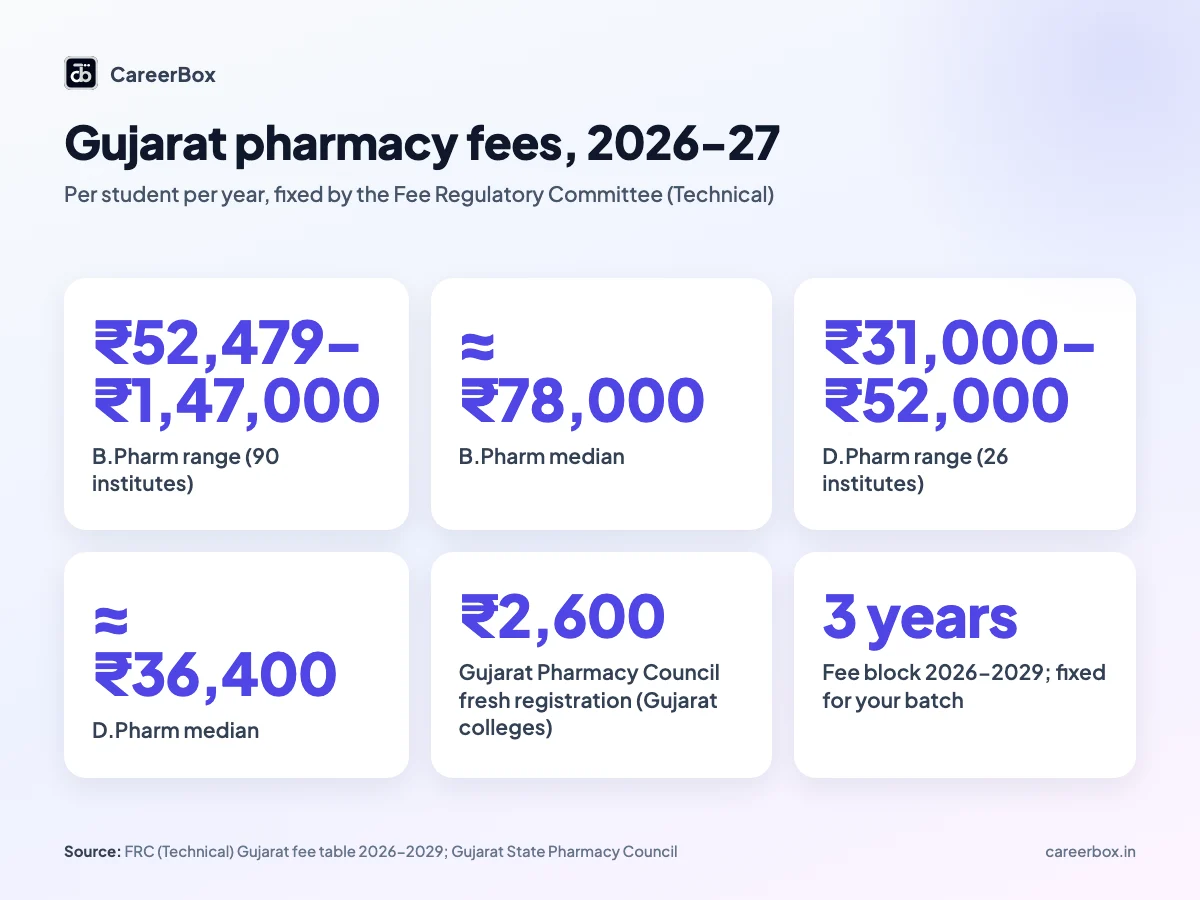
- B.Pharm, Gujarat (2026-27): the FRC (Technical) fee table gives a fee for 90 institutes, ranging from ₹52,479 to ₹1,47,000 a year. The median is about ₹78,000.
- D.Pharm, Gujarat (2026-27): for 26 institutes, the range is ₹31,000 to ₹52,000 a year, with a median of about ₹36,400.
- Per the FRC's conditions, these all-inclusive fees (tuition, library, laboratory and so on) stay fixed for your batch and are collected semester by semester.
For other states, compare colleges on the CareerBox pharmacy colleges list or search pharmacy institutes, and confirm with the state fee authority before paying.
Careers and further study
- Registered pharmacist roles: dispensing in community and hospital pharmacies, open to all three courses.
- Industry and research: B.Pharm leans towards industrial pharmacy, quality assurance and regulatory science; Pharm.D towards clinical pharmacy, clinical research and pharmacovigilance.
- M.Pharm: a two-year course under the M.Pharm Regulations, 2014. You need a B.Pharm with at least 55% aggregate (50% for SC/ST). A 2020 amendment relaxes this to 50% for candidates with five years of professional experience. M.Pharm students must also register with their State Pharmacy Council within a month of admission. See our M.Pharm page.
- GPAT: NBEMS runs the Graduate Pharmacy Aptitude Test for M.Pharm entry and scholarships. GPAT 2026 (7 March 2026) had 125 questions for 500 marks; scores are valid for three years. See our GPAT guide.
- Pharm.D (Post Baccalaureate): a three-year clinical route for B.Pharm graduates.
State check: Gujarat and Uttar Pradesh
Gujarat
- Admission: ACPC Gujarat runs counselling for both degree and diploma pharmacy. Its 2026-27 key dates used a GUJCET-based merit list, with a revised NEET/JEE/GUJCET-based merit list later, and the academic term began on 1 August 2026. D.Pharm holders entering B.Pharm through lateral entry take ACPC's DDCET (Pharmacy), held on 9 May 2026.
- Registration: the Gujarat State Pharmacy Council registers D.Pharm, B.Pharm and Pharm.D graduates of PCI-approved institutions who are 18 or older and live or work in Gujarat. You upload documents online, book an appointment and attend in-person verification. Fees: ₹2,600 for graduates of Gujarat colleges, ₹5,100 for graduates of colleges in other states, and a ₹500 late fee if you apply more than a year after qualifying.
Uttar Pradesh
- Admission: D.Pharm seats in UP's government and private institutes are filled through JEECUP's Pharmacy Counselling. By October 2026 it had announced the Round 3 allotment for 2026.
- Registration: the Uttar Pradesh Pharmacy Council handles registration online. First registration costs ₹1,550 plus 18% GST (₹1,829). Its document list asks D.Pharm applicants for a 500-hour practical training certificate from a PCI-recognised government, semi-government or government-aided hospital. Applicants who studied outside UP need a recent domicile certificate.
PCI is also drafting rules against unauthorised admissions beyond approved seats (placed before its Central Council in August 2026, not yet notified).
Frequently asked questions
What is the full form of B.Pharm, D.Pharm and Pharm.D? B.Pharm is Bachelor of Pharmacy, D.Pharm is Diploma in Pharmacy, and Pharm.D is Doctor of Pharmacy. All three are approved qualifications for registering as a pharmacist in India.
What is the B.Pharm course duration? Four academic years (eight semesters), including 150 hours of practical training. D.Pharm holders who join through lateral entry study for three years.
How many years is D.Pharm? Two academic years, followed by at least 500 hours of practical training spread over at least three months.
Is Pharm.D a doctor course? Pharm.D (Doctor of Pharmacy) is a six-year pharmacy degree with a one-year hospital internship. It trains clinical pharmacists. It is a pharmacy qualification under the Pharmacy Act, not a medical (MBBS) degree.
Can I do B.Pharm after D.Pharm? Yes. PCI regulations allow D.Pharm holders from approved institutions to enter B.Pharm in the second year (third semester). In Gujarat, this lateral entry goes through ACPC's DDCET (Pharmacy).
Is the D.Pharm exit exam compulsory in 2026? The 2022 regulations make it a condition for registration, but as of 14 October 2026 it has not been held. PCI's circular of 8 December 2025 asks State Councils to register the affected batch until it is held.
What is the "Pharmacist Council of India"? The correct name is the Pharmacy Council of India (PCI), the statutory body under the Pharmacy Act, 1948 that regulates pharmacy education. Registration itself is done by your State Pharmacy Council.
Does B.Pharm need NEET? PCI's regulations do not require NEET; states set the admission test. Gujarat's ACPC used GUJCET-based merit for 2026-27, adding NEET and JEE scores in its revised list.
Sources
All official, checked on 14 October 2026: PCI Education Regulations 2020 (D.Pharm); B.Pharm Regulations 2014, B.Pharm syllabus (2016-17) and NEP syllabus (2026); Pharm.D Regulations 2008 and 2019 amendment; M.Pharm Regulations 2014 and 2020 amendment; DPEE Regulations 2022 and PCI circulars of 27 Sep 2024, 31 Dec 2024 and 8 Dec 2025; PCI advisory, approved-institution and State Council lists; Pharmacy Act, 1948 (Chapters IV–V); NBEMS GPAT 2026 bulletin and DPEE page; Gujarat State Pharmacy Council, ACPC Gujarat and FRC (Technical) Gujarat; Uttar Pradesh Pharmacy Council and JEECUP.