
GPAT 2026 Explained: Eligibility, Exam Pattern, Dates, Result and What Comes Next

Quick answer: GPAT (Graduate Pharmacy Aptitude Test) is the national computer-based test for entry to M.Pharm courses and GPAT scholarships. The National Board of Examinations in Medical Sciences (NBEMS) conducts it for the Pharmacy Council of India (PCI). GPAT 2026 was held on 7 March 2026 and its result was declared on 7 April 2026. As of 14 October 2026, NBEMS has not yet published a GPAT 2027 notice or bulletin.
Key takeaways
- GPAT 2026 had 125 multiple-choice questions for 500 marks in 3 hours: 4 marks for a correct answer and 1 mark deducted for a wrong one.
- You need a 4-year B.Pharm (lateral entry included). Students in their final (4th) year and pre-final (3rd) year could also apply for GPAT 2026.
- 53,617 candidates took GPAT 2026 and 5,362 qualified, the top 10% by merit.
- To qualify you need at least the 50th percentile (General/EWS) or the 45th percentile (OBC, SC, ST and PwBD), and you must be in the top 10% of everyone who took the test.
- A GPAT 2026 score is valid for three years.
- NBEMS only conducts the test and declares the result. Admission and counselling are handled by states and institutions, and PCI handles the scholarship.
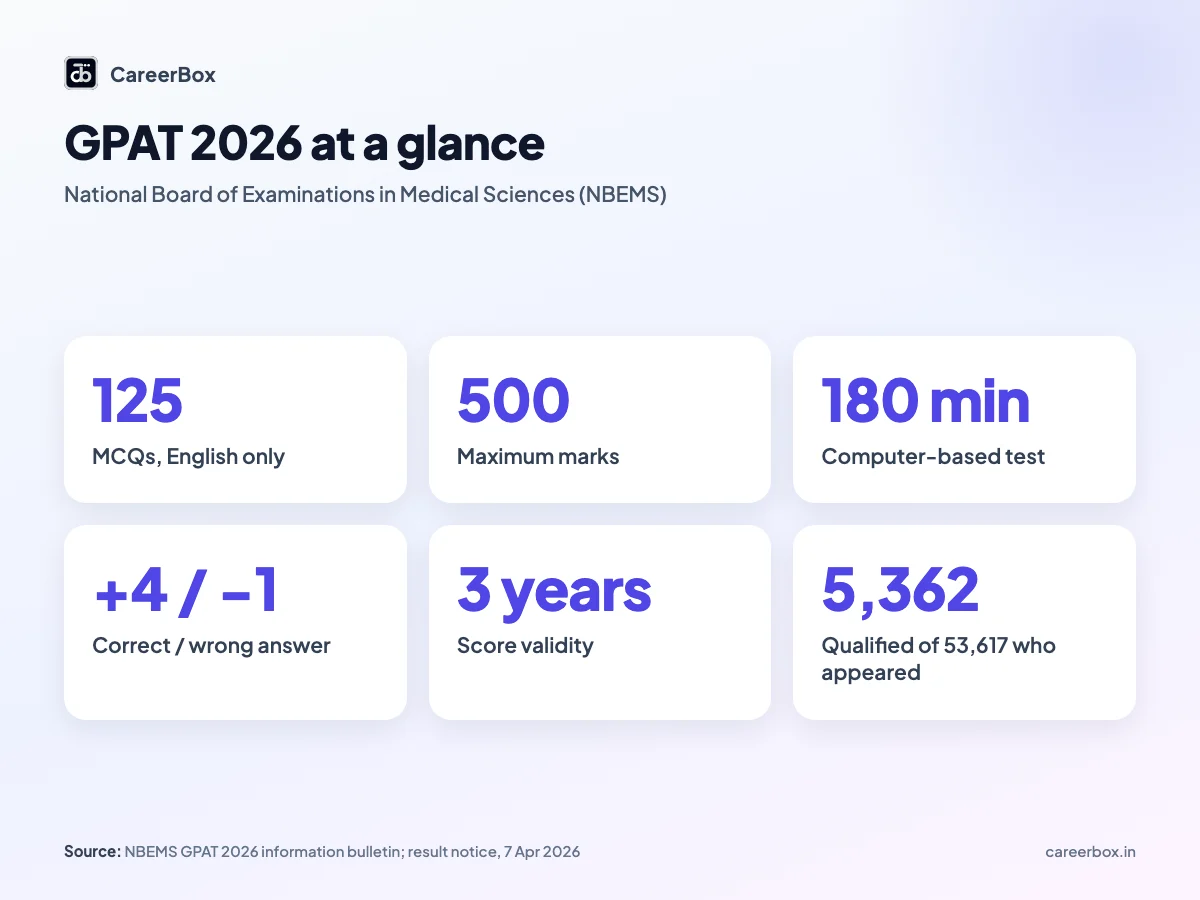
GPAT at a glance
| Item | GPAT 2026 (official) |
|---|---|
| Full form | Graduate Pharmacy Aptitude Test |
| Conducting body | NBEMS, under an MoU with the Pharmacy Council of India |
| Mode | Computer-based test (CBT), single day, single session |
| Duration | 3 hours (180 minutes), 9:00 AM to 12:00 PM |
| Questions and marks | 125 MCQs, 500 marks, English only |
| Marking | +4 for a correct answer, −1 for a wrong one, 0 if unattempted |
| Eligibility | Indian citizen with a 4-year B.Pharm, or in the final or pre-final year |
| Exam fee | ₹3,500 (General, OBC, EWS); ₹2,500 (SC, ST, PwD), plus gateway charges |
| Score validity | Three years |
| Official site | natboard.edu.in (GPAT page) |
GPAT began in 2010. AICTE ran it until 2018, and the National Testing Agency ran it from 2019 to 2023. In 2020 the Supreme Court ruled that pharmacy education would be governed by the Pharmacy Act, 1948, so PCI took over the exam and signed an MoU with NBEMS to conduct it. You can see how GPAT fits with other pharmacy entrance tests on our GPAT exam page and our overview of state pharmacy CETs.
Eligibility
The GPAT 2026 bulletin sets these conditions:
- Citizenship: you must be a citizen of India.
- Degree: a Bachelor's degree in Pharmacy (4 years after 10+2, including lateral entry students), or an equivalent, from a recognised university. See our B.Pharm course guide.
- Final-year students: students taking the final (4th) year B.Pharm exam were eligible if their result would come out before M.Pharm admissions for 2026-27 began.
- Pre-final-year students: students taking the 3rd-year exam were also eligible if their final-year result would come out before M.Pharm admissions for 2027-28 began.
- Not eligible: B.E./B.Tech (Pharmaceutical and Fine Chemical Technology) or equivalent graduates.
Eligibility at the admit-card stage is provisional. NBEMS does not check documents. The counselling or admitting authority checks them later.
Exam pattern and marking
NBEMS publishes an "indicative blueprint" of how the 125 questions are split across subjects:
| Subject area | Questions | Marks |
|---|---|---|
| Pharmaceutical Chemistry and allied subjects | 38 | 152 |
| Pharmaceutics and allied subjects | 38 | 152 |
| Pharmacology and allied subjects | 28 | 112 |
| Pharmacognosy and allied subjects | 10 | 40 |
| Other subjects of the B.Pharm course | 11 | 44 |
| Total | 125 | 500 |
Each question has four options. Because a wrong answer costs 1 of the 4 marks, the bulletin describes this as 25% negative marking. Unattempted questions get zero.
The paper is split into time-bound sections. The bulletin's example is five sections of 25 questions each, with 36 minutes per section. When a section's time runs out, the next one opens automatically, and you cannot go back to review or change your answers. You can mark questions for review only while that section is still open. Answers marked for review are still scored.
Syllabus outline
NBEMS does not publish a separate GPAT syllabus. The bulletin says the syllabus covers the subject areas in "The Bachelor of Pharmacy (B. Pharm.) Course Regulations, 2024". In practice, the five areas in the blueprint above are your syllabus map, and the B.Pharm regulations tell you which topics fall under each one. PCI publishes the B.Pharm and M.Pharm regulations on pci.nic.in.
Important dates
GPAT 2026 cycle (official, NBEMS bulletin and notices):
| Event | Date |
|---|---|
| Bulletin released, registration opens | 23 December 2025 (5:00 PM) |
| Last date to apply | 12 January 2026 (11:55 PM) |
| Edit window | 16 to 19 January 2026 |
| Image correction window | 6 to 9 February 2026 |
| Final image correction window | 17 to 19 February 2026 |
| Test city intimation | 24 February 2026 |
| Admit card | 2 March 2026 |
| Exam | 7 March 2026 |
| Provisional answer key and challenge window | 13 March (3 PM) to 16 March 2026 (3 PM) |
| Result | 7 April 2026 |
| Score card download | On or after 15 April 2026 |
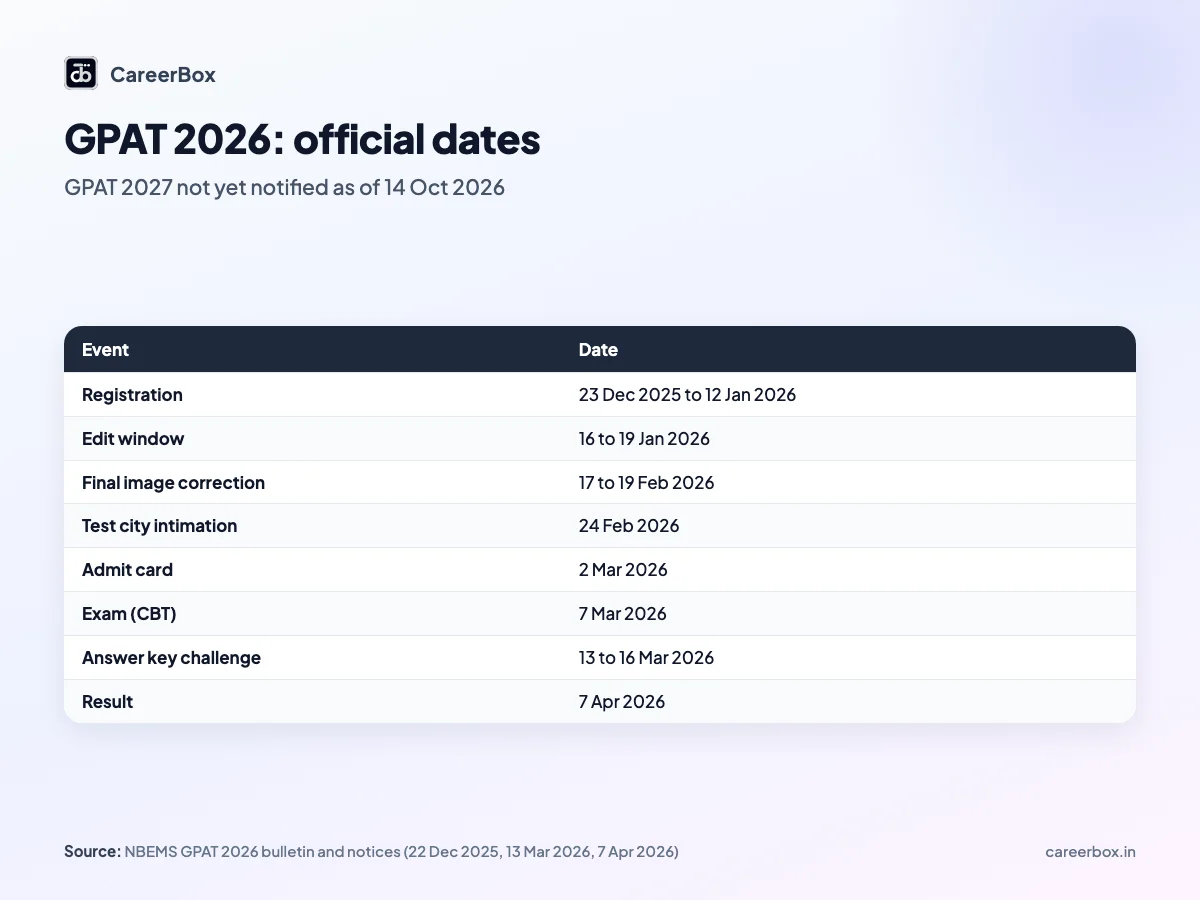
Next cycle (GPAT 2027): as of 14 October 2026, NBEMS has posted no GPAT 2027 notice, bulletin or exam date. The most recent GPAT item on its notice board is the GPAT 2026 result. The timing has changed from year to year. GPAT 2025 was held on 25 May 2025: applications ran from 1 to 21 April 2025 and the result notice is dated 25 June 2025. GPAT 2026 moved earlier, to 7 March 2026. So do not assume a date for 2027. Watch the NBEMS GPAT page and our news desk for the official notice.
How to register
The 2026 bulletin sets out these steps:
- Fill in the user registration form on the NBEMS application link to get your User ID/Application ID and password. These are sent by SMS and email.
- Complete the application form and upload your photograph (taken within the last 3 months), signature, thumb impression and the documents asked for.
- Choose a test city. Cities are given on a first-come, first-served basis, and NBEMS allots the actual centre.
- Pay the fee online through the payment gateway only.
- Preview the form, agree to the declaration and submit.
- Print the form showing the transaction ID and payment status "S" (successful).
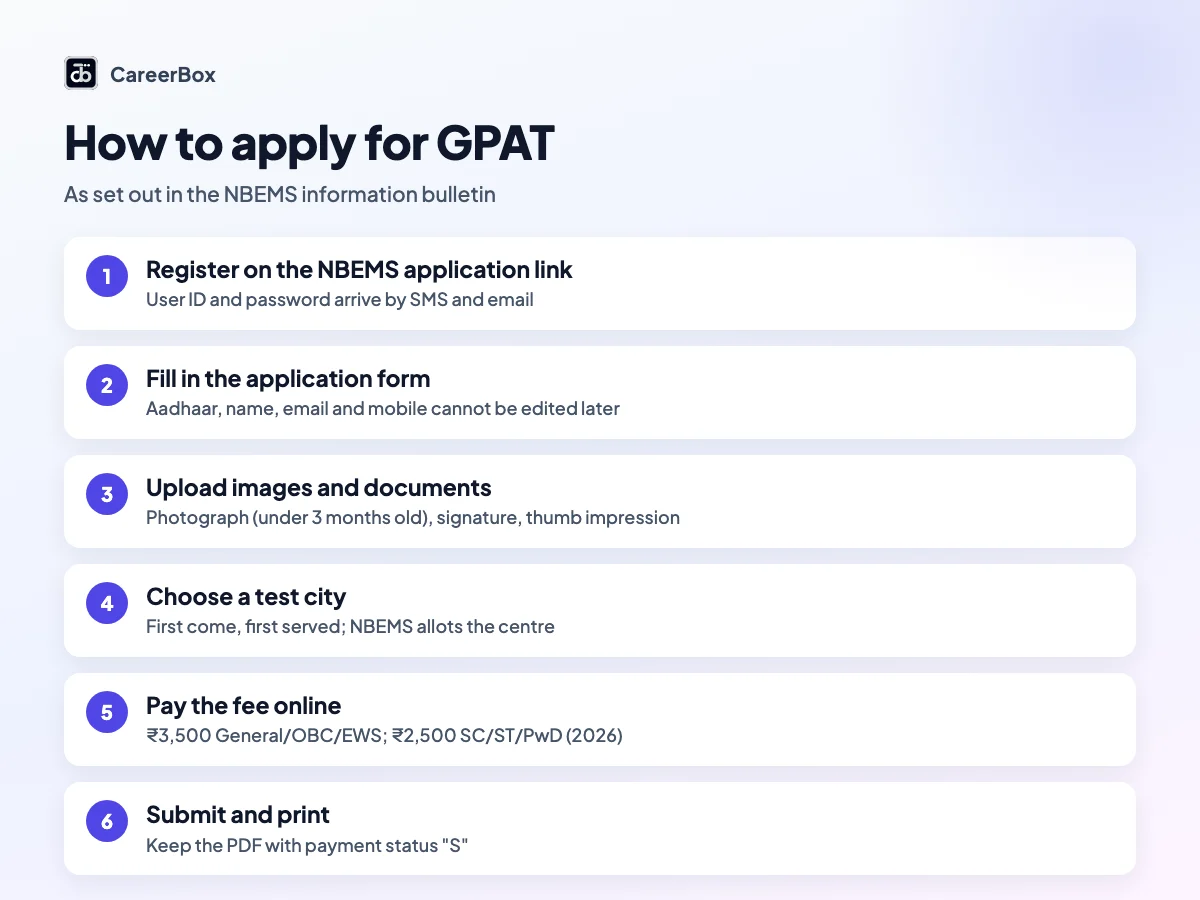
You cannot change your name, nationality, email, mobile number, Aadhaar number or test city after you apply, not even in the edit window. Once you submit, the fee is not refunded or carried forward.
Result, score card and validity
NBEMS first shows you the question paper with your recorded responses and the provisional answer key. You can challenge an answer for ₹200 per question, and this fee is not refunded. For GPAT 2026, NBEMS's experts found 7 questions technically incorrect, so everyone got full marks for those. They also corrected the answer key for 4 other questions.
To qualify, you must meet the category percentile and be in the top 10% of candidates who took the test. The GPAT 2026 cut-offs were:
| Category | Percentile | Score | Rank |
|---|---|---|---|
| General | 96.2586493 | 213 | 2059 |
| General-EWS | 90.8238059 | 180 | 4979 |
| OBC-NCL (Central List) | 90.0870992 | 177 | 5431 |
| SC | 76.4664192 | 142 | 12820 |
| ST | 59.1939124 | 116 | 22213 |
(The PwBD sub-categories had separate, lower cut-offs. They are listed in the NBEMS notice.)
If two candidates have the same score, NBEMS ranks them in this order: the one with fewer wrong answers comes first, then the older candidate, then higher Class XII marks, then higher Class X marks. NBEMS gives only an all-India rank. It does not prepare category-wise or state-wise merit lists, and there is no re-evaluation.
The score card shows your cut-off score, percentile and rank. It can be downloaded only for six months after it is uploaded. The GPAT 2026 score cards were uploaded on or after 15 April 2026, so if you have not saved yours, download it now. NBEMS does not send score cards by email or post. The GPAT 2026 score is valid for three years.
What a GPAT score is used for
- M.Pharm and PhD admission. The bulletin says PCI-approved or affiliated university departments, colleges and institutions accept the GPAT score for M.Pharm and PhD admissions. Each institution or state sets its own cut-off and runs its own counselling. NBEMS has no role in seat allotment. Read more about the degree in our M.Pharm course guide.
- GPAT scholarship (now PCI). A PCI circular dated 5 April 2024 says that from 2024, PCI conducts GPAT and pays scholarships to GPAT-qualified candidates. It says PCI will pay the stipend to students who passed GPAT in 2023-24 and later. The circular does not state the amount.
- AICTE PG scholarship. AICTE used to pay this scholarship to GPAT-qualified students, and its scheme page is still titled "PG Scholarship (GATE/GPAT)". However, AICTE's notification for 2026-27 invites applications only for M.E./M.Tech./M.Des. students with a valid GATE or CEED score, and does not list GPAT. For an M.Pharm stipend, follow PCI's instructions and ask your institution.
A preparation plan based on the official syllabus
No official "toppers' tips" exist, so plan from the documents:
- Match your time to the blueprint. Pharmaceutical Chemistry and Pharmaceutics carry 38 questions each, together 304 of the 500 marks. Pharmacology carries 28 questions, Pharmacognosy 10, and other B.Pharm subjects 11.
- Use the B.Pharm Course Regulations, 2024 as your checklist. Tick off each subject in each semester against the five blueprint areas.
- Practise in timed sections. You cannot go back to an earlier section, so practise sets of about 25 questions in about 36 minutes, the bulletin's example.
- Respect the negative marking. A wrong answer costs 1 mark, and having fewer wrong answers is also the first tie-breaker.
- Keep your documents ready. You need a recent photograph, signature and thumb impression that meet NBEMS image rules, a valid photo ID, and category certificates in the right format. Rejected images have cost candidates their applications.
Where GPAT matters in your state
M.Pharm seats are filled by state admission bodies and institutions, not NBEMS.
- Gujarat (ACPC): ACPC's 2026 instructions for M.E./M.Tech./M.Pharm say that both GATE/GPAT-qualified and non-GATE/non-GPAT candidates must register online. Candidates without GATE or GPAT must take PGCET 2026 to be eligible. Registration for 2026 ran from 15 to 30 May 2026, and ACPC posted M.Pharm vacant-seat rounds in August and September 2026. For undergraduate pharmacy seats in the state, see our report on Gujarat pharmacy vacancies.
- Maharashtra (State CET Cell): the CET Cell runs a separate M.Pharm admission portal for 2026-27, linked from cetcell.mahacet.org. Check the eligibility and GPAT rules in that year's information brochure on the portal.
- Uttar Pradesh (AKTU): AKTU's website links to a PG enrolment portal for M.Tech, M.Pharm and M.Arch. Read the current year's instructions there before you apply.
To compare colleges, browse pharmacy colleges.
Frequently asked questions
What is the full form of GPAT? Graduate Pharmacy Aptitude Test. It is a national test for M.Pharm admission and GPAT scholarships, conducted by NBEMS for the Pharmacy Council of India.
When was GPAT 2026 held, and when is GPAT 2027? GPAT 2026 was held on 7 March 2026. As of 14 October 2026, NBEMS has not announced a date for GPAT 2027.
How do I register for GPAT? Apply online through the application link on the NBEMS GPAT page. For 2026, registration ran from 23 December 2025 to 12 January 2026. The fee was ₹3,500 for General, OBC and EWS candidates and ₹2,500 for SC, ST and PwD candidates.
When was the GPAT 2026 result declared? On 7 April 2026. 53,617 candidates took the test and 5,362 qualified.
How does the GPAT answer key work? NBEMS publishes the provisional key with your recorded responses. In 2026 that was on 13 March. You can challenge an answer for ₹200 per question, and the result is based on the final key.
Is there negative marking in GPAT? Yes. A correct answer gets 4 marks, a wrong answer loses 1 mark, and an unattempted question gets 0.
How long is a GPAT score valid? The GPAT 2026 score is valid for three years. The score card can be downloaded from NBEMS only for six months after it is uploaded.
Sources
All checked on 14 October 2026:
- NBEMS, GPAT page and GPAT 2026 information bulletin (natboard.edu.in)
- NBEMS notices: applications invited for GPAT 2026 (22 Dec 2025); provisional answer keys (13 Mar 2026); result of GPAT 2026 (7 Apr 2026); conduct of GPAT 2025 (27 Feb 2025); result of GPAT 2025 (25 Jun 2025)
- Pharmacy Council of India, circular "Conduct of GPAT Examination and Disbursement of GPAT Scholarship" (5 Apr 2024)
- AICTE, PG Scholarship Scheme page and the 2026-27 notification
- ACPC Gujarat, M.Pharm page and the 2026 admission instructions for M.E./M.Tech./M.Pharm
- Maharashtra State CET Cell admission portal page; AKTU PG enrolment link