
B.Ed admission 2026: entrance tests, eligibility, the new 4-year ITEP and IGNOU B.Ed — a state-by-state guide

Quick answer: In 2026 there are three main ways into a B.Ed. (1) The 2-year B.Ed needs a bachelor's or master's degree with at least 50% marks (55% for B.E./B.Tech with Science and Maths). Admission is through a state entrance test (Uttar Pradesh, Bihar and Maharashtra each held one in 2026) or on graduation merit (Gujarat, through the GCAS portal). (2) The 4-year ITEP is for students who have just passed Class 12. For 2026-27 the only way in was NTA's NCET 2026. (3) IGNOU's B.Ed (distance mode) is only for trained in-service elementary teachers, or for candidates who have finished an NCTE-recognised face-to-face teacher education programme. IGNOU runs its own entrance test and the fee is ₹60,000 for the whole programme.
Key takeaways
- The national floor for B.Ed eligibility is set by NCTE: 50% in a bachelor's and/or master's degree (Sciences, Social Sciences, Humanities), or 55% in B.E./B.Tech with Science and Mathematics. Each state then sets its own relaxation for reserved categories.
- The 2026-27 state cycles are almost over. UP's entrance test was on 31 May 2026, Bihar's on 7 June 2026 and Maharashtra's on 27–29 March 2026. Maharashtra's CAP Round III students had to report to colleges by 13 October 2026.
- The ITEP route closed for 2026-27 with NCET 2026. NCTE told institutions on 17 June 2026 that ITEP admissions must be made strictly through NCET 2026. NTA says 223 institutions were approved for this session.
- The old 4-year B.A. B.Ed / B.Sc. B.Ed is being replaced. Under NCTE's 2024 and 2025 amendments, colleges must switch to ITEP before the 2026-27 session starts.
- IGNOU B.Ed is not for fresh graduates. You must also be a trained in-service elementary teacher, or have completed an NCTE-recognised teacher education programme in face-to-face mode.
- After B.Ed comes a TET. The next CTET (its 22nd edition) is on 12 and 13 December 2026.
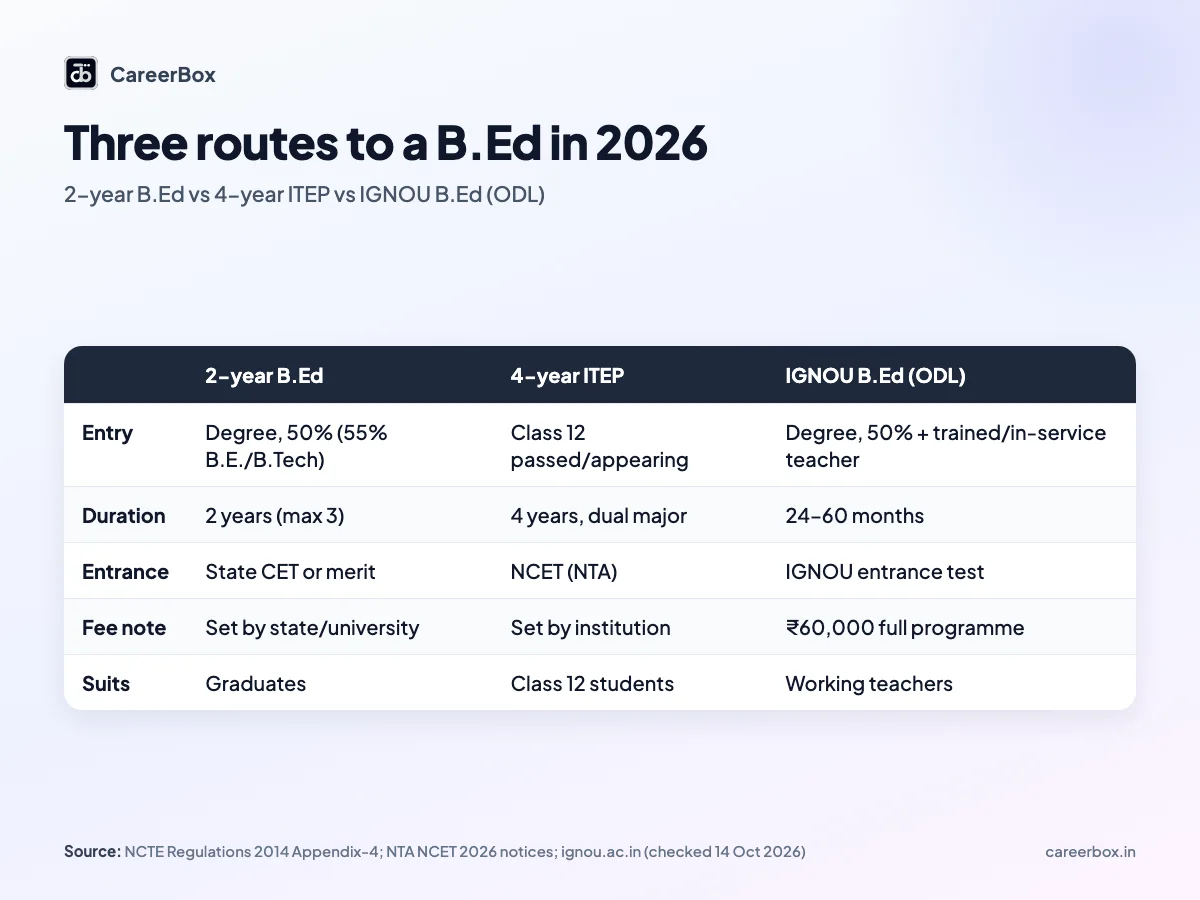
B.Ed routes compared
| 2-year B.Ed | 4-year ITEP | IGNOU B.Ed (ODL) | |
|---|---|---|---|
| Who can apply | Graduates or postgraduates with 50% (55% for B.E./B.Tech, Science + Maths) | Class 12 passed, or appearing in Class 12; NCET has no age limit | 50% in a degree plus trained in-service teacher or NCTE-recognised face-to-face teacher training |
| Duration | 2 academic years (maximum 3) | 4 years, dual major | 24 to 60 months |
| Entrance | State CET or university test, or merit (depends on the state) | NCET (by NTA) | IGNOU entrance test |
| Regulator | NCTE | NCTE | NCTE-recognised; IGNOU |
| Who it suits | Graduates who want to teach in secondary schools | Class 12 students who already know they want to teach | Working teachers who need a B.Ed |
B.Ed eligibility in 2026: what NCTE says
The national rule is in Appendix-4 of the NCTE (Recognition Norms and Procedure) Regulations, 2014. To be eligible you need at least fifty percent marks in the Bachelor's Degree and/or the Master's Degree in Sciences, Social Sciences or Humanity. A Bachelor's in Engineering or Technology with specialisation in Science and Mathematics needs 55%. Reservation and relaxation for SC/ST/OBC/PwD and other categories follow the rules of the Central or State Government, whichever applies. That is why the relaxed cut-off differs from state to state.
The programme lasts two academic years (maximum three), with 80% attendance required in coursework and 90% in school internship. Admission is "on merit on the basis of marks obtained in the qualifying examination and/or in the entrance examination or any other selection process as per the policy of the State Government/U.T. Administration and the University". That is why Gujarat admits on merit while UP, Bihar and Maharashtra hold entrance tests.
In 2026, UP asked for 50% (General/OBC) or 45% (SC/ST), and Maharashtra for 50% (Open/EWS) or 45% (reserved candidates from Maharashtra). Bihar asked for 50% in Sciences, Social Sciences, Humanities or Commerce. All three asked for 55% for B.E./B.Tech graduates (Maharashtra: 50% for reserved candidates).
B.Ed entrance tests by state (2026-27 cycle)
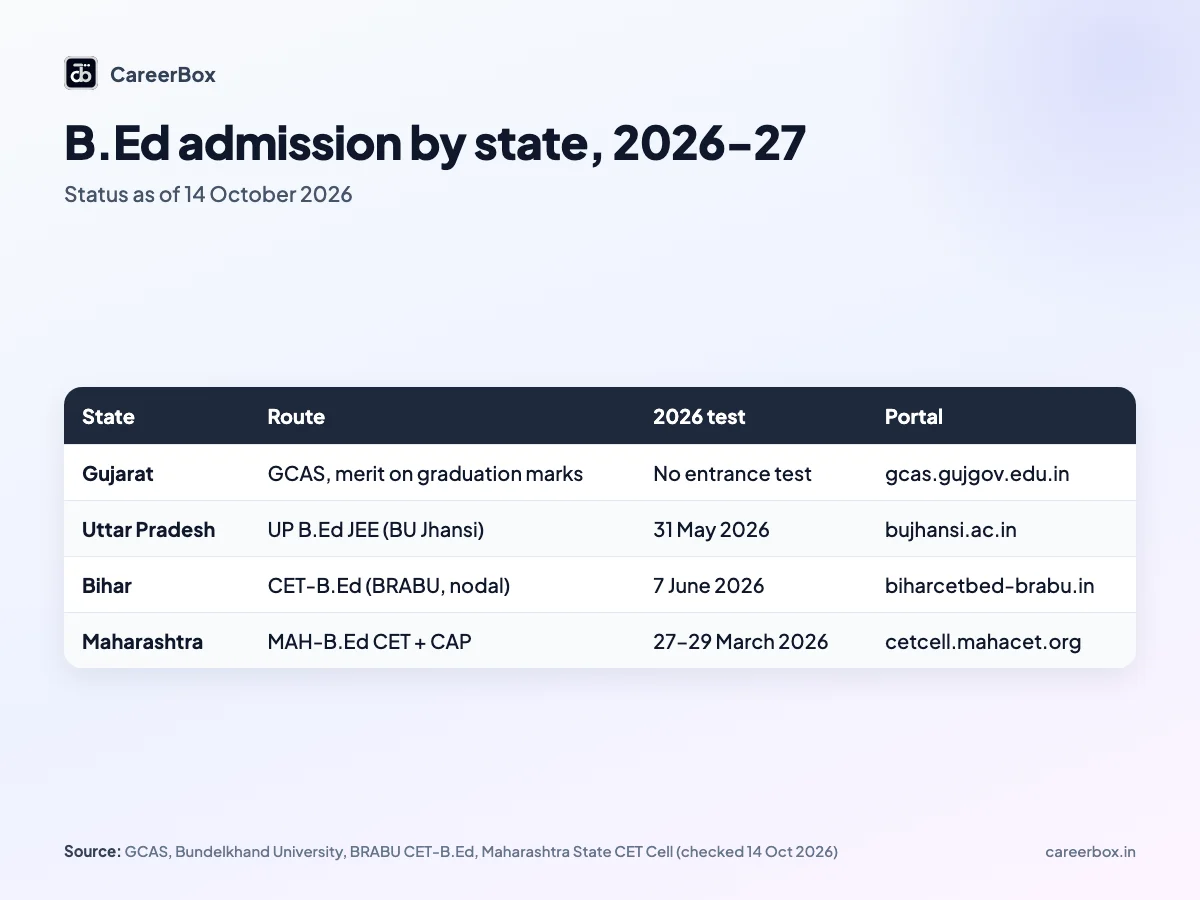
| State | Who runs it | 2026 test | Where things stand (14 Oct 2026) | Official portal |
|---|---|---|---|---|
| Gujarat | GCAS (state Education Department portal); each university sets its own merit rules | No state entrance test; merit is based on graduation marks | B.Ed form guidelines for 2026-27 were published on 15 June 2026; admission is in rounds | gcas.gujgov.edu.in |
| Uttar Pradesh | Bundelkhand University, Jhansi (UP B.Ed JEE 2026-28) | 31 May 2026 | Result declared 16 June 2026; counselling is live on the university page | bujhansi.ac.in |
| Bihar | BRABU Muzaffarpur, nodal university (CET-B.Ed 2026) | 7 June 2026 | Result declared 19 June 2026; final round 29 Sep–3 Oct 2026 | biharcetbed-brabu.in |
| Maharashtra | State CET Cell (MAH-B.Ed CET 2026) | 27–29 March 2026 | CAP Round III allotment on 9 Oct 2026; reporting 10–13 Oct 2026 | cetcell.mahacet.org |
Gujarat. Gujarat has no B.Ed entrance test. Students apply on the Gujarat Common Admission Services (GCAS) portal. GCAS's 2026-27 B.Ed guidelines say every participating university or college prepares B.Ed merit on marks only, so you enter marks, not CGPA. The non-refundable registration fee is ₹300 for Unreserved applicants and ₹150 for SC/ST/SEBC/EWS and PwBD applicants. GCAS is only the platform: each university decides eligibility, merit and tie-breakers.
Uttar Pradesh. The UP government gave Bundelkhand University, Jhansi the job of running the UP B.Ed JEE for the 2026-28 session. Online applications ran from 10 February to 30 April 2026. The test was on 31 May 2026 and the result came out on 16 June 2026. The 2027 cycle has not yet been announced (as of 14 October 2026). Watch bujhansi.ac.in, or whichever university the state names next.
Bihar. The CET-B.Ed 2026 covers the two-year B.Ed and Shiksha Shastri at all universities in Bihar that offer the course. Babasaheb Bhimrao Ambedkar Bihar University, Muzaffarpur was the nodal university, and the test was on 7 June 2026. It had 120 one-mark multiple-choice questions in two hours, with no negative marking. The qualifying score was 42 marks (35%) for Unreserved candidates and 36 marks (30%) for SC, ST, BC, EBC, WBC, EWS and Divyaang candidates. The test fee was ₹1,000 for General candidates, ₹750 or ₹500 for others. The final first-come-first-served round closed on 3 October 2026. See also our story on Bihar's 32,388 teacher posts.
Maharashtra. The State CET Cell held the MAH-B.Ed (General & Special) and B.Ed ELCT CET 2026 from 27 to 29 March 2026. It is a 100-mark online test in 90 minutes: Mental Ability (40), General Knowledge (30) and Teacher Aptitude (30). There is no negative marking, and the test is in English and Marathi. Admission is through the CET Cell's CAP. Registration ran from 2 to 31 July 2026, and Round III allotment was on 9 October 2026.
ITEP and NCET explained
The Integrated Teacher Education Programme (ITEP) is NCTE's four-year, dual-major degree under NEP 2020. The first major is Education, with a specialisation in one school stage (for example, Preparatory, Middle or Secondary). The second major is a discipline you choose. It is offered as B.A. B.Ed., B.Sc. B.Ed. or B.Com. B.Ed. at universities, IITs, NITs, RIEs and government colleges.
NCET 2026, step by step:
- NTA took applications from 12 February to 10 March 2026.
- The exam was held on 17 and 18 April 2026 as a computer-based test in 145 cities. 73,608 candidates registered and 58,995 appeared.
- The result came out on 4 June 2026. NTA said 223 institutions had NCTE approval for ITEP in 2026-27.
- Eligibility: you must have passed Class 12 (or an equivalent exam) or be appearing for it in 2026. NCET has no age limit, but the university you join may set one.
- Paper: you attempt 160 questions out of 181. These cover two languages, three domain subjects, a General Test and Teaching Aptitude. The test was offered in 13 mediums.
On 17 June 2026, NCTE told every ITEP institution that "no admission shall be granted to any candidate who has not appeared in NCET 2026". The older 4-year B.A. B.Ed / B.Sc. B.Ed came under Appendix-13 of the 2014 Regulations, which has since been omitted. NCTE's 2024 and 2025 amendments require those programmes to move to ITEP by the start of the 2026-27 session. NCET 2027 has not yet been announced (as of 14 October 2026). Watch nta.ac.in and NCTE's NCET page.
IGNOU B.Ed admission 2026
IGNOU's programme page gives the eligibility, word for word, as: "Bachelor or master degree with 50% marks and ncte recognized teacher education programme in face to face mode." IGNOU's B.Ed prospectus spells this out. You need 50% in a bachelor's and/or master's degree in Sciences, Social Sciences, Commerce or Humanities (55% for B.E./B.Tech with Science and Mathematics). You must also be one of the following:
- a trained in-service teacher in elementary education, or
- a candidate who has completed an NCTE-recognised teacher education programme through face-to-face mode.
SC/ST/OBC (non-creamy layer) and PwD candidates get a 5% relaxation in marks under Central Government rules. Some qualifications do not count: a D.El.Ed done at the same time as your graduation or master's, and any teacher education programme (such as D.El.Ed or DPE) completed through open and distance learning.
- Fee: ₹60,000 for the full programme. Exam fees are extra.
- Duration and medium: 24 to 60 months, taught in English and Hindi.
- Entrance and session: admission is based on IGNOU's own entrance test. Each Programme Study Centre takes at most 50 students.
- Cycle: the latest cycle was the January 2026 session. Online registration was due by 27 February 2026. The January 2027 session has not yet been announced (as of 14 October 2026).
See IGNOU on CareerBox: Indira Gandhi National Open University, New Delhi.
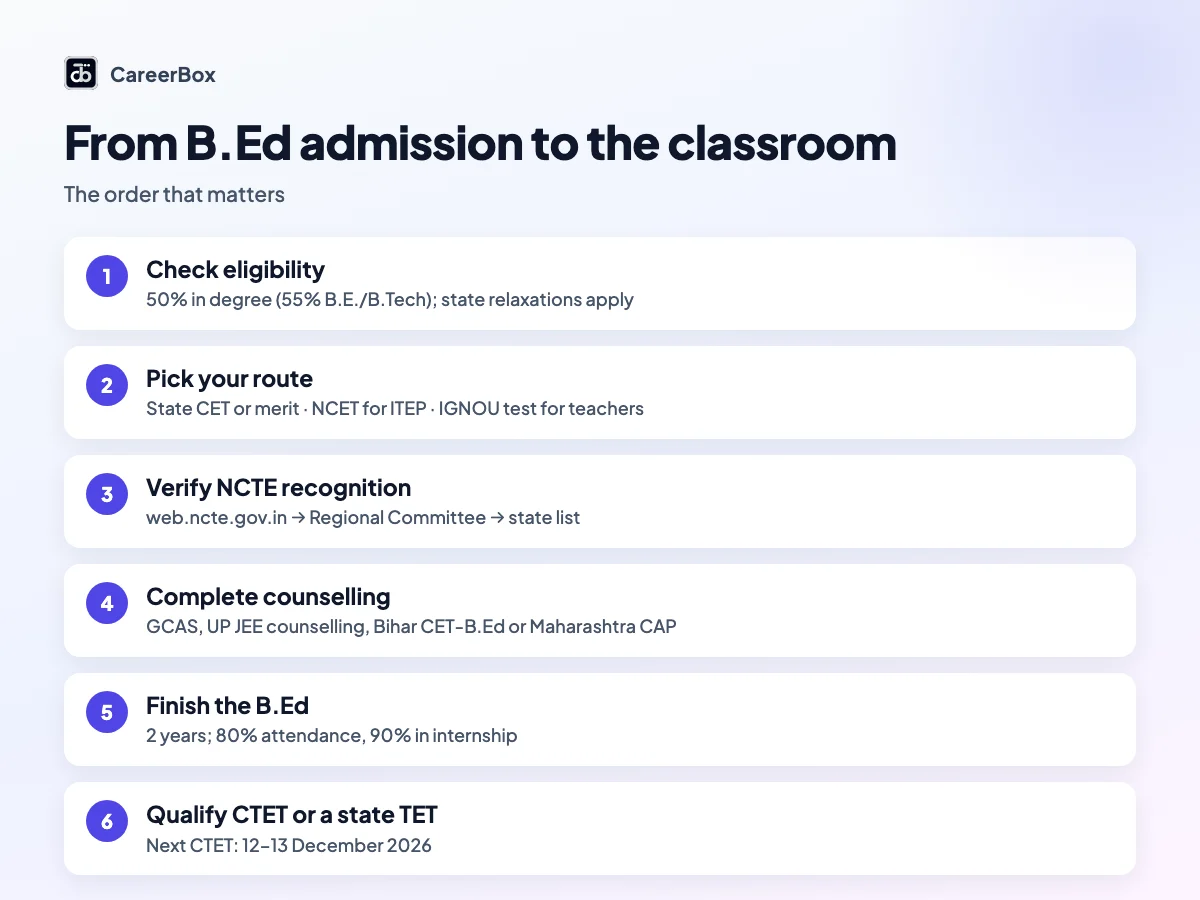
After B.Ed: CTET and state TETs
For teaching posts in schools covered by the RTE Act, NCTE makes passing a Teacher Eligibility Test (TET) one of the minimum qualifications, so a B.Ed alone is not enough. CBSE runs the Central Teacher Eligibility Test (CTET). Paper II is for people who want to teach Classes VI to VIII. The 22nd CTET will be held on 12 and 13 December 2026. Since NCTE's 2021 change, a TET certificate stays valid for life unless the government concerned says otherwise. States also run their own TETs.
Read our CTET guide and the news story CTET 2026 will be held on 12 and 13 December. On state TETs, see Tamil Nadu's special TET results and the Maharashtra TET leak chargesheet.
How to choose a B.Ed college: check NCTE recognition first
Check every college's NCTE recognition before you pay any fee:
- Open web.ncte.gov.in and go to Recognized Teacher Training Institutions.
- Choose the right Regional Committee. Gujarat and Maharashtra come under the Western (WRC), Uttar Pradesh under the Northern (NRC), and Bihar under the Eastern (ERC).
- Open your state's list. Check the college's name, its address and that B.Ed is listed with an intake.
- Look at the same committee's Withdrawal list as well, to make sure the college's recognition has not been withdrawn.
Then confirm the college appears in your state's counselling list. Compare colleges on CareerBox's B.Ed course page and education institutes on CareerBox. Follow the next cycle on CareerBox News.
Frequently asked questions
What is the eligibility for B.Ed admission 2026? Under NCTE's norms, you need at least 50% in a bachelor's and/or master's degree in Sciences, Social Sciences or Humanities, or 55% in B.E./B.Tech with Science and Mathematics. States relax this for reserved categories. UP and Maharashtra use 45% for SC/ST or reserved-category candidates.
Is there one national B.Ed admission test? Not for the 2-year B.Ed. Each state chooses its own method. The national test, NCET, is only for the 4-year ITEP.
Can I get IGNOU B.Ed admission in 2026 as a fresh graduate? No. You need 50% in your degree and must also be a trained in-service elementary teacher, or have completed an NCTE-recognised teacher education programme in face-to-face mode.
What is the IGNOU B.Ed fee and last date? ₹60,000 for the full programme (exam fees extra). For the January 2026 session, online registration was due by 27 February 2026; the January 2027 session had not been announced as of 14 October 2026.
Can I join ITEP without NCET? Not for 2026-27. NCTE's advisory of 17 June 2026 says no admission can be given to a candidate who did not appear in NCET 2026.
Do I need CTET after B.Ed? To teach Classes VI–VIII in schools that follow NCTE's TET rule, yes: you must pass CTET Paper II or the state TET. The next CTET is on 12 and 13 December 2026.
Sources
- NCTE Regulations 2014, Appendix-4: Norms and Standards for B.Ed — checked 14 October 2026
- NCTE (Recognition Norms and Procedure) (Amendment) Regulations, 2024 — transition to ITEP — checked 14 October 2026
- NCTE Gazette notification of 3 July 2025 extending the ITEP transition to 2026-27 — checked 14 October 2026
- NCTE: NCET information 2026 page — checked 14 October 2026
- NCTE advisory on ITEP admissions 2026-27 through NCET 2026 (17 June 2026) — checked 14 October 2026
- NTA public notice: NCET 2026 applications (12 February 2026) — checked 14 October 2026
- NTA public notice: NCET 2026 result (4 June 2026) — checked 14 October 2026
- NCET 2026 Information Bulletin (eligibility, scheme) — checked 14 October 2026
- NCTE list of ITEP institutions 2026-27 — checked 14 October 2026
- IGNOU: Bachelor of Education (B.ED) programme page — checked 14 October 2026
- IGNOU B.Ed e-Prospectus (eligibility, entrance, admission) — checked 14 October 2026
- IGNOU B.Ed admission portal, January 2026 session — checked 14 October 2026
- IGNOU advertisement: B.Ed entrance, January 2026 session — checked 14 October 2026
- IGNOU: Result of B.Ed Entrance Test 2026 — checked 14 October 2026
- GCAS Gujarat: B.Ed admission form-filling guidelines 2026-27 — checked 14 October 2026
- Bundelkhand University, Jhansi: UP B.Ed JEE 2026-28 — checked 14 October 2026
- Bihar CET-B.Ed 2026 portal (BRABU, nodal university) — checked 14 October 2026
- Bihar CET-B.Ed 2026 prospectus — checked 14 October 2026
- Maharashtra State CET Cell: MAH-B.Ed CET 2026 Information Brochure — checked 14 October 2026
- Maharashtra State CET Cell: final CET 2026 schedule (Higher Education) — checked 14 October 2026
- Maharashtra State CET Cell: B.Ed CAP 2026-27 admission schedule — checked 14 October 2026
- CBSE CTET public notice: 22nd CTET on 12–13 December 2026 — checked 14 October 2026
- CBSE CTET public notice: TET certificate validity for life (21 June 2021) — checked 14 October 2026
- CTET September 2026 Information Bulletin — checked 14 October 2026
- NCTE: Recognized teacher training institutions (regional committees) — checked 14 October 2026