
CLAT 2027: exam date, registration last date, eligibility, pattern, syllabus and how NLU counselling works
CLAT 2027 is on 6 December 2026 and applications close on 31 October 2026. Eligibility, fee, the 120-question pattern, syllabus, NLU counselling, last year’s closing ranks, GNLU’s Gujarat domicile quota and how AILET differs.

CLAT 2027 is the Common Law Admission Test run by the Consortium of National Law Universities for five-year integrated law (LL.B.) and LL.M. admission in the 2027-28 academic year. The Consortium fixed the date at its meetings of 18 July 2026 and announced it in a press release dated 22 July 2026. Everything below is taken from the Consortium's own pages and documents, read on 15 October 2026.
Key takeaways
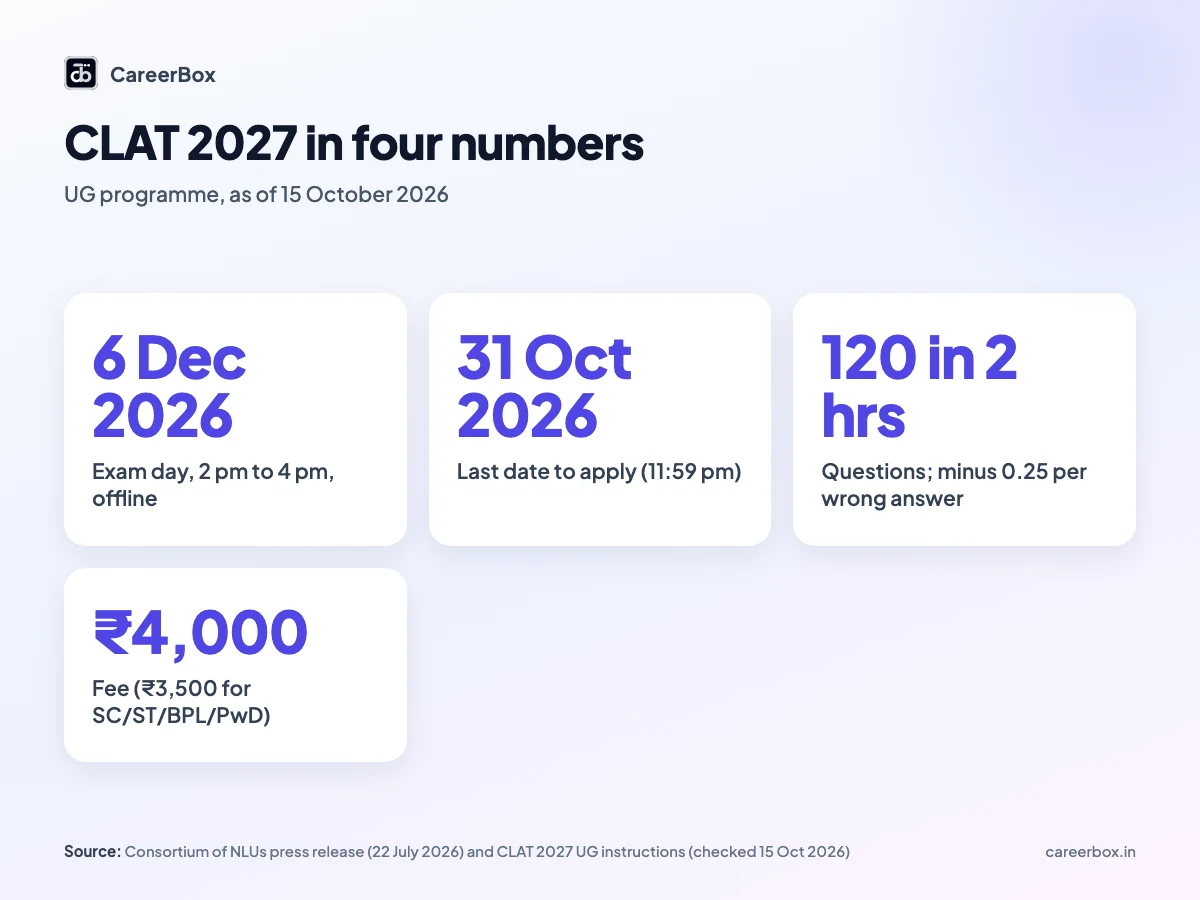
- Exam date: Sunday, 6 December 2026, 2:00 pm to 4:00 pm. Eligible PwD candidates get until 4:40 pm.
- Registration last date: 31 October 2026, 11:59 pm. The form must be complete and paid by then; incomplete forms are not considered.
- Fee: ₹4,000 for General/OBC (and NRI for PG); ₹3,500 for SC/ST/BPL/PwD. Past question papers cost ₹500 extra. The fee is non-refundable.
- Pattern (UG): 120 questions, 120 marks, 2 hours, minus 0.25 for every wrong answer, across five sections.
- Seats: 26 participating NLUs; NRI and foreign national seats are filled by each NLU directly.
- Counselling: the Consortium's FAQ says it will be held in December 2026/January 2027.
CLAT 2027 exam date and registration last date
| Item | CLAT 2027 (as of 15 October 2026) |
|---|---|
| Conducting body | Consortium of National Law Universities |
| Application window | 3 August 2026 to 31 October 2026 (11:59 pm) |
| Exam date and time | Sunday, 6 December 2026, 2:00 pm to 4:00 pm (PwD: to 4:40 pm) |
| Mode | Offline exam; application online only, at consortiumofnlus.ac.in |
| Admit card | Downloadable from your login; date not announced as of 15 October 2026 |
| Result date | Not announced as of 15 October 2026 |
| Counselling | December 2026/January 2027, as per the Consortium's FAQ |
| Application fee | ₹4,000 (General/OBC); ₹3,500 (SC/ST/BPL/PwD) |
| Courses | Five-year integrated LL.B. (UG) and LL.M. (PG), session 2027-28 |
The Consortium's UG instructions say the date is "subject to revision in case of necessity", so keep checking the site.
CLAT 2027 eligibility: who can apply
For the UG programme (official eligibility page):
- You need Class 12 (10+2) or an equivalent exam with 45% marks or the equivalent grade, or 40% if you are SC, ST or PwD.
- If you are writing Class 12 in March/April 2027, you can apply now. You must show proof of passing at the time of admission, or you lose the seat.
- There is no upper age limit.
- Indian nationals, NRIs, PIO and OCI card holders can take CLAT. Foreign nationals cannot; they apply to NLUs directly.
You can apply without a reservation certificate, but must produce it at admission (FAQ). If your documents don't match the category you claimed, you lose the reserved seat.
CLAT 2027 exam pattern and marking scheme
The UG question paper format is the same shape as the last few cycles:
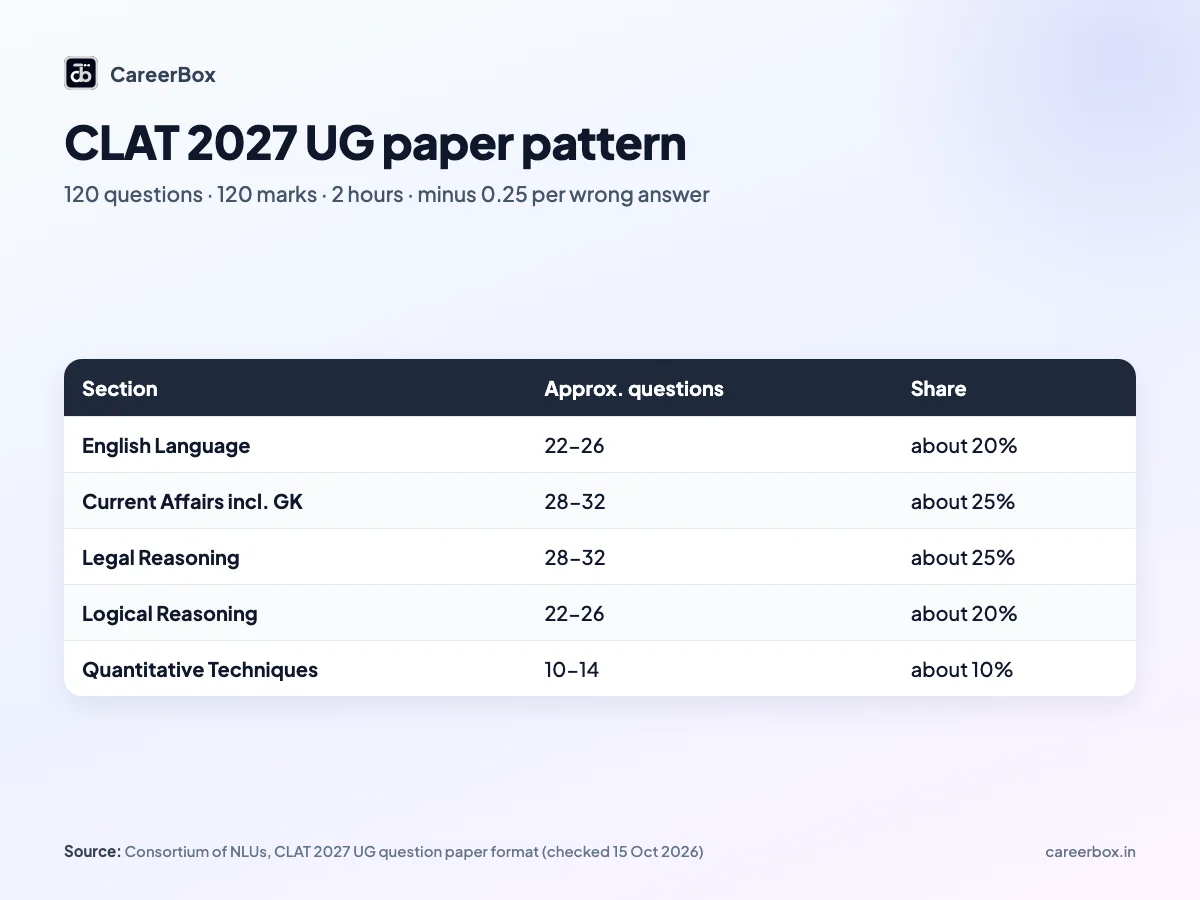
| Section | Approximate questions | Share of paper |
|---|---|---|
| English Language | 22-26 | about 20% |
| Current Affairs, including General Knowledge | 28-32 | about 25% |
| Legal Reasoning | 28-32 | about 25% |
| Logical Reasoning | 22-26 | about 20% |
| Quantitative Techniques | 10-14 | about 10% |
Each question carries one mark. A wrong answer costs 0.25 marks; a blank costs nothing. Ties are broken by higher Legal Aptitude marks, then higher age, then a computerised draw of lots.
CLAT 2027 syllabus: what each section tests
The Consortium calls the UG paper "a test of aptitude and skills" rather than prior knowledge. From its UG syllabus guide:
English Language. Passages of about 450 words that a Class 12 student can read in 5 to 7 minutes. Questions test the main point, inferences, summaries and word meanings in context.
Current Affairs, including General Knowledge. Passages from news and non-fiction on events in India and the world, arts and culture, international affairs and history. The FAQ says there is no fixed time frame for this section.
Legal Reasoning. Passages on legal situations, public policy or moral questions. You need no prior knowledge of law: you apply the rule in the passage to the facts.
Logical Reasoning. Questions on arguments: premises, conclusions, and what strengthens or weakens a claim.
Quantitative Techniques. Numerical information set out in text. The maths is Class 10 level: ratios, basic algebra, mensuration and statistical estimation.
How to fill the CLAT 2027 application form
- Register at consortiumofnlus.ac.in with your own mobile number and email ID, and verify the OTP.
- Fill the form. Spell your name and your parents' names exactly as on your mark sheets.
- Choose UG or PG and your category carefully. Once paid, you cannot change the programme, category or BPL field.
- Upload a passport photo, your signature and any SC/ST/OBC, PwD or BPL certificate, as PDF.
- Pay ₹4,000 or ₹3,500 online, plus bank charges.
- Submit before 11:59 pm on 31 October 2026. If you file two forms, only the last counts.
How NLU counselling and seat allotment work
CLAT itself gives you a rank. Seats are then allotted by the Consortium on merit-cum-preference: your All India Rank (AIR), your category and the order in which you list NLUs in your counselling form. That wording comes from the Consortium's own allotment lists.
Here is how the last cycle ran, based on the Consortium's CLAT 2026 documents:
- After the result, candidates filled a counselling form listing NLU preferences.
- The Consortium published five provisional allotment lists, one PDF per NLU per programme, from January 2026 to May 2026.
- Each list shows the AIR, category and any horizontal quota (women, PwD, state domicile) behind each seat, with a cut-off rank table.
- Students took admission at the allotted NLU with original certificates.
For CLAT 2027, the counselling notification, fee and round dates had not been announced as of 15 October 2026. Allotments are provisional, and NLUs can change seat numbers before the final allotment.
What is the cut-off for CLAT 2027? Last year's closing ranks
There is no CLAT 2027 cut-off yet, and there cannot be one before the exam. NLUs do not publish a qualifying mark for admission; what matters is the last rank admitted in your category at each NLU.
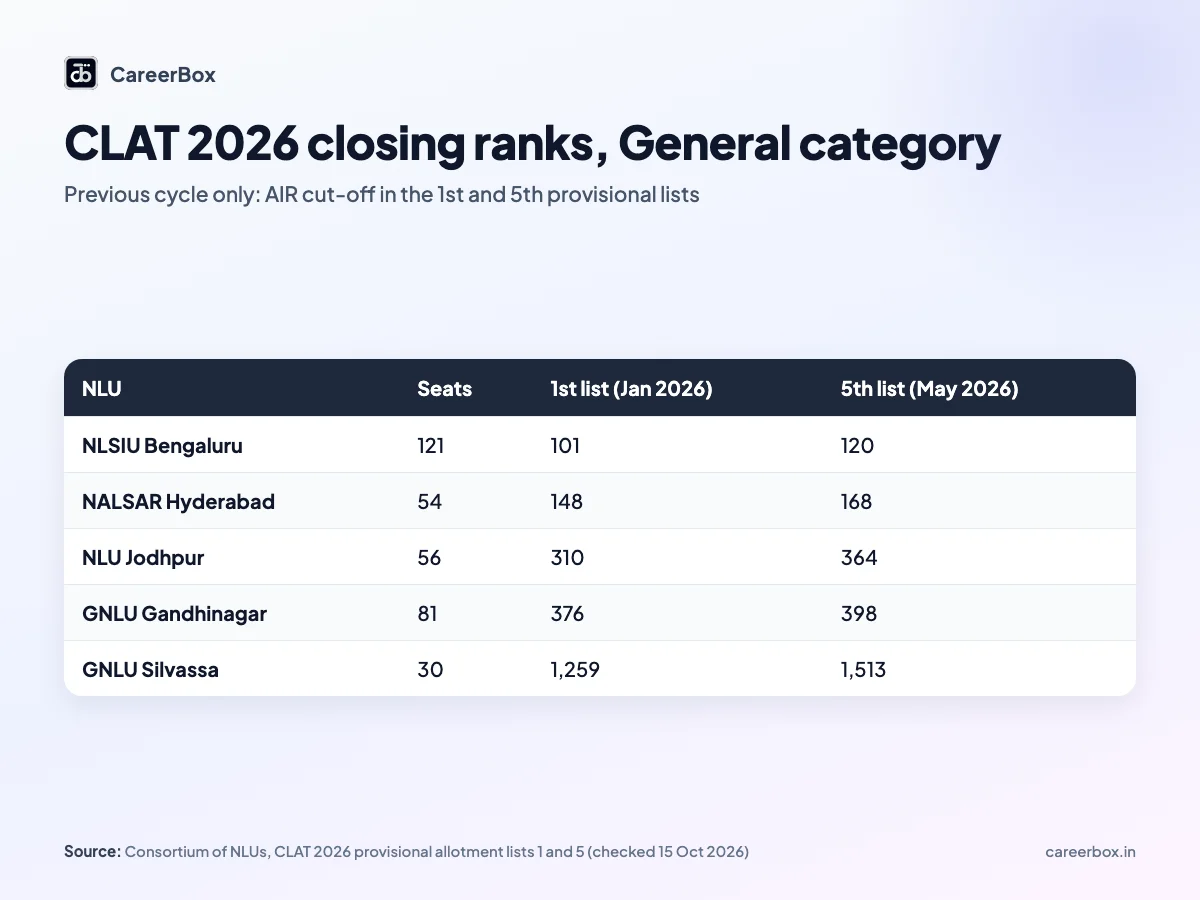
These are CLAT 2026 General category closing ranks from the Consortium's provisional allotment lists:
| NLU | CLAT 2026 General seats | 1st list closing AIR (Jan 2026) | 5th list closing AIR (May 2026) |
|---|---|---|---|
| NLSIU Bengaluru | 121 | 101 | 120 |
| NALSAR Hyderabad | 54 | 148 | 168 |
| NLU Jodhpur | 56 | 310 | 364 |
| GNLU Gandhinagar | 81 | 376 | 398 |
| GNLU Silvassa | 30 | 1,259 | 1,513 |
Reserved categories close further down: at GNLU Gandhinagar's 5th list, OBC closed at AIR 1,952, EWS 1,261 and SC 5,446. 2027 ranks will depend on the 2027 paper, so treat these as scale only.
GNLU Gandhinagar and the Gujarat domicile quota
Gujarat National Law University (GNLU), Gandhinagar takes its All India UG and LL.M. students through CLAT. Its CLAT 2027 brochure for the 2027-28 year lists five UG programmes: B.A. LL.B. (Hons.), B.Com. LL.B. (Hons.), B.Sc. LL.B. (Hons.), B.B.A. LL.B. (Hons.) and B.S.W. LL.B. (Hons.).
Seats allotted through CLAT at the Gandhinagar campus (UG): 176 in all. The vertical split is General 81, OBC (NCL) 43, SC 24, EWS 16 and ST 12.
Gujarat domicile: GNLU reserves 25% of seats for Gujarat domicile candidates as a horizontal quota. That is 40 UG seats and 13 LL.M. seats. It cuts across the vertical categories except EWS. Women get a 30% horizontal reservation (48 UG seats) and PwD candidates 5% (8 seats).
In CLAT 2026, the Gujarat domicile quota at GNLU Gandhinagar closed at AIR 3,620 in the first list and AIR 3,940 in the fifth list, against AIR 398 for an open General seat. Gujarat students should mark domicile correctly and keep the certificate ready.
Fees for 2027-28: a first-year UG total of ₹2,72,000 including mess (tuition ₹1,32,000), plus a one-time ₹17,000.
GNLU Silvassa in Dadra and Nagar Haveli and Daman and Diu offers B.A. LL.B. (Hons.) with 66 CLAT seats. Its 25% domicile quota is for DNH and DD candidates, not Gujarat. More on the GNLU Gandhinagar page on CareerBox.
CLAT PG 2027 for LL.M. admission
CLAT PG 2027 is on the same date and has the same last date and fee. Eligibility is an LL.B. or equivalent with 50% (45% for SC/ST/PwD); final-year LL.B. students of 2027 can apply. There is no upper age limit.
The paper has 120 objective questions of one mark in two hours, with the same 0.25 negative marking and no descriptive section. Questions are built on extracts from judgments, statutes and regulations. The PG syllabus covers Constitutional Law and the other compulsory LL.B. subjects, from Contract and Torts to Tax and Labour Law. See our CLAT PG exam page and LL.M. course guide.
CLAT vs AILET 2027: what is different
The All India Law Entrance Test (AILET) is National Law University Delhi's own exam. NLU Delhi does not admit through CLAT.
| CLAT 2027 (UG) | AILET 2027 (B.A. LL.B.) | |
|---|---|---|
| Run by | Consortium of NLUs | National Law University Delhi |
| Exam date | 6 December 2026, 2-4 pm | 13 December 2026, 2-4 pm |
| Last date to apply | 31 October 2026 | 10 November 2026 |
| Questions / time | 120 in 120 minutes | 150 in 120 minutes |
| Sections | English, Current Affairs and GK, Legal Reasoning, Logical Reasoning, Quantitative Techniques | English (50), Current Affairs and GK (30), Logical Reasoning (70) |
| Negative marking | 0.25 per wrong answer | 0.25 per wrong answer |
| Fee | ₹4,000 / ₹3,500 | ₹3,000 / ₹1,000 (SC/ST/PwD); BPL SC/ST and women exempt |
| Seats | 26 NLUs | 110 B.A. LL.B. seats on AILET merit |
AILET's admission notice of 7 August 2026 asks for 45% in Class 12 (42% OBC, 40% SC/ST). Ahmedabad is one of its test cities. On the AILET pattern page, Logical Reasoning carries 70 of 150 marks and also breaks ties, so the paper leans heavily on reasoning. AILET also has no Legal Reasoning or Quantitative section. AILET gives less time per question for far fewer seats. The two dates do not clash, so you can write both. Read more on our AILET exam page.
Frequently asked questions
When should I apply for CLAT 2027?
Now. The window opened on 3 August 2026 and closes at 11:59 pm on 31 October 2026. Don't wait for the last evening; the Consortium says it is not responsible for last-minute problems.
What is the CLAT 2027 exam date?
Sunday, 6 December 2026, from 2:00 pm to 4:00 pm (4:40 pm for eligible PwD candidates), as per the Consortium's press release of 22 July 2026.
What is the cutoff for CLAT 2027?
It is not out, and closing ranks only exist after allotment. For scale, in CLAT 2026 the General category closed at AIR 120 at NLSIU Bengaluru and AIR 398 at GNLU Gandhinagar in the fifth list.
Is 40 a good score in CLAT?
On a 120-mark paper, 40 is a third of the maximum. With negative marking, 40 could mean 40 right and none wrong, or 48 right and 32 wrong. Whether it gets you an NLU seat depends on your rank and category, and the Consortium does not publish a score-to-rank table before results.
Will CLAT 2027 be tough?
The format is unchanged: 120 passage-based questions in 120 minutes. Time is the real pressure; the maths stays at Class 10 level.
Which is harder, AILET or CLAT?
AILET gives 150 questions in 120 minutes and has 110 merit seats at one university. CLAT gives 120 questions in 120 minutes for seats across 26 NLUs. AILET is weighted towards Logical Reasoning; CLAT has Legal Reasoning and Quant sections that AILET does not.
Is there an age limit for CLAT 2027?
No. There is no upper age limit for either CLAT UG or CLAT PG.
Where to go next
- Exam overview: CLAT on CareerBox
- The degree itself: five-year integrated LL.B. course guide
- Explore the field: law stream on CareerBox
- Top NLU profiles: NLSIU Bengaluru and GNLU Gandhinagar
- Where a law degree can lead in Gujarat: Gujarat High Court names 60 law graduates as legal assistants
- Latest updates: CareerBox News
Sources
All checked on 15 October 2026.
- Consortium of NLUs: CLAT 2027 press release (22 July 2026): consortiumofnlus.ac.in/clat-2027/notifications/Press_Release_CLAT_2027.pdf
- CLAT 2027 UG instructions (dates, fee, documents, tie-break): consortiumofnlus.ac.in/clat-2027/ug-instructions.html
- CLAT 2027 UG eligibility, question format and syllabus guide: consortiumofnlus.ac.in/clat-2027/ug-eligibility.html, consortiumofnlus.ac.in/clat-2027/ug-question-format.html, consortiumofnlus.ac.in/clat-2027/ug-syllabus.html
- CLAT 2027 PG eligibility, question format and syllabus: consortiumofnlus.ac.in/clat-2027/pg-eligibility.html, consortiumofnlus.ac.in/clat-2027/pg-question-format.html, consortiumofnlus.ac.in/clat-2027/pg-syllabus.html
- CLAT 2027 FAQs (counselling timing): consortiumofnlus.ac.in/clat-2027/FAQs.html
- GNLU admission brochure for CLAT 2027 (seats, domicile quota, fees): consortiumofnlus.ac.in/clat-2027/nlus/brochure/GNLU.pdf
- Consortium of NLUs: CLAT 2026 provisional allotment lists 1 and 5
- National Law University Delhi: AILET 2027 notification (23 July 2026) and admission notice (7 August 2026): nationallawuniversitydelhi.in/notification/AILET_2027.pdf
- National Law University Delhi: AILET 2027 B.A. LL.B. test pattern: nationallawuniversitydelhi.in/ballb/exam-details.html
Dates and rules can change. Confirm them on consortiumofnlus.ac.in before you act.
More to read
All articles
CAT exam 2026: date, admit card, pattern, syllabus, fees, eligibility and what happens after the exam
Oct 15, 202613 min read
UGC NET December 2026: exam dates, application, syllabus, eligibility, cut-offs and how JRF works
Oct 15, 202614 min read
B.Ed admission 2026: entrance tests, eligibility, the new 4-year ITEP and IGNOU B.Ed, state by state
Oct 14, 202613 min read
B.Pharm vs D.Pharm vs Pharm.D in 2026: Course, Duration, Eligibility, Syllabus, Fees and Careers
Oct 14, 202612 min read
MBBS admission 2026 in India: from NEET UG to your seat, with AIQ, state quota and the Gujarat process step by step
Oct 14, 202612 min read
NEET PG Counselling 2026: MCC Schedule, Rounds, Registration, Security Deposit and State Quota Explained
Oct 14, 202613 min read