
MBBS Course in India
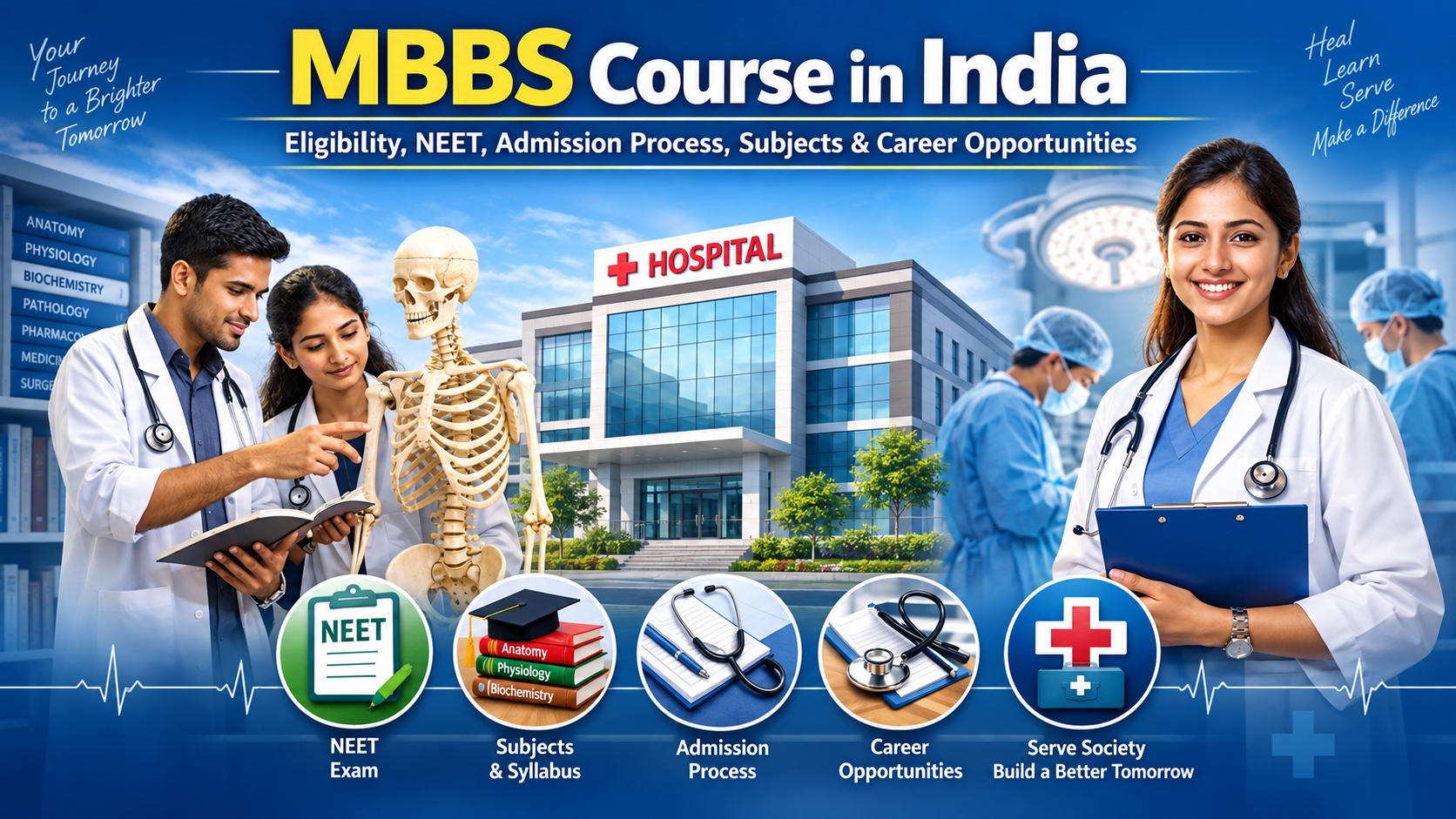
MBBS Course in India
Guidance With Eligibility, NEET UG Counselling, Curriculum, Documentation & Career Opportunities
MBBS (Bachelor of Medicine and Bachelor of Surgery) is one of the most prestigious and respected professional degrees in the field of Health Care. Every year thousands of students in India aspire to become doctors and serve society through healthcare.
In this article, we cover complete details about the MBBS course, eligibility criteria, admission process, required documents, study system, internship and career opportunities after MBBS.
What is MBBS?
MBBS stands for Bachelor of Medicine and Bachelor of Surgery.
It is an undergraduate medical degree that trains students to become qualified medical doctors. During the course, students study the structure of the human body, diseases, diagnosis methods, treatment procedures, medicines, and patient care.
After completing MBBS and internship, a student becomes eligible to register as a doctor and practice medicine.
MBBS Course Duration in India
The duration of the MBBS course in India is 5.5 years.
This includes:
- 4.5 Years Academic Study — Students learn theoretical and clinical medical subjects.
- 1 Year Compulsory Internship — Students work in different hospital departments and gain practical experience in treating patients.
After successful completion, the student receives the MBBS Degree.
MBBS Eligibility Criteria in India
Students must fulfil the following eligibility requirements to study MBBS in India.
1. Educational Qualification
- Student must pass 12th Science with Physics, Chemistry and Biology (PCB)
- English must be a compulsory subject
- Board must be recognised (CBSE, State Board, ICSE etc.)
2. Minimum Marks Required
| Category | Minimum Marks in PCB |
|---|---|
| General | 50% |
| OBC / SC / ST | 40% |
| PwD (General) | 45% |
3. Entrance Exam
Admission to MBBS in India is through the NEET (National Eligibility cum Entrance Test). 🔗 neet.nta.nic.in
Students must qualify NEET in the same academic year to get admission in:
- Government Medical Colleges
- Private Medical Colleges
- Deemed Universities
4. Age Limit
- Minimum Age: 17 Years (by 31 December of admission year)
- Maximum Age: No fixed limit currently (as per latest NEET rules)
5. Nationality
The following students can apply:
- Indian Citizens
- NRI Students
- OCI / PIO Candidates
Documents Required for MBBS Admission in India
Students must submit the following documents during counselling and admission:
- NEET Scorecard
- NEET Admit Card
- 10th Marksheet (Date of Birth Proof)
- 12th Marksheet (PCB subjects proof)
- Transfer Certificate (TC) or School Leaving Certificate (if applicable)
- Migration Certificate (if board is different)
- Caste Certificate (SC / ST / OBC / EWS — if applicable)
- OBC Non-Creamy Layer Certificate
- Aadhaar Card or Photo ID Proof
- Passport Size Photographs
- Domicile Certificate (for State Quota)
- Medical Fitness Certificate
Additional Documents for NRI Candidates
Apart from regular documents, NRI candidates must submit additional proofs:
- Valid Passport of Student or NRI Sponsor
- Work Permit / PR / OCI / Citizenship proof of sponsor
- NRI Sponsorship Affidavit
- Relationship Certificate with Sponsor
- Embassy Certificate confirming NRI status
- Address Proof of Sponsor Abroad
⚠️ Important: NRI students must also qualify the NEET exam for MBBS admission in India.
MBBS Admission Process in India (Step by Step)
Step 1: Qualify NEET UG Exam
Students must pass 12th Science (PCB) and qualify the NEET UG entrance exam.
Step 2: Register for Counselling
Qualified students must register for counselling through:
Medical Counselling Committee (MCC) — 🔗 mcc.nic.in
- 15% All India Quota Seats
- 100% AIIMS Institutes Seats
- 100% Deemed Universities Seats
- 100% National Institutes Seats
State Counselling Authorities — 🔗 medadmgujarat.org
- 85% State Quota seats in Government Colleges
- 100% seats in Private Medical Colleges (Including all types of Quota seats like GQ, MQ and NRI)
Step 3: Choice Filling
Students select preferred medical colleges and courses during counselling.
Step 4: Seat Allotment
Seats are allotted based on:
- NEET Rank
- Category
- Seat Availability
Step 5: Document Verification & Admission
Students must:
- Submit documents
- Pay college fees
- Confirm admission
MBBS Subjects Year-Wise (Curriculum)
The MBBS syllabus is divided into Pre-Clinical, Para-Clinical and Clinical subjects.
First Year MBBS Subjects (Pre-Clinical)
Students study basic structure and functions of the human body.
- Anatomy
- Physiology
- Biochemistry
Second Year MBBS Subjects (Para-Clinical)
Focus on disease causes and medicines.
- Pathology
- Microbiology
- Pharmacology
- Forensic Medicine
Third Year MBBS Subjects
Students start clinical exposure.
- Community Medicine
- Ophthalmology
- Otorhinolaryngology (ENT)
Final Year MBBS Subjects
Students learn diagnosis and treatment of diseases.
- General Medicine
- General Surgery
- Obstetrics and Gynaecology
- Pediatrics
- Orthopedics
- Dermatology
- Psychiatry
- Radiology
MBBS Internship (1 Year)
After completing academic study, students must complete a 1 year compulsory internship in hospitals.
During internship they work in departments such as:
- Medicine
- Surgery
- Pediatrics
- Emergency
- Community Health
This provides practical medical experience before becoming a doctor.
What to Do After MBBS?
After completing MBBS and internship, students must register with the National Medical Commission (NMC) 🔗 nmc.org.in or State Medical Council 🔗 gmcgujarat.org to practice as a doctor.
Students can then choose different career paths.
Career Opportunities After MBBS
MBBS graduates have many career opportunities.
Postgraduate Study
Students can specialise by studying after MBBS:
- MD (Doctor of Medicine)
- MS (Master of Surgery)
After MBBS, students must qualify the NEET PG exam for Postgraduate Study. 🔗 nbe.edu.in
Super Speciality Courses
After MD/MS, students can pursue:
- DM (Doctorate of Medicine)
- MCh (Master of Chirurgiae)
Job and Practice Opportunities
- Government Medical Officer — Doctors can work in State and National Health departments. 🔗 mohfw.gov.in
- Government Hospital Doctor — Doctors can work in government hospitals through state or central government exams. 🔗 arogyasathi.gujarat.gov.in
- Private Hospital Doctor — Work as Resident Doctor or Consultant in private hospitals.
- General Practitioner — Start a private medical clinic and treat patients.
- Hospital Administration — Study MBA in Hospital Management.
- Medical Research — Work in research institutes or clinical trials.
- Medical Professor / Lecturer — After postgraduate study, teach in medical colleges.
- Public Health Career — Study MPH (Master of Public Health).
Work Abroad
Doctors can practice abroad after clearing licensing exams:
| Country | Exam | Website |
|---|---|---|
| United States | USMLE | usmle.org |
| United Kingdom | PLAB | gmc-uk.org |
| Canada | MCCQE | mcc.ca |
| Australia | AMC Exam | amc.org.au |
| New Zealand | NZREX | mcnz.org.nz |
| Germany | FSP Exam | isz.uni-heidelberg.de |
Other Career Options
- Medical Writing
- Medical Advisor in Pharmaceutical Companies
- Armed Forces Medical Services (Army Doctor)
Conclusion
MBBS is one of the most respected professional degrees in the world. It provides students with knowledge, clinical skills and opportunities to serve society through healthcare. With the right dedication and hard work, MBBS graduates can build successful careers in clinical practice, research, education, public health, or even work internationally.