
PM Vidyalaxmi scheme: collateral-free education loan, 3% interest subvention, college list and how to apply
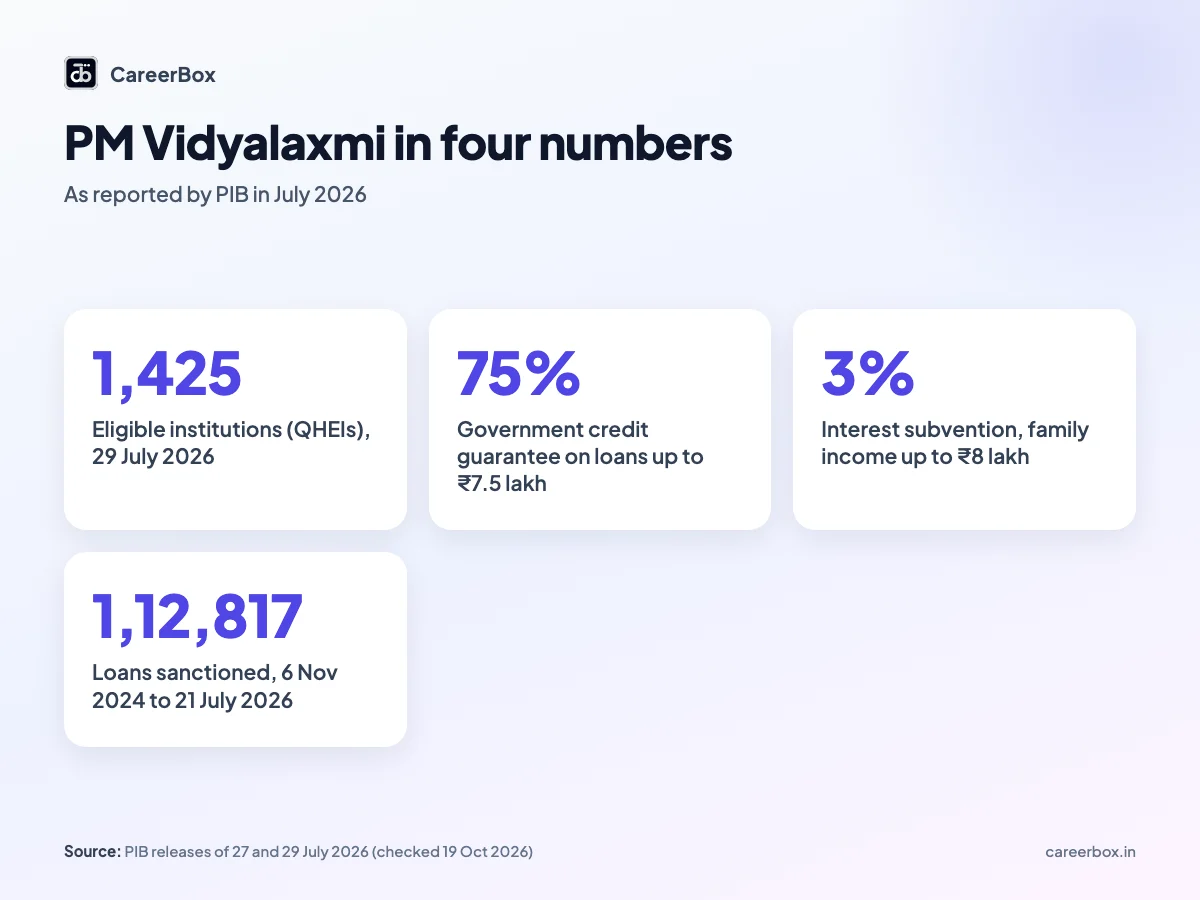
PM Vidyalaxmi gives students with merit admission in 1,425 NIRF-based institutions an education loan with no collateral or guarantor, a 75% government guarantee up to ₹7.5 lakh and 3% interest subvention for family income up to ₹8 lakh. Eligibility, the college list, documents, the portal steps, CSIS and Gujarat options.

This guide to the PM Vidyalaxmi scheme uses Press Information Bureau (PIB) releases up to 29 July 2026 and the PM-Vidyalaxmi portal, its FAQ and user manual, checked on 19 October 2026. Bank interest rates differ and change, so treat the bank's own sanction letter as the final word on cost.
Key takeaways
- Who runs it: the Department of Higher Education, Ministry of Education. It is a Central Sector scheme with an outlay of ₹3,600 crore from 2024-25 to 2030-31.
- No collateral, no guarantor, no fixed ceiling: the loan can cover tuition, hostel, mess, a reasonable laptop and living costs, and students from every income group may apply.
- 75% credit guarantee: the Government of India guarantees 75% of the default on loans up to ₹7.5 lakh, through the National Credit Guarantee Trustee Company (NCGTC).
- 3% interest subvention: for family income up to ₹8 lakh, on loans up to ₹10 lakh, during the course plus one year. Capped at 1 lakh fresh students a year.
- Rate cap: interest is capped at the bank's External Benchmark Lending Rate (EBLR) plus 0.5%, and repayment can run up to 15 years after the moratorium.
- Merit seats only: management quota and NRI quota admissions do not get PM Vidyalaxmi benefits.
- Uptake so far: 1,12,817 PM Vidyalaxmi loans worth ₹15,634.78 crore were sanctioned from 6 November 2024 to 21 July 2026.
What is the PM Vidyalaxmi scheme, and under which ministry?
PM Vidyalaxmi (Pradhan Mantri Vidyalaxmi) is a Central Sector scheme of the Department of Higher Education, Ministry of Education. The Cabinet release of 6 November 2024 says it grew out of the National Education Policy 2020, which asked for financial help for meritorious students in public and private institutions.
The PM-Vidyalaxmi portal has worked since 25 February 2025. Canara Bank built and runs it for the Department of Higher Education, with the Department of Financial Services and the Indian Banks' Association (IBA). As of the 27 July 2026 Lok Sabha reply, 12 public sector banks, 20 private banks, 25 Regional Rural Banks and 7 cooperative banks were on the portal.
PM Vidyalaxmi eligibility: who can get the loan
Per PIB's 29 July 2026 backgrounder, you qualify if:
- you secured merit-based admission, through a competitive exam or the merit quota, in a designated QHEI in India;
- the course is any degree or diploma programme (there is no limit on the number of students who can get the loan);
- you register with Aadhaar, stay enrolled and keep up satisfactory academic performance.
You lose the benefits if you drop out midway or are expelled for disciplinary or academic reasons. The interest subvention and the credit guarantee are available only once: for one undergraduate, postgraduate or integrated course.
The student manual adds a practical point. If your institute is not a QHEI, or you came in through management or NRI quota, and you need more than ₹7.5 lakh, the bank will ask for collateral. Vocational and skill development loans on the portal are capped at ₹7.5 lakh.
PM Vidyalaxmi college list: how QHEIs are chosen from NIRF
The institution list comes from the National Institutional Ranking Framework (NIRF). The backgrounder sets three rules. A college is a QHEI if it is:
| Rule | Who it covers |
|---|---|
| Top 100 in NIRF | Government and private HEIs ranked in the top 100 overall, in any category or in any subject (domain) ranking |
| Top 200 in NIRF | HEIs run by state or Union Territory governments |
| Central government HEIs | Every remaining institution governed by the Government of India |
The scheme began with 860 QHEIs in November 2024 and covered 1,425 by 29 July 2026. The list is redone each year from the latest NIRF results. Indian campuses of foreign universities, foreign campuses of Indian institutions and foreign institutions are not covered.
How to check your college: the portal home page has a "List of PM Vidyalaxmi Institutes" button showing each QHEI by AISHE code, state and management type. The user manual also links the AISHE directory of QHEIs. Search by your college's AISHE code, not just its name, because many colleges share similar names.
Interest subvention under PM Vidyalaxmi and PM-USP CSIS
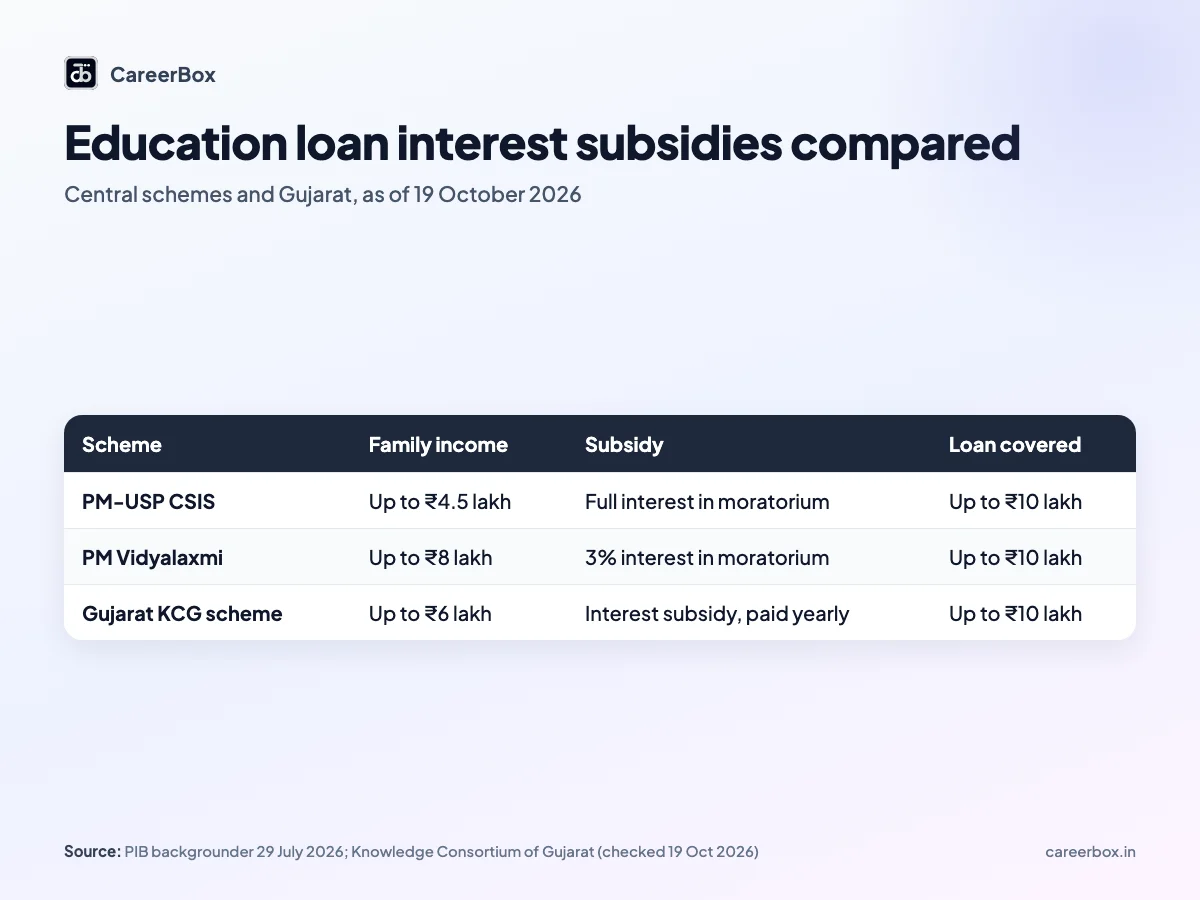
Two subsidies run through the same portal: the 3% PM Vidyalaxmi subvention and the older PM-USP Central Sector Interest Subsidy (CSIS), for which Canara Bank is the nodal bank receiving claims.
| Point | PM-USP CSIS | PM Vidyalaxmi |
|---|---|---|
| Family income | Up to ₹4.5 lakh | Up to ₹8 lakh |
| Subsidy | Full interest during moratorium | 3% interest during moratorium |
| Loan covered | Up to ₹10 lakh | Up to ₹10 lakh |
| Courses | Technical or professional, NAAC or NBA accredited or regulator-approved | All degree and diploma courses at QHEIs |
| Slots | No limit | 1 lakh fresh students a year |
The moratorium is the course period plus one year. On a bigger loan, the 3% applies only to the first ₹10 lakh disbursed. You cannot get either subsidy if you already take any other central or state scholarship, interest subvention or fee reimbursement.
Who gets priority? If more than 1 lakh students apply in a year, the portal FAQ sets this order: admission in a government HEI, then technical or professional courses, then Class 12 from a government school, then Class 10 from a government school, then Class 12 from a rural school, then girl students. From the second year, the subsidy depends on satisfactory academic results.
How to apply for PM Vidyalaxmi online (step by step)
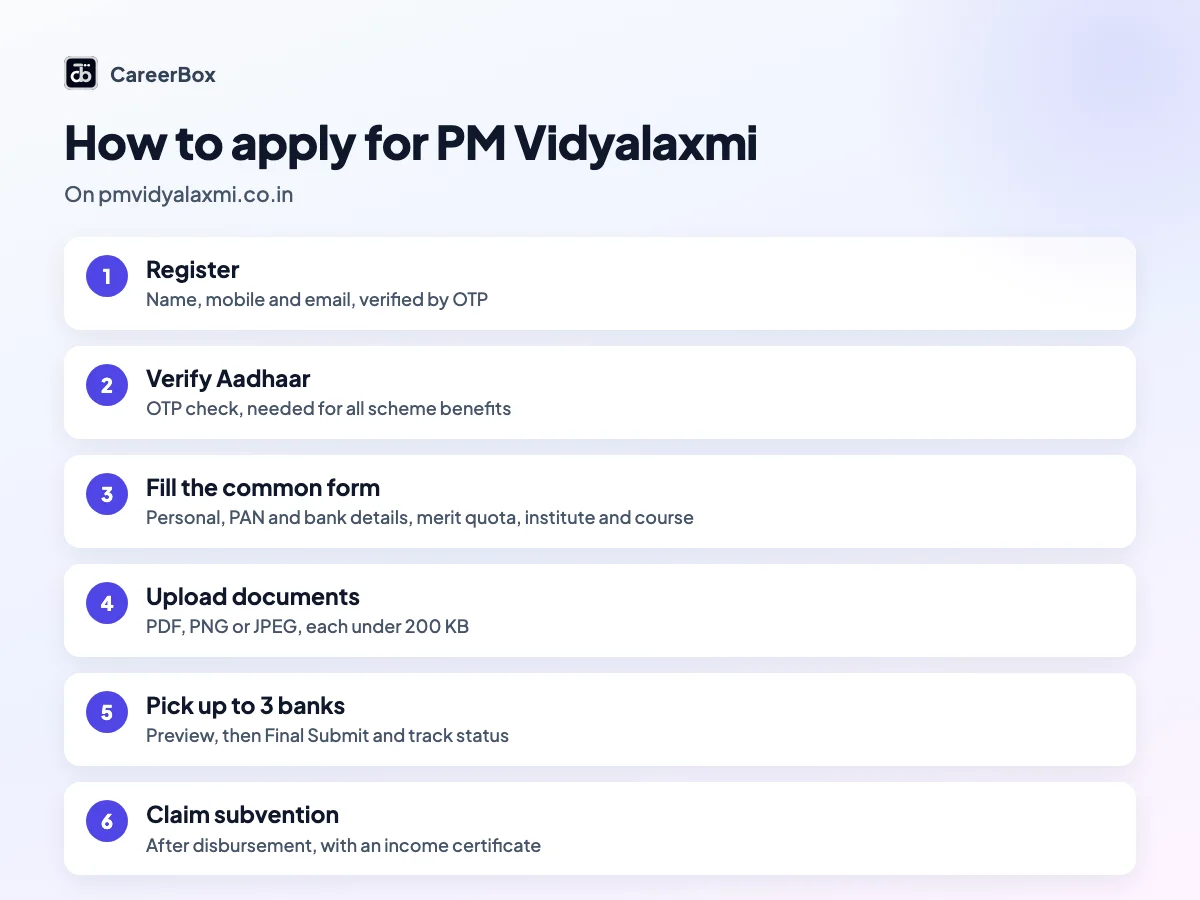
The steps below follow the official student user manual:
- Register: on Student Login, choose Create an Account and enter your name, mobile number, email ID and password. Verify both OTPs to get a Student ID.
- Log in: use your email ID, password and an OTP.
- Aadhaar authentication: under Apply for Education Loan, verify Aadhaar by OTP. You can skip it, but Aadhaar is compulsory for the loan benefits, the subvention and the credit guarantee.
- Personal details: check the details pulled from Aadhaar, pick your Class 10 and 12 schools, verify your PAN (name and date of birth must match) and add one bank account.
- Course details: choose Merit quota exactly as your allotment letter says. Pick your institute by state and district, then the course, duration and start date.
- Cost of course: enter the full cost from the institute's fee schedule, minus any scholarship or own funds. The balance is your loan required. Repayment can run up to 180 monthly instalments.
- Upload documents as PDF, PNG or JPEG, each under 200 KB.
- Choose up to 3 banks and their branches, preview the form and click Final Submit.
You can keep one active application at a time. You can withdraw it only while it says "Submitted"; once a bank acts on it, you must ask that branch to close it. Statuses include Submitted, Reqinfo, In process, Sanctioned, Disbursed, Rejected and Closed. The PM-Vidyalaxmi FAQ calls the form a two-page Common Education Loan Application Form used by all banks.
Documents required for PM Vidyalaxmi
From the FAQ and the official scheme leaflet:
- PAN card when you apply, and Aadhaar before disbursement
- Class 10 and Class 12 mark sheets (or last qualifying exam or diploma; semester-wise for graduates)
- Admission or offer letter
- Schedule of expenses from the institute
- Passport-size colour photo of the student, and of the parent or co-applicant if needed
- Income certificate from a competent authority, such as a Tehsildar or SDM, or the institute's Annexure-6; needed only if you claim interest subvention
What happens after you apply: bank processing and disbursement
The portal does not lend money. Each bank checks your documents, does its own due diligence and decides. After sanction, the bank pays the institute directly. You do not need an existing account with that bank, but after sanction it will ask you, or you with a parent, to open a savings account at that branch.
On timing, the official word is old: a PIB reply of 3 August 2018 said IBA guidelines ask banks to dispose of education loan applications within 15 to 30 days in the normal course. PM Vidyalaxmi sets no faster deadline.
Claiming the subsidy: after sanction and disbursement, open Apply for Interest Subvention, validate Aadhaar and upload the income certificate. Approved students get an SMS to install the PM-Vidyalaxmi Digital Rupee App, an e-rupee (CBDC) wallet run as a Reserve Bank of India pilot. The government credits the subsidy to that wallet, and you approve its transfer to your loan account. The leaflet gives you 30 days each year to do this. Your bank files the claim. For loans of 2025-26, the claim window runs from 1 September to 31 December 2026, per the portal notice checked on 19 October 2026.
PM Vidyalaxmi vs Vidya Lakshmi: what changed
The old Vidya Lakshmi portal (vidyalakshmi.co.in) was launched on 15 August 2015 and run by NSDL e-Governance, per a PIB release of 20 August 2015. When we tried on 19 October 2026, the old address did not load. The new portal calls itself the "exclusive and unified portal" for education loans from all bank types, in India and abroad. Abroad loans are ordinary bank loans: PM Vidyalaxmi benefits cover only QHEIs in India.
Gujarat students: KCG interest subsidy, MYSY and PM Vidyalaxmi
Gujarat runs its own Interest Subsidy Scheme on Education Loan through the Knowledge Consortium of Gujarat (KCG). Its page lists these conditions:
- Class 12 passed with 60 percentile or more
- Family income up to ₹6 lakh
- Loan taken from a scheduled bank on or after 4 July 2017 for higher education
- No benefit taken under any other government scheme
The subsidy covers loans up to ₹10 lakh and is deposited in your loan account after 31 March each year. Since both Gujarat's scheme and the central subsidies bar other government help, you will usually have to choose one, so compare what each pays on your loan. If you hold MYSY or a Digital Gujarat scholarship, you can still take a PM Vidyalaxmi loan. The interest subvention is a different matter: PIB's backgrounder of 29 July 2026 says it is not available to students who get a state scholarship or fee reimbursement. MYSY is not named in it, so ask your bank how the rule applies to you before you count on the subvention. For study abroad, see Gujarat's foreign study loans in our study abroad scholarships guide.
Frequently asked questions
What interest subvention scheme is available under the Pradhan Mantri Vidyalaxmi scheme?
A 3% interest subvention during the course plus one year, on loans up to ₹10 lakh, for families earning up to ₹8 lakh a year. Families up to ₹4.5 lakh in technical or professional courses get full interest paid under PM-USP CSIS instead.
How much education loan can I get under PM Vidyalaxmi?
There is no fixed ceiling. The amount depends on your institute's fees plus hostel, mess, a laptop and living costs. The 75% guarantee covers loans up to ₹7.5 lakh, and the 3% subvention applies to the first ₹10 lakh.
How much education loan can I get for MDS?
PM Vidyalaxmi does not set amounts per course. If your MDS seat is a merit seat in a listed QHEI, the bank can fund the full fee schedule without collateral; management quota seats are excluded.
Can I get a 100% student loan?
For merit admissions in a QHEI, the scheme lets banks cover the full tuition and related costs. On the portal, the loan required equals total cost minus any scholarship or own funds you enter.
What is the interest rate on a PM Vidyalaxmi loan?
Each bank sets its own rate, capped at that bank's EBLR plus 0.5%. Check the bank's website before you choose; banks may give up to 1% more off if you pay the interest during the study and moratorium period.
How long does Vidyalakshmi loan approval take?
No portal deadline exists. A 2018 PIB reply said IBA guidelines ask banks to decide within 15 to 30 days of a complete application, so no rule promises a loan in 3 days.
Is PM Vidyalaxmi available for study abroad?
No. The scheme covers QHEIs in India only. You can still apply for an ordinary abroad education loan through the same portal.
Where to go next
- Central scholarships: NSP scholarship 2026-27 guide
- Gujarat's merit scheme: MYSY scholarship 2026-27 guide
- Gujarat state scholarships: Digital Gujarat scholarship 2026-27 guide
- Going abroad: scholarships for Indian students, 2027-28 deadlines
- Where to study: engineering colleges in India
- Latest updates: CareerBox News
Sources
All checked on 19 October 2026.
- PIB: Cabinet approves PM-Vidyalaxmi (6 November 2024): pib.gov.in/PressReleasePage.aspx?PRID=2071131
- PIB: PM-Vidyalaxmi Portal for Higher Education Loans, Lok Sabha reply (27 July 2026): pib.gov.in/PressReleasePage.aspx?PRID=2290079
- PIB: PM Vidyalaxmi Scheme backgrounder (29 July 2026): pib.gov.in/PressReleasePage.aspx?PRID=2290972
- PIB: backgrounder PDF: static.pib.gov.in/WriteReadData/specificdocs/documents/2026/jul/doc2026729936401.pdf
- PM-Vidyalaxmi portal: home page, notice and counters: pmvidyalaxmi.co.in
- PM-Vidyalaxmi portal: About Scheme: pmvidyalaxmi.co.in/AboutScheme.aspx
- PM-Vidyalaxmi portal: FAQ: pmvidyalaxmi.co.in/PublicFaq.aspx
- PM-Vidyalaxmi: Student User Manual: pmvidyalaxmi.co.in/img/UserManual-Student.pdf
- PM-Vidyalaxmi: scheme leaflet (English): pmvidyalaxmi.co.in/img/Scheme_Leaflet.pdf
- AISHE: directory of PM Vidyalaxmi institutions: dashboard.aishe.gov.in/hedirectory/#/hedirectory/vidhyaLakshmi/All
- Department of Higher Education: scholarships and education loan bureau: dohe-education.gov.in/department/our-bureaus/details/scholarships-education-loan-MDO2AjMtQWa
- NIRF: nirfindia.org
- PIB: Vidya Lakshmi portal launched (20 August 2015): pib.gov.in/newsite/PrintRelease.aspx?relid=126195
- PIB: Vidyalakshmi Portal for Education Loan (3 August 2018): pib.gov.in/PressReleasePage.aspx?PRID=1541568
- Knowledge Consortium of Gujarat: Interest Subsidy Scheme on Education Loan: kcg.gujarat.gov.in/interest-subsidy-scheme-education-loan
Bank rates and scheme rules can change. Confirm them on pmvidyalaxmi.co.in and with your bank before you sign.
More to read
All articles
CTET December 2026: exam dates, admit card, eligibility, pattern, qualifying marks and result
Oct 19, 202614 min read
PM Internship Scheme 2026: eligibility, ₹9,000 stipend, 6 or 9 month internships and how to apply
Oct 19, 202613 min read
APAAR ID: what it is, how to create and download it, and how it links to your ABC ID and DigiLocker
Oct 19, 202612 min read
Study abroad scholarships for Indian students 2027-28: what is open now, what has closed and what opens next
Oct 16, 202612 min read
Australia student visa 2026: new rules for Indian students on dependants, onshore applications and transfers, plus fees, funds and the 485 visa
Oct 16, 202612 min read
UK student visa fees 2026-27 for Indian students: visa fee, IHS, funds from 30 November and the 18-month Graduate Route
Oct 16, 202612 min read