
APAAR ID: what it is, how to create and download it, and how it links to your ABC ID and DigiLocker
APAAR ID is a free 12-digit lifelong student ID, the renamed ABC ID, issued into DigiLocker. How school students get it through UDISE+ with parental consent, how college students create it in DigiLocker, how to download it, fix name mismatches, and whether it is mandatory.
This APAAR ID guide uses only the APAAR and Academic Bank of Credits (ABC) portals, DigiLocker, the Press Information Bureau (PIB), the University Grants Commission (UGC) and the National Testing Agency (NTA), checked on 19 October 2026.
Key takeaways
- One ID for life: APAAR gives each learner a unique 12-digit number meant to stay with them from school to college, skilling and jobs.
- APAAR ID and ABC ID are the same thing: PIB's 4 July 2026 explainer says the ABC ID was renamed the APAAR ID.
- Schools generate it on UDISE+ against the student's PEN, only after a parent or guardian gives written consent.
- College students self-register in DigiLocker by picking their institution, admission year and roll or enrolment number.
- Your name must match Aadhaar. A mismatch between school records and Aadhaar is the most common reason generation fails.
- Consent can be refused or withdrawn. The official consent form says refusing will not affect admission, promotion or government benefits.
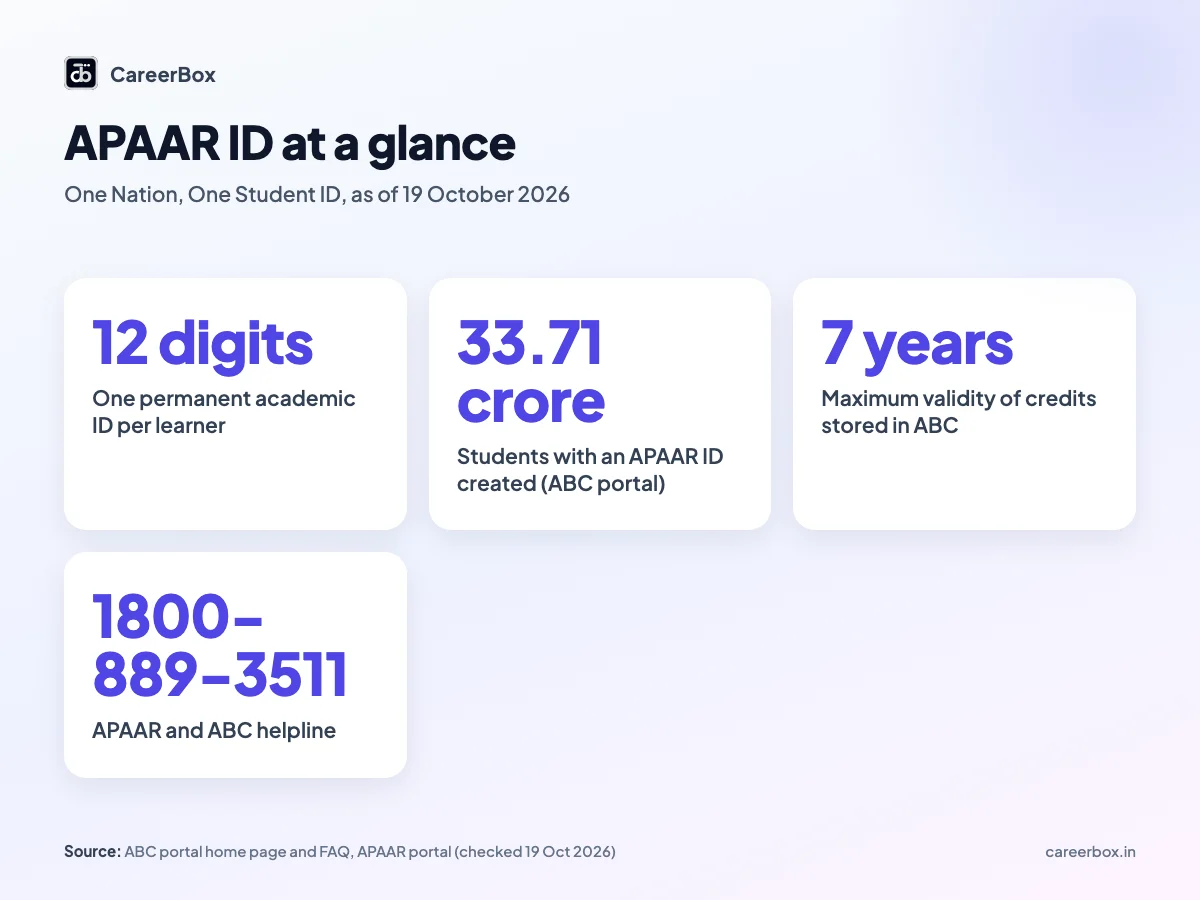
- Scale: the ABC portal counted 33.71 crore students with an APAAR ID created as of 19 October 2026.
What is an APAAR ID?
The APAAR portal describes APAAR as an ID system for all students in India under the "One Nation, One Student ID" programme of the National Education Policy 2020. The 12-digit code lets a student keep mark sheets, degrees, certificates and co-curricular achievements in one place.
The Union Education Minister launched APAAR on 13 February 2024, per the portal's Key Decisions note, and the school campaign began on 22 August 2024. PIB's 4 July 2026 explainer put verified APAAR IDs at 26.35 crore as of 2 July 2026.
APAAR ID vs ABC ID vs DigiLocker: are they the same?
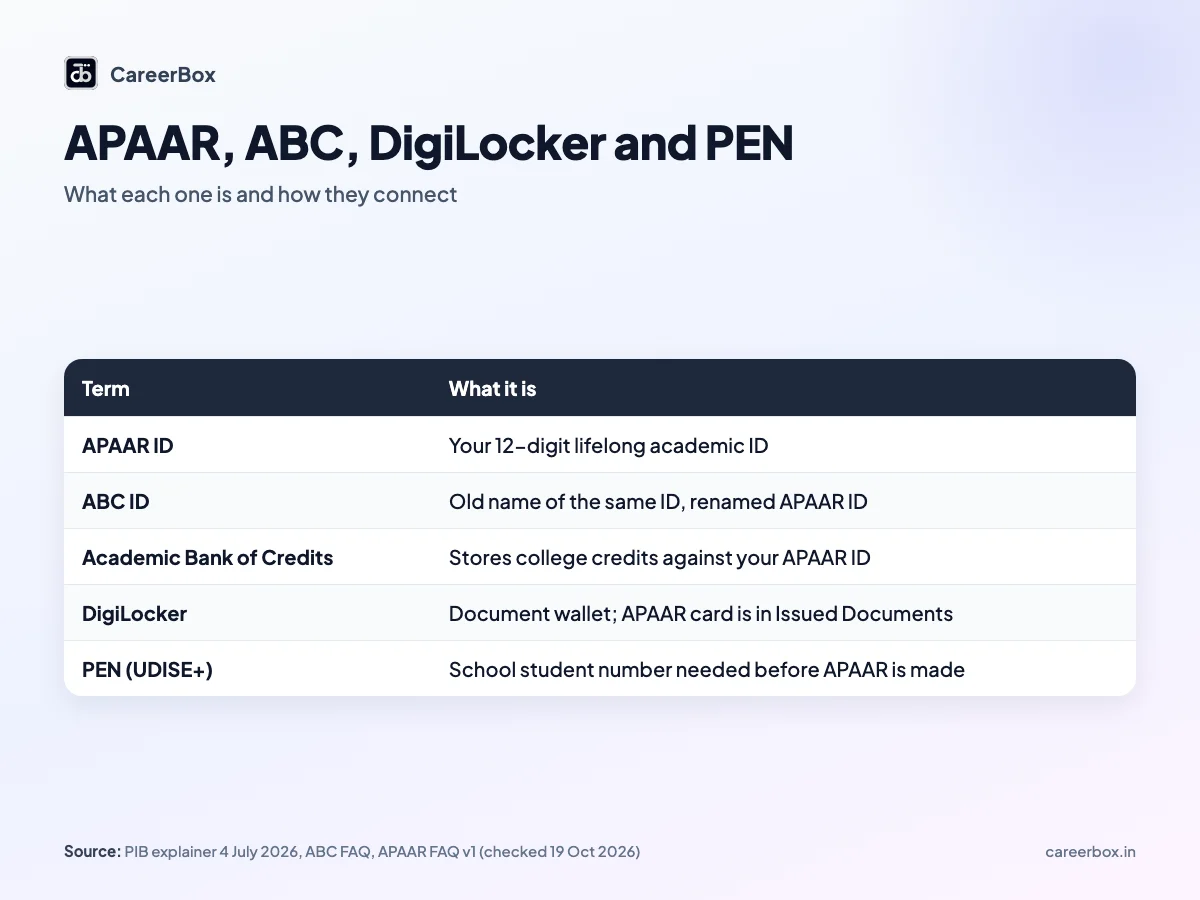
Here is how they fit together:
| Term | What it is | Who runs it |
|---|---|---|
| APAAR ID | Your 12-digit lifelong academic ID | Ministry of Education |
| ABC ID | The older name of the same ID; renamed APAAR ID | Ministry of Education, regulated by UGC |
| Academic Bank of Credits | The "credit bank" where your college credits are stored against your APAAR ID | UGC and Digital India Corporation |
| DigiLocker | Your document wallet; the APAAR card appears in Issued Documents | Ministry of Electronics and IT |
| PEN | Permanent Education Number in UDISE+, needed before a school can make your APAAR | Ministry of Education (UDISE+) |
So if a college form asks for your "ABC ID", give your APAAR ID. The ABC FAQ says without one you cannot use ABC services such as credit transfer, and credits stay valid for up to 7 years.
A DigiLocker account and an APAAR ID are different: DigiLocker is the locker, APAAR is one document inside it.
Who needs an APAAR ID?
- School students: all school management types are covered, government or private, per the APAAR misconceptions note. Your school does the work.
- College and university students: UGC's SOPs for the National Credit Framework, sent to universities on 7 August 2024, say every higher education institution "shall ensure that their students register on the ABC portal and create an APAAR Id".
- Skill and vocational learners: the same UGC SOP says the APAAR ID can be created by the student through DigiLocker, by the awarding body or by the training partner.
- Exam and admission forms: IGNOU's July 2026 admission portal told applicants to keep an APAAR ID ready (our IGNOU story); the NTA's CUET (PG) 2026 bulletin shows a "Register APAAR ID" step that asks "Do you have APAAR ID?"; and the National Scholarship Portal accepts APAAR ID as a login (our NSP guide).
How to create an APAAR ID for a school student
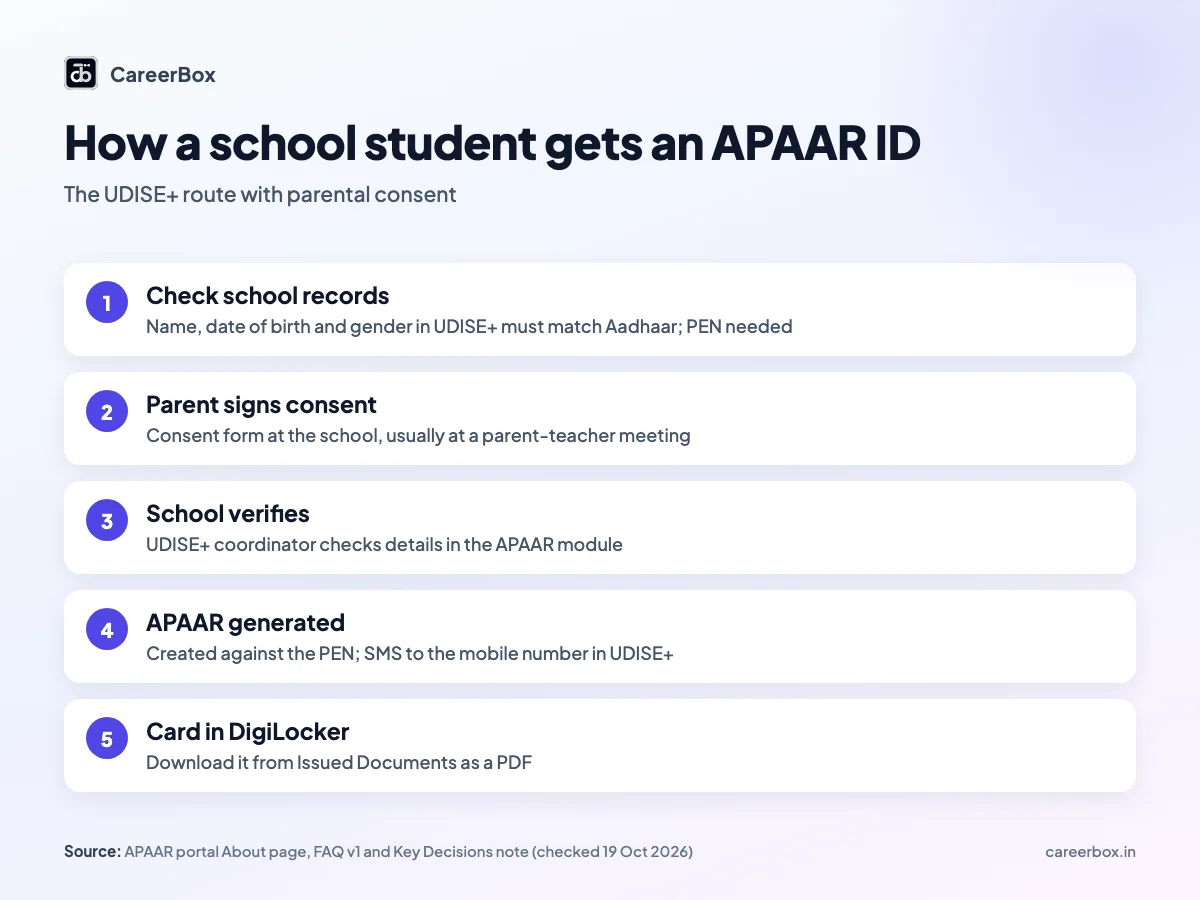
The APAAR About page and FAQs set out the school route:
- Check UDISE+ details: the student's name, date of birth and gender in school records must match Aadhaar, and the student must have a PEN.
- Parent fills the consent form: usually at a parent-teacher meeting. The consent form is also available in Gujarati (Gujarati form) and other Indian languages on the Resources page. The Key Decisions note says parents must be physically present when submitting it.
- School verifies: the UDISE+ coordinator checks the form against Aadhaar in the APAAR module of UDISE+.
- APAAR is generated against the PEN, and an SMS goes to the mobile number in UDISE+.
- Card lands in DigiLocker: the ID is pushed to the student's DigiLocker under Issued Documents.
Details the school needs, per the APAAR FAQ: PEN, student's name, date of birth, gender, mobile number, mother's name, father's name, name as per Aadhaar and Aadhaar number. In remote areas, PIB says APAAR IDs can also be generated at the nearest Common Service Centre (CSC).
How to create an APAAR ID yourself in DigiLocker (college students)
The ABC portal lists this route for higher education and skill learners:
- Sign in to DigiLocker with an Aadhaar-verified account, or click Login/Register Student on abc.gov.in, which opens DigiLocker.
- Search "APAAR" and open the APAAR ID (Academic Bank of Credits) service, then pick your education category.
- Your name as per Aadhaar, date of birth and gender fill in on their own. Choose your institution, admission year and identity type (roll number, registration number, enrolment number or new admission), then enter the value.
- Tick the consent box and click Get Document.
- Your APAAR card appears in Issued Documents, ready to download as a PDF.
DigiLocker's experts session of 18 October 2024 said students under 16 cannot create an APAAR ID on DigiLocker and should go through their school. The ABC student guide also shows the UMANG app as a channel. Neither portal lists any fee.
How to download your APAAR ID card or find a child's APAAR ID
The General Advisory on the APAAR portal gives these steps:
- Go to DigiLocker and click Sign In.
- Enter the child's Aadhaar number (or APAAR ID).
- Enter the OTP sent to the Aadhaar-linked mobile, which is often a parent's number, and the security PIN.
- Open Issued Documents. If the card is not there, search "APAAR", select APAAR ID (Academic Bank of Credits) and fetch it.
- Click Download to save the card as a PDF and print it if needed.
If nothing shows up, ask the school to check the student's status in the APAAR module of UDISE+.
APAAR ID not generated? Common errors and fixes
- Name or date of birth mismatch with Aadhaar: the APAAR FAQ says generation fails with an error when demographic data does not match Aadhaar. Correct the wrong record and resubmit. If the school record is wrong, the school fixes it in UDISE+; if Aadhaar is wrong, update Aadhaar first.
- Changed details after the ID was made: the ABC portal's order is update Aadhaar, redo e-KYC in DigiLocker, then update the APAAR ID. The General Advisory has the e-KYC steps.
- Changed school: ask the new school's UDISE+ coordinator to update the record, then download the card again.
- No consent on record: the school can only generate after a parent's form is marked Consent Given in UDISE+.
- No Aadhaar: the APAAR Important Information note says the ID cannot be created without Aadhaar and points families to an Aadhaar enrolment centre. The current consent form mentions an alternate government photo ID, but as of 19 October 2026 we found no published procedure for that route.
For anything else, raise a ticket at DigiLocker support or on the APAAR portal, call 1800-889-3511, or email [email protected].
Is APAAR ID mandatory?
Official documents differ. The exact positions as of 19 October 2026:
- APAAR portal: its Important Information note says "APAAR is not mandatory" and that there is "no legal requirement mandating its use".
- Consent form: "refusing APAAR ID will not affect my ward's admission, promotion, or access to government benefits."
- Government schemes: the misconceptions note says APAAR is not mandatory for availing any government scheme.
- Higher education: PIB's 7 February 2024 release said it is necessary to have an ABC ID to take admission to any college or university, the ABC FAQ says every student "is required to register", and UGC's SOPs ask colleges to make sure students create one.
- Boards and exams: CBSE's 2026-27 list-of-candidates circular treats APAAR ID as optional (our CBSE story), while IGNOU asked applicants to keep one ready.
In practice: for a school child it is the parent's choice. For a college student, expect your institution to ask for it, because ABC credits cannot be stored without it.
Privacy, consent and how to withdraw
The consent form has two parts: consent to share Aadhaar with the Ministry of Education to create the APAAR ID and a DigiLocker account, and a separate optional tick for using academic data for scholarship portals and talent or recruitment agencies. You can leave the second box unticked.
The form says a parent can withdraw or modify consent at any time by writing to the school or to [email protected]. The APAAR privacy policy says users may ask for their account and data to be deleted, though some records may be kept for legal and compliance purposes.
Gujarat students: what to check
Gujarat schools follow the same UDISE+ route, and the consent form is available in Gujarati. The usual snag is name order: older school records may run surname first while Aadhaar does not. GSHSEB's newer mark sheets print name before surname (our Gujarat board story), so match the UDISE+ entry to Aadhaar exactly before the school generates the ID.
Frequently asked questions
How do I get my APAAR ID online?
School students get it through their school on UDISE+. College and skill students can create it in DigiLocker by choosing their institution, admission year and roll or enrolment number.
Are APAAR ID and ABC ID the same?
Yes. PIB's 4 July 2026 explainer says the ABC ID was renamed the APAAR ID, so one 12-digit number serves both.
Is DigiLocker ID and APAAR ID the same?
No. DigiLocker is your document account; the APAAR ID is a 12-digit academic ID whose card is issued into it.
Can I get APAAR ID without DigiLocker?
A school can generate it on UDISE+ and CSCs can help, but the card is pushed to DigiLocker, so you need DigiLocker to view and download it.
How to check APAAR ID of child?
Sign in to DigiLocker with the child's Aadhaar, enter the OTP from the linked mobile and open Issued Documents. The school can also check status in the UDISE+ APAAR module.
How do I download my APAAR ID?
In DigiLocker, open Issued Documents or search "APAAR", select APAAR ID (Academic Bank of Credits) and click Download for a PDF.
Is APAAR ID mandatory?
The APAAR portal says it is not mandatory and that refusing will not affect admission or benefits. UGC still asks colleges to make sure students create one, so most college students will need it.
What are the benefits of having an APAAR ID?
It stores your academic records and credits in one verifiable place for admissions, transfers, scholarships and jobs. PIB adds that students aged 13 to 30 who authenticate it can get up to 10% off base airfares and an extra 10 kg of baggage.
Where to go next
- Applying to IGNOU: IGNOU July 2026 admissions and the APAAR ID
- Planning for CUET PG: CUET PG 2027 runs across 17 days in March
- Class 10 or 12 with CBSE: CBSE 2027 list of candidates and corrections
- Scholarships: NSP scholarship 2026-27 guide
- Latest updates: CareerBox News
Sources
All checked on 19 October 2026.
- APAAR portal: apaar.education.gov.in
- APAAR: About: apaar.education.gov.in/about
- APAAR: FAQs: apaar.education.gov.in/faqs
- APAAR: FAQ v1 (PDF): cdn-apaar.dl6.in/apaar/faq/06-APAAR-FAQ-Eng_v1.pdf
- APAAR: Resources: apaar.education.gov.in/resource
- APAAR: parental consent form V1: cdn-apaar.dl6.in/apaar/consent_form/English_APAAR_Consent_Form_V1.pdf
- APAAR: General Advisory: cdn-apaar.dl6.in/apaar/info/APAAR_General_advisory.pdf
- APAAR: Important Information: cdn-apaar.dl6.in/resources/resoucre_files/03-APAAR-Important-Information-Eng.pdf
- APAAR: Common Misconceptions: cdn-apaar.dl6.in/resources/resoucre_files/04-APAAR-Misconception-Eng.pdf
- APAAR: Key Decisions note: cdn-apaar.dl6.in/resources/resoucre_files/05-B-APAAR-Key-Decisions-Support-WO-TollFree-Eng.pdf
- APAAR: Privacy Policy: apaar.education.gov.in/privacy-policy
- Academic Bank of Credits: home page: abc.gov.in
- Academic Bank of Credits: FAQ: abc.gov.in/faq
- Academic Bank of Credits: step-by-step guide for students: cdn-abc.dl6.in/assets/circulars/Step_by_Step_Guide_ABCID_Students.pdf
- DigiLocker: digilocker.gov.in
- DigiLocker: Ask our Experts answers (18 October 2024): digilocker.gov.in/assets/DIGILOCKER%20ASK%20EXPERT.pdf
- PIB: APAAR launched through CSCs (7 February 2024): pib.gov.in/PressReleasePage.aspx?PRID=2003802
- PIB: Academic Bank of Credits and APAAR explainer (4 July 2026): static.pib.gov.in/WriteReadData/specificdocs/documents/2026/jul/doc202675912501.pdf
- UGC: SOPs for implementation of NCrF (7 August 2024): ugc.gov.in/pdfnews/SOPs%20for%20implementation%20of%20NCrF%20Final.pdf
- NTA: CUET (PG) 2026 information bulletin: cdnbbsr.s3waas.gov.in/s388a839f2f6f1427879fc33ee4acf4f66/uploads/2025/12/202512161583029269.pdf
Rules and portal steps can change. Confirm on apaar.education.gov.in and abc.gov.in before you act.
More to read
All articles
Three-language policy 2026: NEP 2020, CBSE R3 rules for Classes 6, 9 and 10, and the Supreme Court order
Oct 20, 202612 min read
UGC new rules 2026: equity regulations, Supreme Court stay, assistant professor rules and degrees
Oct 20, 202611 min read
CBSE board exam 2027: date sheet status, Class 10 two board exams, LOC, private forms and sample papers
Oct 20, 202613 min read
Canada student visa 2026 for Indian students: study permit cap, PAL, funds, GIC, fees, processing time
Oct 20, 202611 min read
JEE Main 2027: session 1 exam date, registration, fee, documents, eligibility, syllabus and pattern
Oct 20, 202612 min read
CUET PG 2027: exam date, registration, fee, eligibility, syllabus, pattern and participating universities
Oct 20, 202611 min read