
UGC new rules 2026: equity regulations, Supreme Court stay, assistant professor rules and degrees
What the UGC Equity Regulations 2026 say, why they were stayed on 29 January 2026, the 5 November hearing, and which assistant professor and degree rules are draft or in force.

The University Grants Commission (UGC) is India's regulator for universities and colleges. This explainer uses only official records read on 20 October 2026: the UGC regulations page, the Gazette PDFs it links, PIB and Supreme Court of India records.
Key takeaways
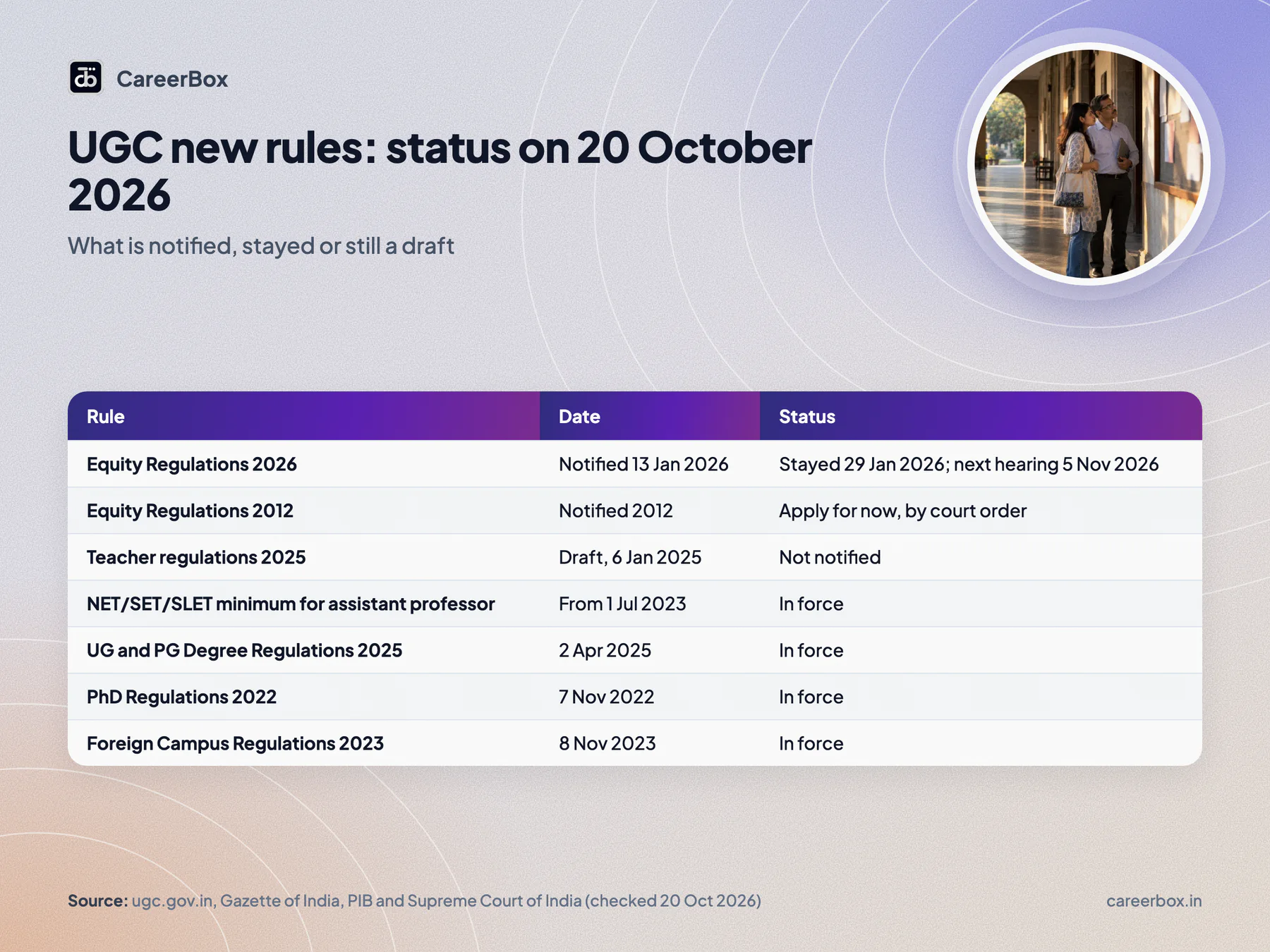
- Equity Regulations 2026: notified 13 January 2026, stayed on 29 January 2026. The 2012 equity regulations apply meanwhile.
- Court status: the rules are "under active consideration", the Solicitor General said on 20 August 2026; next date 5 November 2026.
- Assistant professor: the 2025 draft is not final. Since 1 July 2023, NET/SET/SLET is the minimum for direct recruitment.
- Degrees: biannual admission, two programmes at once and faster or slower degrees are in force under the 2025 regulations.
- Foreign campuses: global top 500 universities can apply under the 2023 regulations.
UGC new rules kya hai: the Equity Regulations 2026 in simple words
The University Grants Commission (Promotion of Equity in Higher Education Institutions) Regulations, 2026 appeared in the Gazette of India, Extraordinary, No. 40, on 13 January 2026. They replaced the 2012 regulations of the same name and applied to "all the higher education institutions in India".
What the rules asked every college and university to do:
- Set up an Equal Opportunity Centre with a professor as Coordinator. A college with fewer than five teachers could use its affiliating university's centre.
- Form an Equity Committee chaired by the head of the institution, with three senior teachers, one non-teaching staff member, two civil society members and two students as special invitees. The committee had to include OBC, SC, ST, women and persons with disabilities.
- Run a 24-hour Equity Helpline and an online portal to report discrimination. The reporter's identity is kept confidential on request.
- Create Equity Squads and name an Equity Ambassador in every department, hostel and library.
- Take an undertaking from every student, teacher and staff member not to discriminate.
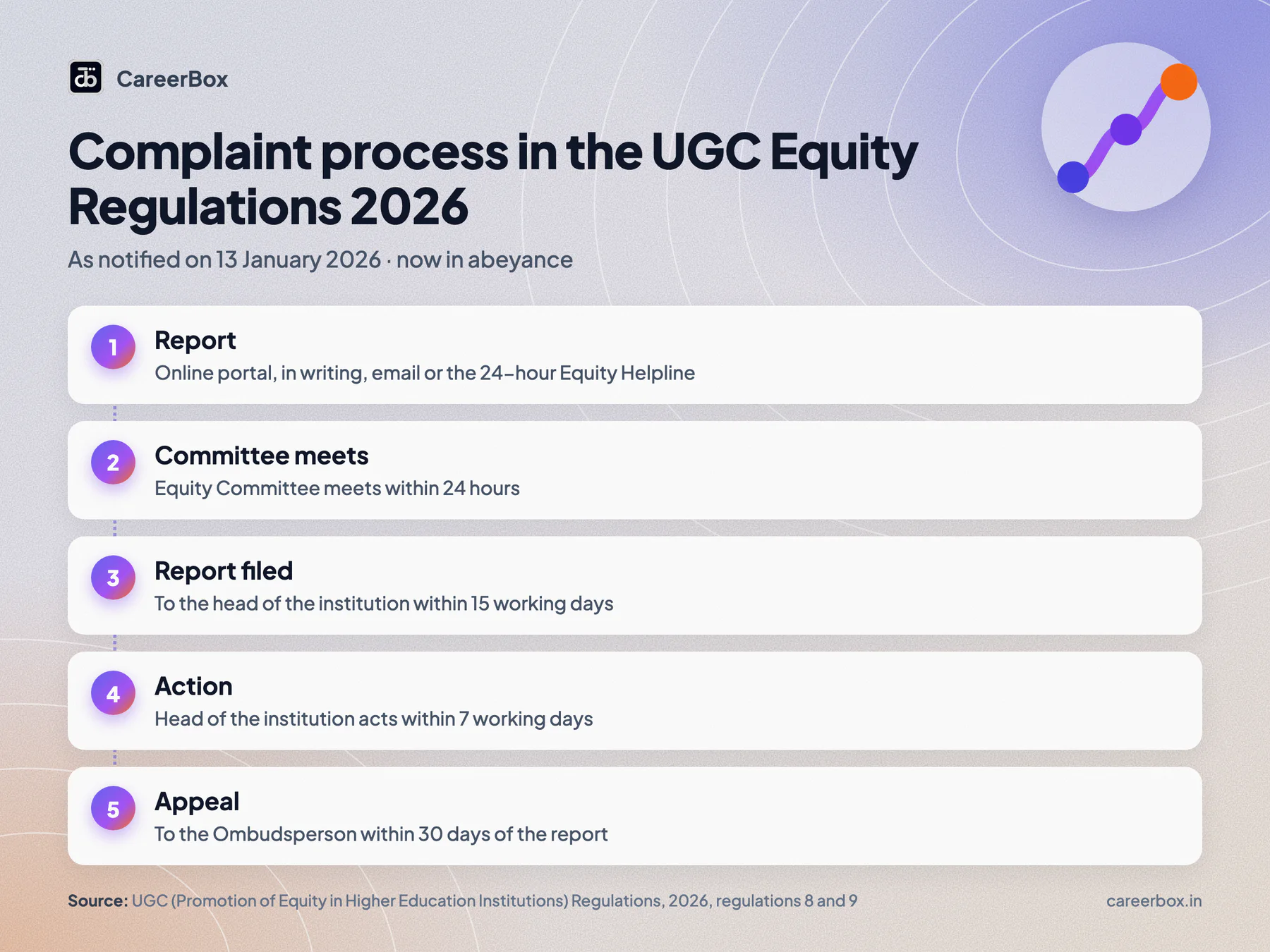
How a complaint was to be handled:
| Step | Time limit in the 2026 rules |
|---|---|
| Equity Committee meets after a complaint | Within 24 hours |
| Committee report to the head of the institution | Within 15 working days |
| Head of the institution starts action | Within 7 working days |
| Appeal to the Ombudsperson | Within 30 days of the report |
Punishment for colleges, not students: if a UGC enquiry found that an institution did not follow the rules, it could be barred from UGC schemes, barred from offering degree programmes, barred from online and distance programmes, or removed from the lists UGC keeps under Sections 2(f) and 12B of the UGC Act.
Why are the UGC new rules controversial? The general category question
The debate centres on Regulation 3(1)(c). It defined "caste-based discrimination" as discrimination "only on the basis of caste or tribe against the members of the scheduled castes, scheduled tribes, and other backward classes".
The wider definition of "discrimination" in Regulation 3(1)(e) covered any stakeholder treated unfairly on grounds of religion, race, caste, gender, place of birth or disability. But the caste-specific definition named only SC, ST and OBC members. Critics, including several petitioners in the Supreme Court, say this leaves general category students without the same protection. The 2019 case that led to these rules asks for stronger safeguards for SC and ST students. The court is hearing both together.
These rules did not change reservation in admissions or jobs. They dealt with how complaints of discrimination are handled on campus.
Where they came from: the 2026 rules grew out of Abeda Salim Tadvi v. Union of India (W.P.(C) No. 1149/2019), a public interest case on caste discrimination in higher education. In its order of 15 September 2025, the Supreme Court recorded the Solicitor General's statement that public suggestions on the draft regulations had been reviewed by an expert committee and were with UGC, "the competent authority to notify the regulations". UGC notified the final text four months later.
UGC new rules Supreme Court: stayed, and what happens next
| Date | What happened (official record) |
|---|---|
| 13 January 2026 | UGC notifies the Equity Regulations 2026 in the Gazette |
| 29 January 2026 | Hearing W.P.(C) No. 101/2026 (Mritunjay Tiwari v. Union of India) and connected petitions, a bench of Chief Justice Surya Kant and Justice Joymalya Bagchi keeps the 2026 rules "in abeyance"; 2012 regulations to operate; notice returnable 19 March 2026 |
| 20 August 2026 | Tadvi case heard with 19 connected petitions; Centre says the rules are "under active consideration" |
| 5 November 2026 | Next date fixed by the court |
The 20 August 2026 order gives UGC four weeks to file a counter affidavit and petitioners two weeks after that to reply. It adds: "It will be appreciated if an appropriate decision with respect thereto is also taken before the next date of hearing."
So, are the UGC new rules implemented or not? No. On 20 October 2026 the 2026 rules remain in abeyance. Colleges follow the 2012 equity regulations. A stay pauses the rules; it does not delete them. No rollback or replacement has been notified as of 20 October 2026.
UGC new rules for assistant professor: what is draft and what is in force
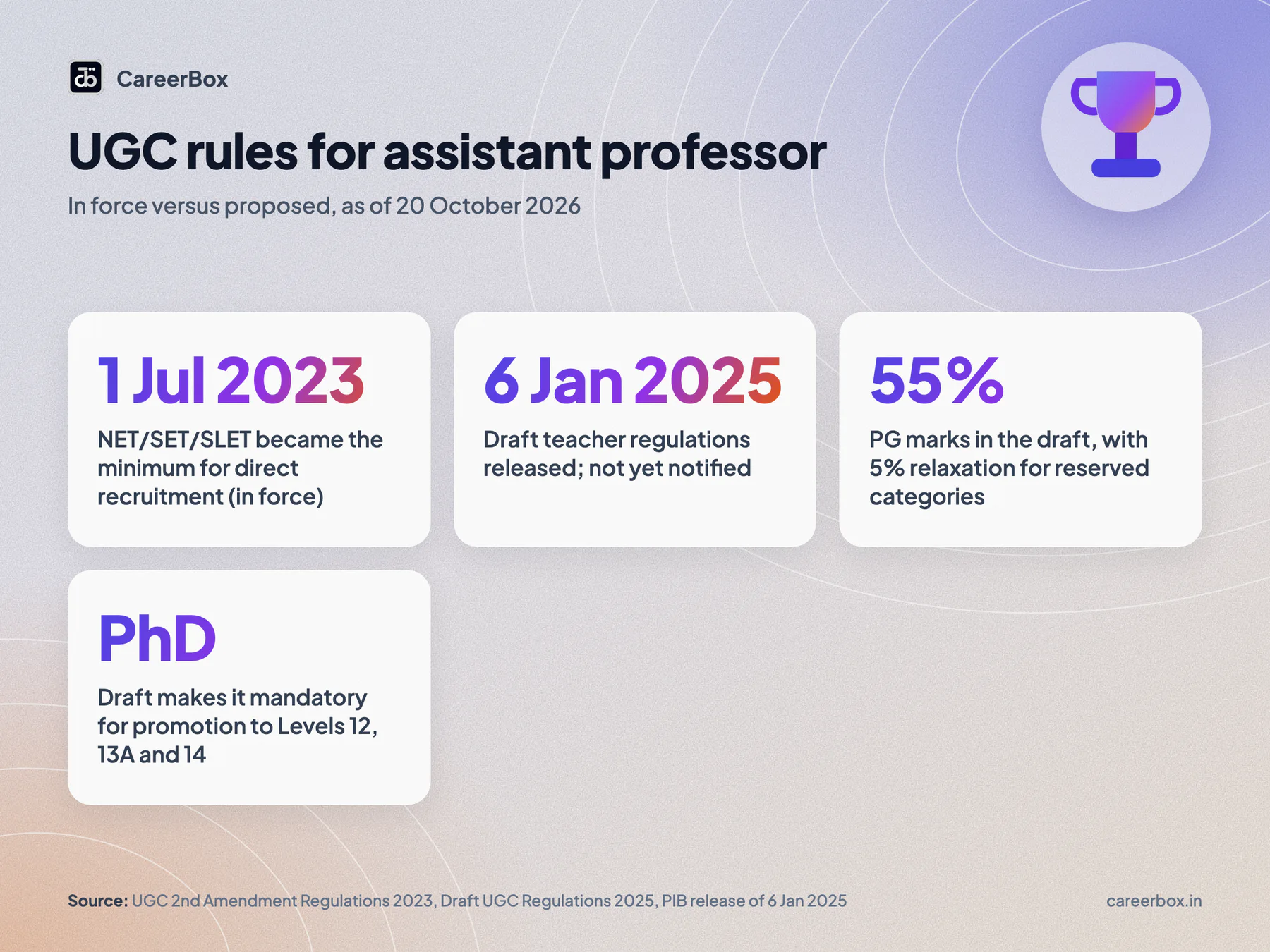
In force now: the UGC Minimum Qualifications Regulations, 2018, with amendments. The 2nd Amendment of 30 June 2023, in force from 1 July 2023, says: "NET/SET/SLET shall be the minimum criteria for the direct recruitment to the post of Assistant Professor for all Higher Education Institutions."
Still a draft: the Draft UGC (Minimum Qualifications for Appointment and Promotion of Teachers and Academic Staff) Regulations, 2025, released by Education Minister Dharmendra Pradhan on 6 January 2025 for public feedback, per PIB. On 20 October 2026 it is not among UGC's notified regulations. It will apply only once notified.
What the draft proposes:
- NET subject over degree subject: if your NET/SET subject differs from your UG or PG subject, you can be appointed assistant professor in the NET/SET subject. The same applies to the PhD subject, for assistant, associate and full professor.
- Assistant professor eligibility: a 4-year UG degree with 75% or a PG degree with 55%, plus a PhD; or a PG degree with 55% plus NET (UGC, CSIR, ICAR) or SET/SLET; or an M.E./M.Tech with 55%.
- 5% relaxation in UG or PG marks for SC, ST, OBC (non-creamy layer), EWS and persons with disabilities.
- PhD mandatory for promotion to Academic Level 12, Associate Professor (Level 13A) and Professor (Level 14).
- Arts, music, yoga and drama: a UG degree plus five years of professional experience and State or National level achievement can qualify.
- Vice-Chancellor: open also to people with ten years at a senior level in industry, public administration or public sector undertakings.
Preparing for NET? Read our UGC NET December 2026 guide and the December 2026 registration news.
UGC new rules for PhD admission
No new PhD regulation has been notified in 2026. Under the UGC PhD Regulations, 2022 (7 November 2022), you can apply for a PhD after a master's degree with 55%, or straight after a 4-year bachelor's degree with 75%, with a 5% relaxation for SC, ST, OBC (non-creamy layer), EWS and differently-abled candidates.
UGC rules on degrees, twice-yearly admission and two degrees at once
These are in force under the UGC UG and PG Degree Regulations, 2025 (Gazette dated 2 April 2025):
- Biannual admission: colleges "prepared to handle biannual admissions may admit students twice a year, in July/August and January/February". It is optional for the college.
- Any stream, any degree: whatever subjects you took in Class 12, you can join any UG discipline if you clear the national or university entrance exam for it.
- Two degrees at once: a student "can pursue two UG programmes simultaneously", and the same for PG, under UGC's guidelines.
- Faster or slower degree: an Accelerated Degree (up to 10% of seats) or an Extended Degree of up to two extra semesters, to be treated on par by employers and bodies like UPSC.
- Attendance is decided by each institution.
See also our reports on UGC's revised degree list and deemed university status for state colleges.
UGC rules for foreign university campuses in India
The UGC foreign campus regulations (Gazette dated 8 November 2023) are in force. A foreign university must rank in the top 500 globally, overall or by subject, or "possess outstanding expertise in a particular area", to apply on fhei.ugc.ac.in. One recent result: CU Denver got a UGC letter of intent for Hyderabad.
What this means for students and teachers in Gujarat
All these UGC rules apply equally to Gujarat's state universities, private universities and affiliated colleges. Until the Supreme Court decides, a student facing discrimination should use the existing grievance system: the college's Equal Opportunity Cell and SC/ST Cell, and the Ombudsperson appointed under the UGC (Redressal of Grievances of Students) Regulations, 2023. Teaching job aspirants in Gujarat should go by the 2018 regulations and their amendments until UGC notifies the final teacher regulations.
Frequently asked questions
What are the UGC new rules 2026?
Mainly the UGC Equity Regulations 2026, notified on 13 January 2026 to deal with discrimination on campuses through Equity Committees, a 24-hour helpline and time-bound complaint handling.
Did the Supreme Court stay the UGC new rules?
Yes. On 29 January 2026 a bench of Chief Justice Surya Kant and Justice Joymalya Bagchi kept the 2026 regulations in abeyance and directed that the 2012 regulations continue. The stay continues as of 20 October 2026.
Why are the UGC new rules opposed by some general category students?
Regulation 3(1)(c) defined caste-based discrimination as discrimination against SC, ST and OBC members only. Petitioners say this excludes general category students from that protection. The court is examining the point.
When is the next Supreme Court hearing?
The order of 20 August 2026 lists the case for further consideration on 5 November 2026.
Are the new UGC rules for assistant professor in force?
No. The 2025 rules are a draft released on 6 January 2025. The 2018 regulations, as amended, apply, and NET/SET/SLET has been the minimum for direct recruitment since 1 July 2023.
Can I become an assistant professor in a subject different from my PG?
Only under the draft. It proposes that your NET/SET or PhD subject decides your teaching subject. This becomes law only after UGC notifies the final regulations.
Can colleges admit students twice a year?
Yes, under the UG and PG Regulations 2025. Colleges that are ready may admit in July/August and January/February. It is not compulsory.
Can I do two degrees at the same time?
Yes. The 2025 regulations allow two UG or two PG programmes simultaneously, following UGC's guidelines on pursuing two academic programmes.
Sources
All checked on 20 October 2026.
- UGC regulations page: ugc.gov.in/Regulations
- Equity Regulations 2026, Gazette of 13 January 2026: ugc.gov.in/pdfnews/1881254_UGC-Promotion-of-Equity-in-HEIs-Regulations-2026.pdf
- Supreme Court order of 20 August 2026: api.sci.gov.in/supremecourt/2019/30988/30988_2019_1_14_73463_Order_20-Aug-2026.pdf
- Supreme Court order of 15 September 2025: api.sci.gov.in/supremecourt/2019/30988/30988_2019_2_20_64213_Order_15-Sep-2025.pdf
- Supreme Court cause list, 29 January 2026: api.sci.gov.in/jonew/cl/2026-01-29/M_J_2.pdf
- News On AIR report of the 29 January 2026 stay: newsonair.gov.in/supreme-court-stays-ugcs-new-equity-regulations
- Draft teacher regulations 2025: ugc.gov.in/pdfnews/3045759_Draft-Regulation-Minimum-Qualifications-for-Appointment-and-Promotion-of-Teachers-and-Academic-Staff-in-Universities-and-Colleges-and-Measures-for-the-Maintenance-of-Standards-in-HE-Regulations-2025.pdf
- PIB release, 6 January 2025: pib.gov.in/PressReleasePage.aspx?PRID=2090673
- 2nd Amendment Regulations 2023: ugc.gov.in/pdfnews/5751331_UGC-Regulations-Minimum-Qualifications-2023.pdf
- UG and PG Degree Regulations 2025: ugc.gov.in/pdfnews/5576784_UG-and-PG-Regulations-2025.pdf
- PhD Regulations 2022: ugc.gov.in/pdfnews/0909572_Minimum-Standards-and-Procedure-for-Award-of-PhD-Degree.pdf
- Foreign Campus Regulations 2023: ugc.gov.in/pdfnews/Setting%20up%20and%20Operation%20of%20Campuses%20of%20Foreign%20Higher%20Educational%20Institutions%20in%20India.pdf
Court matters move. Check the Supreme Court's records and ugc.gov.in for any order or notification after 20 October 2026.
More to read
All articles
Three-language policy 2026: NEP 2020, CBSE R3 rules for Classes 6, 9 and 10, and the Supreme Court order
Oct 20, 202612 min read
CBSE board exam 2027: date sheet status, Class 10 two board exams, LOC, private forms and sample papers
Oct 20, 202613 min read
Canada student visa 2026 for Indian students: study permit cap, PAL, funds, GIC, fees, processing time
Oct 20, 202611 min read
JEE Main 2027: session 1 exam date, registration, fee, documents, eligibility, syllabus and pattern
Oct 20, 202612 min read
CUET PG 2027: exam date, registration, fee, eligibility, syllabus, pattern and participating universities
Oct 20, 202611 min read
US student visa 2026 new rules for Indians: F-1 fees in rupees, interview, social media, OPT and slot booking
Oct 20, 202611 min read