
US student visa 2026 new rules for Indians: F-1 fees in rupees, interview, social media, OPT and slot booking
The F-1 visa for Indian students on 20 October 2026: $185 (₹18,130) and $350 SEVIS, public social media, in-person interviews, the court-postponed 4-year rule, the proposed OPT fee and how slot booking works.
Some 2025-26 US student visa changes are in force, some are only proposals and one is stuck in court. This guide uses only US government pages and court orders, read on 20 October 2026.
Key takeaways
- Social media (in force): F, M and J applicants must set every social media profile to "public" or "open", per US Mission India and the State Department.
- Interview (in force): since 1 October 2025, almost every visa applicant needs an in-person interview. Students are not on the waiver list.
- Where to apply (in force): book in your country of nationality or residence. For Indian students living in India, that means India.
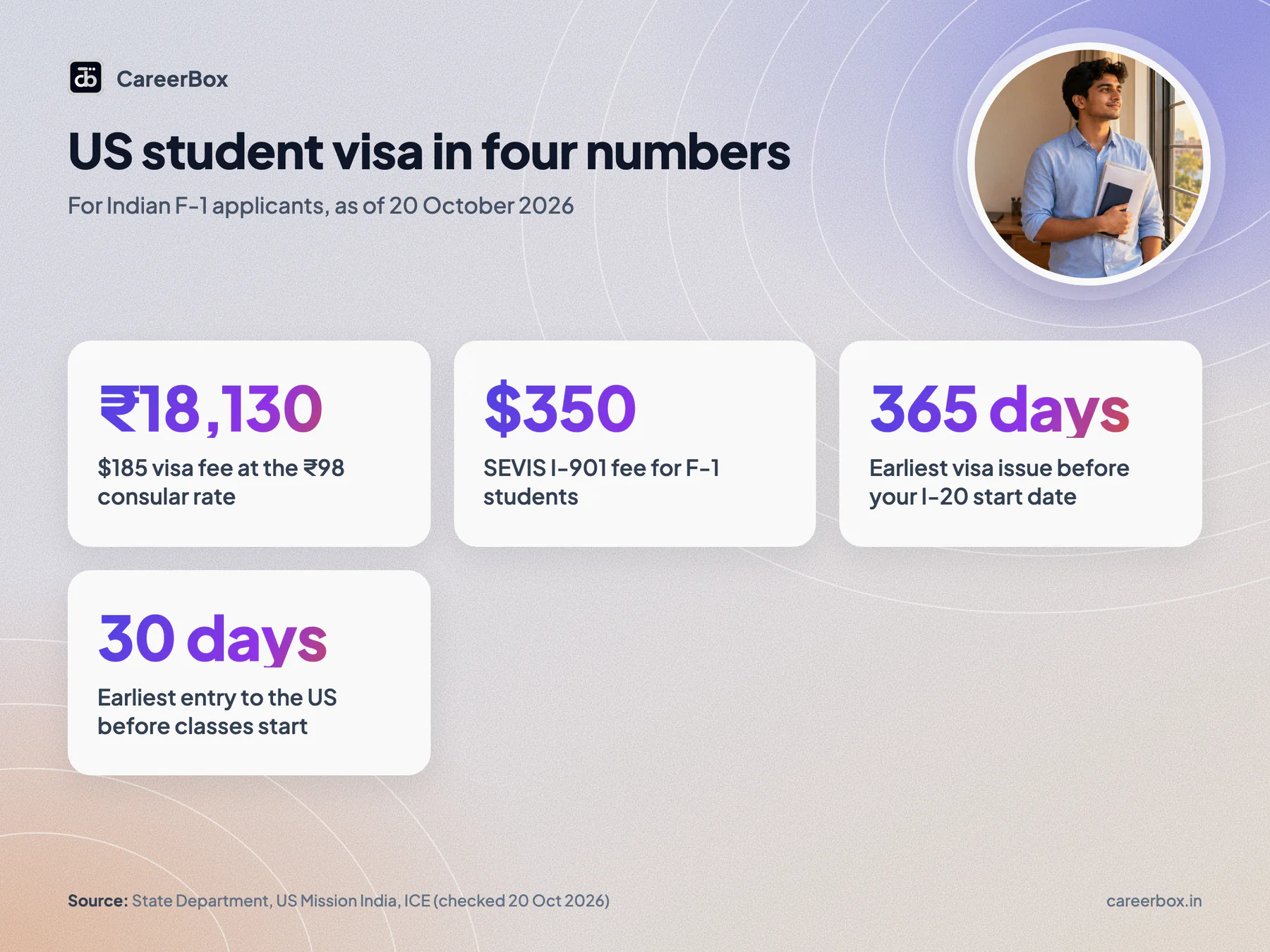
- Fees (in force): $185 visa fee plus $350 SEVIS fee. Pay the visa fee in rupees.
- Visa integrity fee: in the law since 4 July 2025, at least $250, charged when a visa is issued. DHS said it would be set up "in a future publication"; no start date has been published.
- Fixed 4-year admission: final rule, but postponed by a federal court. Appeal pending.
US student visa new rules 2026: what is in force, proposed or blocked
| Rule | Status on 20 Oct 2026 | Date |
|---|---|---|
| Public social media profiles | In force | Widened to more visa types from 30 Mar 2026 |
| In-person interview for students | In force | Since 1 Oct 2025 |
| Apply in country of nationality or residence | In force | Page last updated 12 Dec 2025 |
| Visa integrity fee ($250 or more) | Law, not in fee lists yet | Enacted 4 Jul 2025 |
| Fixed admission, up to 4 years | Final rule, postponed by court | Final 17 Jul 2026, postponed 14 Sep 2026 |
| OPT fee ($70,000, then $30,000) | Proposed | Comments close 9 Nov 2026 |
US student visa social media vetting: what "public" means
The State Department's vetting notice (last updated 25 March 2026) says applicants for F, M and J visas, and several other types, "are instructed to adjust the privacy settings on all of their social media profiles to 'public' or 'open'". From 30 March 2026 the same review was widened to more visa types; students were "already subject to this review".
The US Mission India visa page repeats the instruction for F applicants. In practice:
- Switch every account you list on your DS-160 to public before your interview, and keep it public until a decision.
- List your handles honestly on the DS-160. Do not delete accounts in a hurry.
US student visa interview: no waiver for students
The State Department's interview waiver update of 18 September 2025 took effect on 1 October 2025. It says all nonimmigrant applicants, "including applicants under the age of 14 and over the age of 79, will generally require an in-person interview". The few exceptions are diplomatic and official visas and some renewals of B1/B2 and H-2A visas within 12 months. F-1 is not among them.
In India, the interview step page says every applicant must appear in person at the embassy or consulate. Missing it makes you a "No Show": you pay a new fee and restart.
Applying in your country of residence
The State Department's country of residence notice says applicants "should schedule their visa interview appointments at the U.S. Embassy or Consulate in their country of nationality or residence". Booking elsewhere can make it "more difficult to qualify", and fees "will not be refunded and cannot be transferred". The India scheduling page and the embassy carry the same rule.
Indian students living in India should book in India. If you live abroad, you may apply there but must prove residence.
US student visa fees for Indians in rupees
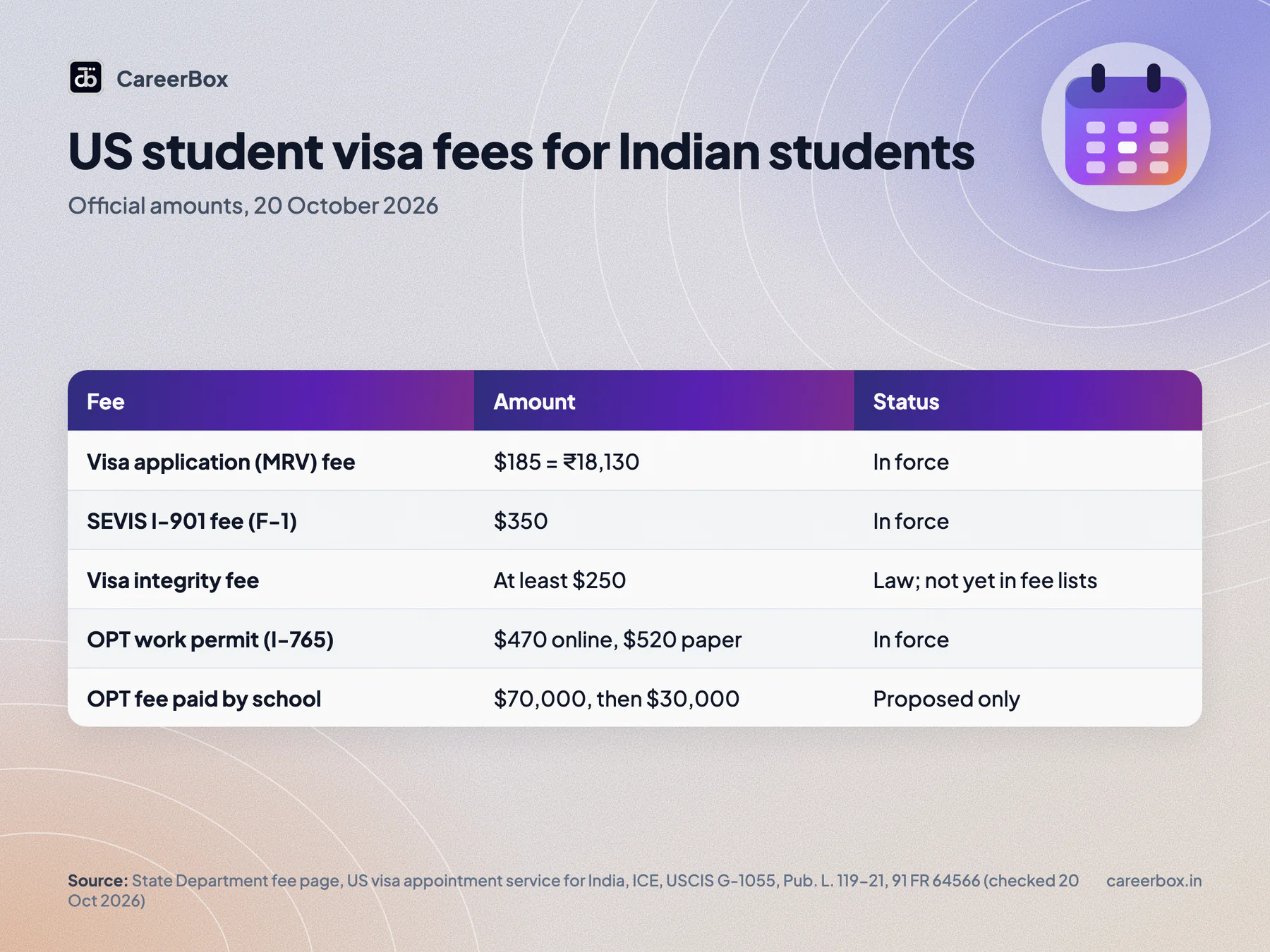
- Visa application (MRV) fee: $185 for F, M and J, on the State Department fee page and the India fee page. Fees are listed in dollars but paid in rupees.
- Consular rate: ₹98 a dollar since 25 May 2026 (US Mission India). So $185 = ₹18,130.
- Payment: NEFT, UPI, debit or credit card, or cash at the listed bank branches. The receipt is valid for 365 days to book an appointment.
- SEVIS I-901 fee: $350 for F and M students (ICE), paid in dollars on fmjfee.com, not at the embassy.
- Visa integrity fee: Public Law 119-21, section 100007, signed 4 July 2025, requires a fee of at least $250 "at the time of such issuance", with no waiver, adjusted for inflation from fiscal year 2026. A refund is possible if you follow your visa conditions. USCIS's notice of 22 July 2025 said it "requires cross-agency coordination" and "will be implemented in a future publication". The India fee page (updated 10 April 2026) and the State Department fee page list no such fee, and we found no implementation notice in the Federal Register as of 20 October 2026.
US student visa duration of status: the 4-year limit
Right now an F-1 student is admitted for "duration of status" (D/S): you stay as long as you follow your I-20. DHS wants to replace that with a fixed date.
- Proposed: 28 August 2025 (90 FR 42070); comments closed 29 September 2025.
- Final rule: 17 July 2026 (91 FR 44976), effective 15 September 2026.
- What it would do: admit you up to your programme length, "not to exceed a 4-year period". Longer courses would need an extension from USCIS. The grace period after your course or OPT would drop from 60 to 30 days. Graduate students could not switch programmes, and could not transfer without an SEVP exception. Language courses would be capped at 24 months.
- Postponed: on 14 September 2026 the US District Court in Massachusetts postponed the rule and barred DHS from "taking any further action to implement" it.
- Next: the government appealed on 30 September 2026 (docket). An order of 16 October 2026 sets summary judgment motions by 26 October and replies by 2 November 2026.
So on 20 October 2026, D/S and the 60-day grace period still apply. A two-year MS fits inside 4 years; a long PhD would need an extension if the rule returns.
US student visa OPT: what changed and what is proposed
The USCIS OPT page still allows up to 12 months of OPT and a 24-month STEM extension. You apply on Form I-765, up to 90 days before your degree ends and no later than 60 days after. Per Form G-1055 (edition 16 October 2026), the fee is $470 online or $520 on paper.
The ICE proposed rule of 8 October 2026 would make your school pay $70,000 for your first OPT and $30,000 for any later OPT. DHS says schools may pass it on to students. It is only proposed: comments close on 9 November 2026, and it would start 60 days after a final rule. For the H-1B side, see our H1B visa fee explainer.
How to apply for a US student visa from India, step by step
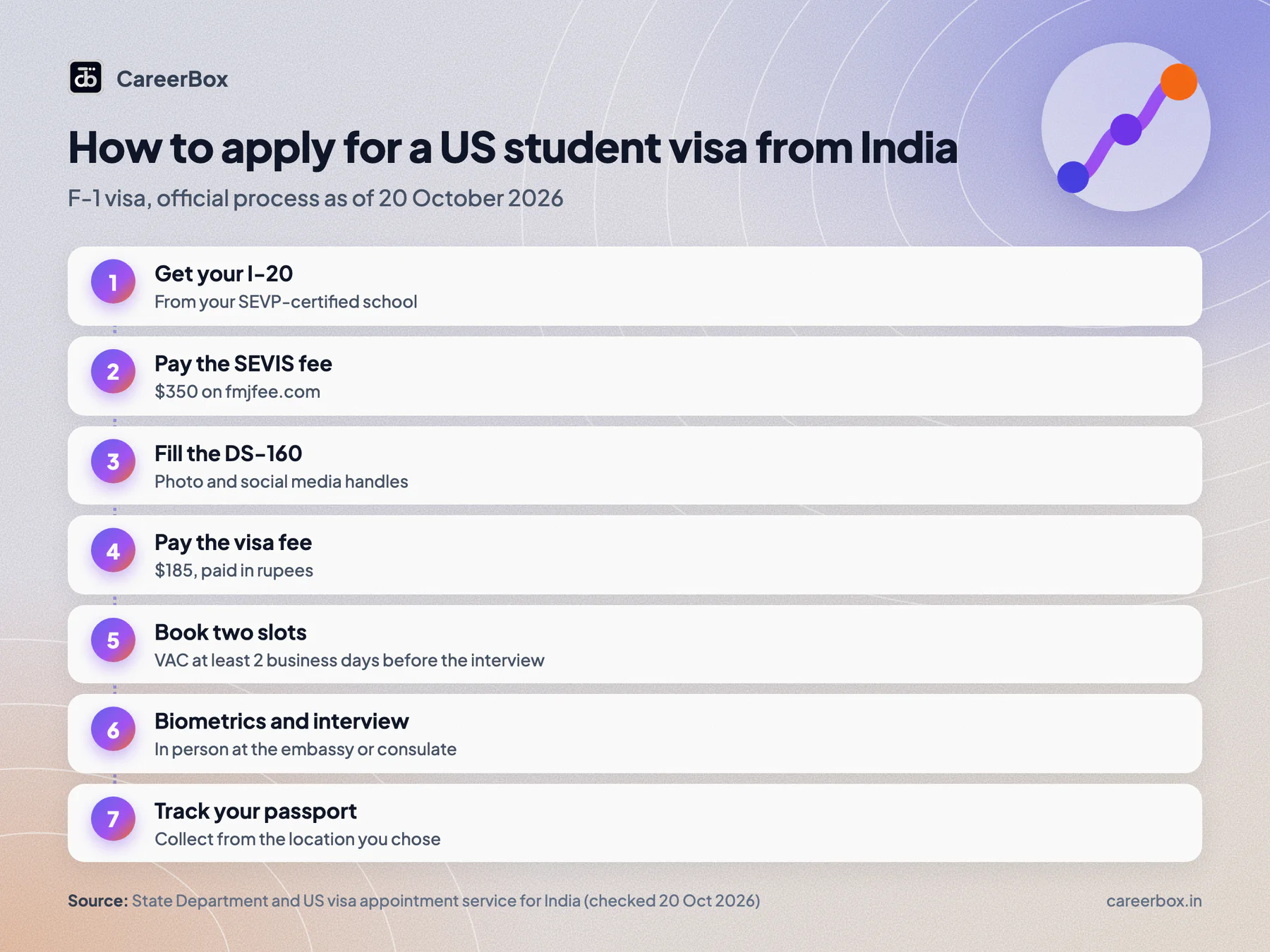
- Get your I-20. Your SEVP-certified school issues it after admission. Sign it.
- Pay the SEVIS fee. $350 on fmjfee.com; keep the receipt.
- Fill the DS-160. Upload your photo and list your social media handles.
- Pay the visa fee. $185 in rupees through the official appointment site.
- Book two appointments. A biometrics slot at a Visa Application Centre (VAC) and the interview.
- Attend biometrics, then the interview. Carry your passport (valid 6 months beyond your stay), I-20, DS-160 page, receipts and appointment letter. The officer may ask for marksheets, test scores, proof of funds and your plans after study.
- Track your passport. If approved, you collect it from the location you chose.
New students can get the visa up to 365 days before the I-20 start date, but can enter the US no more than 30 days before it (State Department).
US student visa slot booking: the official rules
From the India scheduling page:
- Where: only online at usvisascheduling.com. The embassy does not take requests by email.
- Order: book the VAC appointment at least 2 business days before the interview.
- Rescheduling is limited. After the limit you can only attend or cancel; cancelling voids your fee.
- Cancel at least 2 business days before your interview to avoid being marked a no-show.
- Bots get blocked. An "Access limitation" message means the site detected automation plug-ins. Remove them and wait at least 24 hours.
- Plan early. The page asks applicants to apply at least three months before travel; processing is "typically seven to ten working days".
- Expedited requests need a confirmed appointment first (expedited page); the embassy calls those slots "very limited".
Live waits for each Indian post are on the State Department's wait times tool. No official source publishes a fixed opening date for student slots.
Gujarat students: where your US visa interview happens
The US Consulate General in Mumbai covers "Maharashtra, Gujarat, Madhya Pradesh, Chhattisgarh, and Goa". Its VAC is in Bandra Kurla Complex, Mumbai. Ahmedabad is a document drop-off and passport collection location under the Mumbai consulate, not an interview venue.
Frequently asked questions
How much is the US student visa fee for Indians in 2026?
$185, which is ₹18,130 at the consular rate of ₹98 a dollar in force since 25 May 2026, plus the $350 SEVIS I-901 fee paid in dollars.
Is the $250 visa integrity fee charged on F-1 visas now?
It is law since 4 July 2025 and charged at issuance once implemented. The official fee lists checked on 20 October 2026 do not show it, and no start date has been published.
Is there a 4-year limit on the US student visa?
A final rule of 17 July 2026 would cap admission at programme length, up to 4 years. A court postponed it on 14 September 2026, so duration of status continues for now.
Do I need to make my Instagram public for an F-1 visa?
Yes. The State Department tells F, M and J applicants to set all social media profiles to "public" or "open".
Can I get an F-1 interview waiver in India?
No. Since 1 October 2025, students are not in the waiver categories, and the India pages say all applicants must attend the interview in person.
How early can I get my US student visa?
Up to 365 days before your I-20 start date. You can enter the US only within 30 days of that date.
Has OPT been cancelled?
No. OPT (12 months) and the 24-month STEM extension continue. A $70,000 school-paid OPT fee is only proposed, with comments due by 9 November 2026.
Where do Gujarat students attend the US visa interview?
At the US Consulate General in Mumbai, which covers Gujarat. Ahmedabad handles document drop-off and passport collection only.
Where to go next
- Funding: study abroad scholarships for Indian students, 2027-28 and the PM Vidyalaxmi education loan scheme
- After your MS: H1B visa fee 2026 and what it means for students and the US proposal on H-1B extensions
- Other countries: UK student visa fees 2026, Australia student visa 2026 and study in Germany 2027
Sources
All checked on 20 October 2026. travel.state.gov pages were read in their July 2026 archived copies because the site blocked automated access.
- US Mission India visas and Mumbai consulate: in.usembassy.gov/visas, in.usembassy.gov/embassy-consulates/mumbai
- US visa appointment service for India (student visa, fees, scheduling, interview, expedited): ustraveldocs.com/in/en/student-visa, ustraveldocs.com/in/en/step-3, ustraveldocs.com/in/en/step-4, ustraveldocs.com/in/en/step-5, ustraveldocs.com/in/en/expedited-appointment
- State Department student visa, fees, interview waiver, country of residence, vetting and wait times: travel.state.gov/content/travel/en/us-visas/study/student-visa.html, travel.state.gov/content/travel/en/us-visas/visa-information-resources/fees/fees-visa-services.html, travel.state.gov/content/travel/en/News/visas-news/interview-waiver-update-sept-18-2025.html, travel.state.gov/content/travel/en/News/visas-news/adjudicating-niv-applicants-in-their-country-of-residence.html, travel.state.gov/content/travel/en/News/visas-news/announcement-of-expanded-screening-and-vetting-for-visa-applicants.html, travel.state.gov/content/travel/en/us-visas/visa-information-resources/wait-times.html
- ICE SEVIS I-901 fee: ice.gov/sevis/i901
- USCIS OPT page and Form G-1055: uscis.gov/working-in-the-united-states/students-and-exchange-visitors/optional-practical-training-opt-for-f-1-students, uscis.gov/g-1055
- Federal Register: fixed-admission proposed and final rules, OPT fee proposal, HR-1 fee notice: federalregister.gov/documents/2025/08/28/2025-16554/establishing-a-fixed-time-period-of-admission-and-an-extension-of-stay-procedure-for-nonimmigrant, federalregister.gov/documents/2026/07/17/2026-14439/establishing-a-fixed-time-period-of-admission-and-an-extension-of-stay-procedure-for-nonimmigrant, federalregister.gov/documents/2026/10/08/2026-20660/optional-practical-training-fees, federalregister.gov/documents/2025/07/22/2025-13738/uscis-immigration-fees-required-by-hr-1-reconciliation-bill
- Public Law 119-21, section 100007: govinfo.gov/content/pkg/PLAW-119publ21/html/PLAW-119publ21.htm
- Presidents' Alliance v. DHS (D. Mass.): storage.courtlistener.com/recap/gov.uscourts.mad.305059/gov.uscourts.mad.305059.51.0_1.pdf, storage.courtlistener.com/recap/gov.uscourts.mad.305059/gov.uscourts.mad.305059.61.0.pdf, courtlistener.com/docket/74661796/presidents-alliance-on-higher-education-and-immigration-v-united-states
Visa rules, fees and court orders can change quickly. Confirm on in.usembassy.gov, travel.state.gov and your school's international office before you act.
More to read
All articles
Three-language policy 2026: NEP 2020, CBSE R3 rules for Classes 6, 9 and 10, and the Supreme Court order
Oct 20, 202612 min read
UGC new rules 2026: equity regulations, Supreme Court stay, assistant professor rules and degrees
Oct 20, 202611 min read
CBSE board exam 2027: date sheet status, Class 10 two board exams, LOC, private forms and sample papers
Oct 20, 202613 min read
Canada student visa 2026 for Indian students: study permit cap, PAL, funds, GIC, fees, processing time
Oct 20, 202611 min read
JEE Main 2027: session 1 exam date, registration, fee, documents, eligibility, syllabus and pattern
Oct 20, 202612 min read
CUET PG 2027: exam date, registration, fee, eligibility, syllabus, pattern and participating universities
Oct 20, 202611 min read