
Three-language policy 2026: NEP 2020, CBSE R3 rules for Classes 6, 9 and 10, and the Supreme Court order
What NEP 2020 para 4.13 says, what CBSE now requires in Classes 6 to 10, which languages count as Indian, the Supreme Court order of 28 September 2026 and Gujarat’s Gujarati law.
This guide is built only from the official documents, as read on 20 October 2026: the National Education Policy 2020, NCERT's National Curriculum Framework for School Education 2023, CBSE's academic circulars and the Supreme Court's own case records.
Key takeaways
- The rule: three languages (R1, R2, R3), at least two of them Bhartiya Bhashas, meaning languages native to India.
- Foreign languages: English, French, German and others count as non-native. One can be R3 only if R1 and R2 are both Indian, or it can be a fourth language.
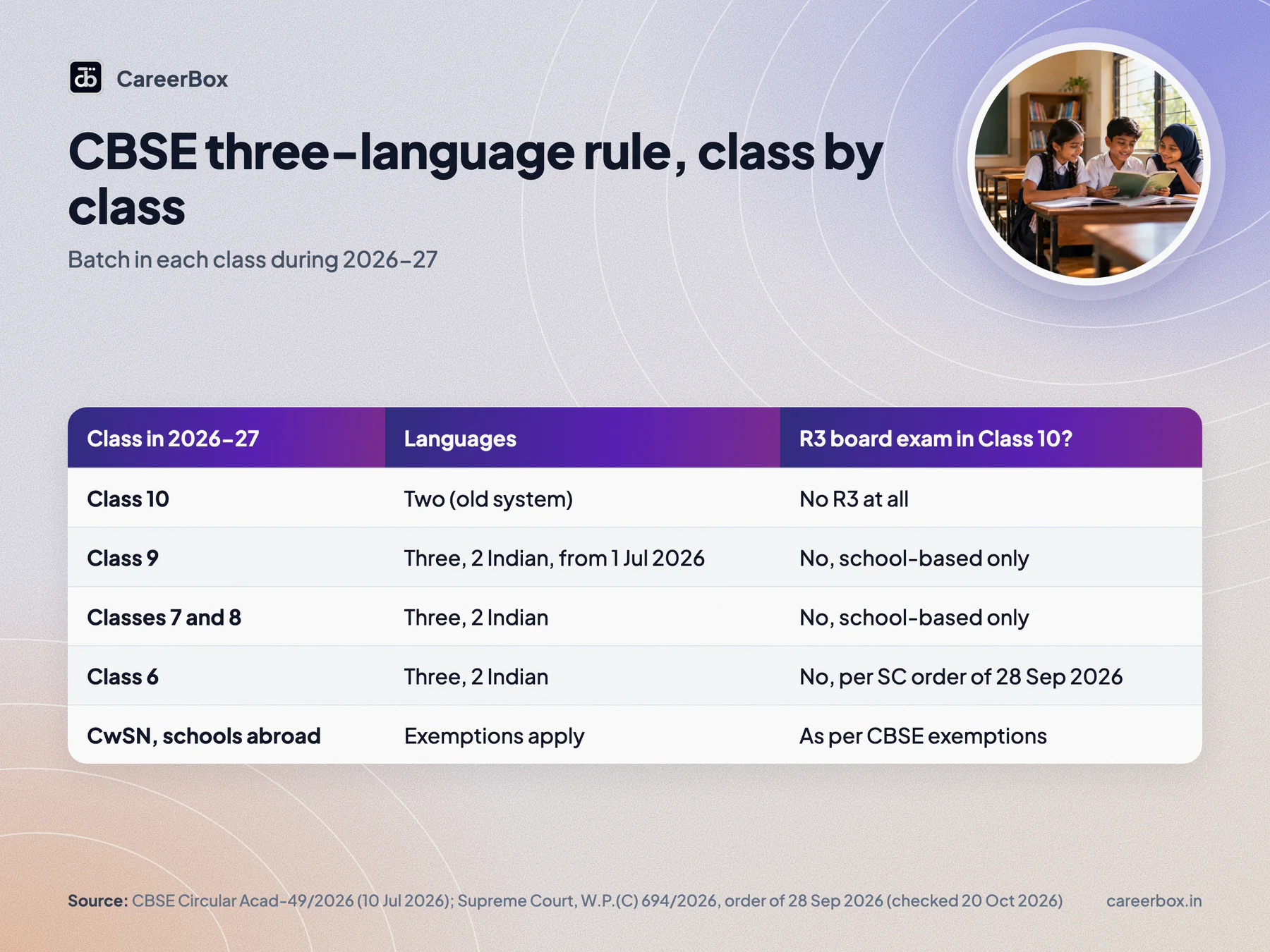
- Class 10 in 2026-27: no change. Two languages, no third language.
- Class 9 in 2026-27: three languages from 1 July 2026. R3 is a 100-mark school assessment. No CBSE board exam in R3 when this batch reaches Class 10 in 2027-28.
- Classes 6, 7 and 8: three languages, R3 assessed by the school; Class 6 got the same exemption as Class 7 from the Supreme Court on 28 September 2026.
- Exempt: children with special needs (as per the RPwD Act, 2016), CBSE schools outside India, and foreign students returning to India.
What is the three-language policy? What NEP 2020 says
NEP 2020 covers languages in paras 4.11 to 4.21. Para 4.13 is the "three-language formula under NEP 2020". It says the formula "will continue to be implemented" with the Constitution, people's aspirations, multilingualism and national unity in mind. Then:
- "There will be a greater flexibility in the three-language formula, and no language will be imposed on any State."
- "The three languages learned by children will be the choices of States, regions, and of course the students themselves, so long as at least two of the three languages are native to India."
- Students who want to change a language "may do so in Grade 6 or 7", as long as they show "basic proficiency in three languages (including one language of India at the literature level) by the end of secondary school".
Para 4.20 adds that foreign languages such as French, German, Japanese and Spanish "will also be offered at the secondary level". NEP sets the principle; it does not say which board exam you sit. That came from NCERT and CBSE.
NCF-SE 2023 and the R1, R2, R3 model
NCERT's National Curriculum Framework for School Education 2023 gave the formula its labels:
- R1 is the language in which a child first learns to read and write in school, "usually" the mother tongue or the language of the neighbourhood.
- In the Middle Stage (Classes 6 to 8), "students need to learn three languages (R1, R2 and R3)".
- In Grades 9 and 10, students "study 3 Languages: R1, R2, R3, at least two of which are native to India", and the Class 10 Board design has "3 examinations for R1, R2 and R3".
- In Grades 11 and 12, at least two languages, at least one of them native to India.
That Class 10 point is why families worried: under the framework, R3 would eventually carry a board exam.
What CBSE requires now: the 2026-27 scheme
CBSE brought R3 in through a run of academic circulars:
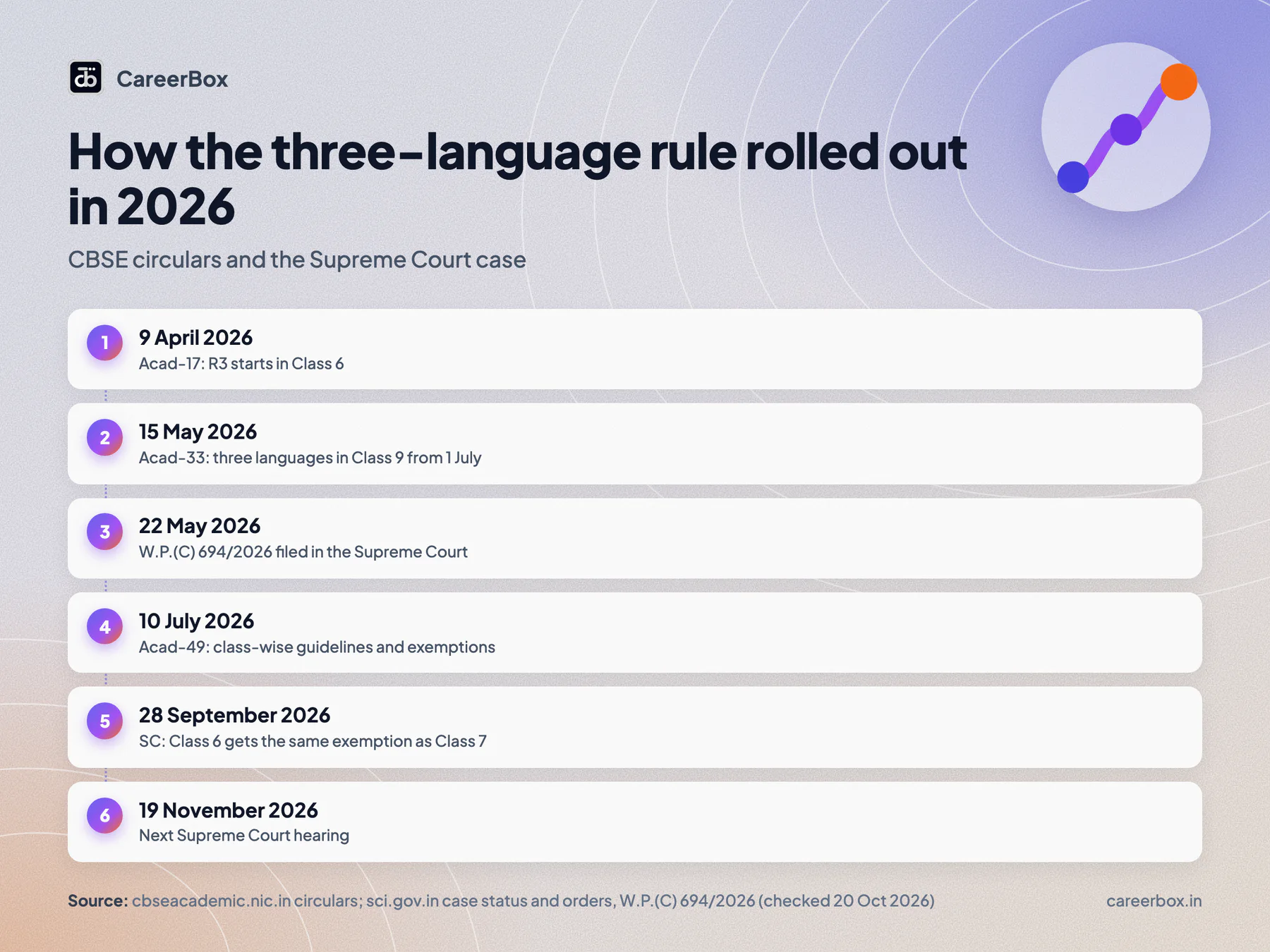
- Acad-17/2026 (9 April 2026): R3 starts in Class 6 from 2026-27. Only the R3 languages a school starts in Class 6 will be options in its Classes 9 and 10.
- Acad-33/2026 (15 May 2026): three languages compulsory in Class 9 from 1 July 2026; R3 school-based, and "no student will be barred from appearing in the Class X Board Examinations due to R3."
- Acad-46/2026 (2 July 2026): the 100-mark Class 9 R3 assessment.
- Acad-49/2026 (10 July 2026): the class-by-class guidelines, matching CBSE's press release of 29 June 2026.
Three-language policy for Class 9: what this year's students must do
Acad-49/2026 gives three situations for students in Class 9 in 2026-27:
- You already study two Indian languages (for example Hindi and Tamil): your third can be another Indian language or a foreign one such as English or French.
- You study one Indian and one foreign language (for example Tamil and English): your R3 must be an Indian language.
- You study two foreign languages (for example English and French): as a "special one-time relaxation", keep both and add one Indian language as R3.
Class 9 students continue the three languages they studied in Class 8, with one marked as R3. Until Class 9 R3 books arrive, they use the Class 6 R3 textbook of that language plus a local literary text chosen by the school.
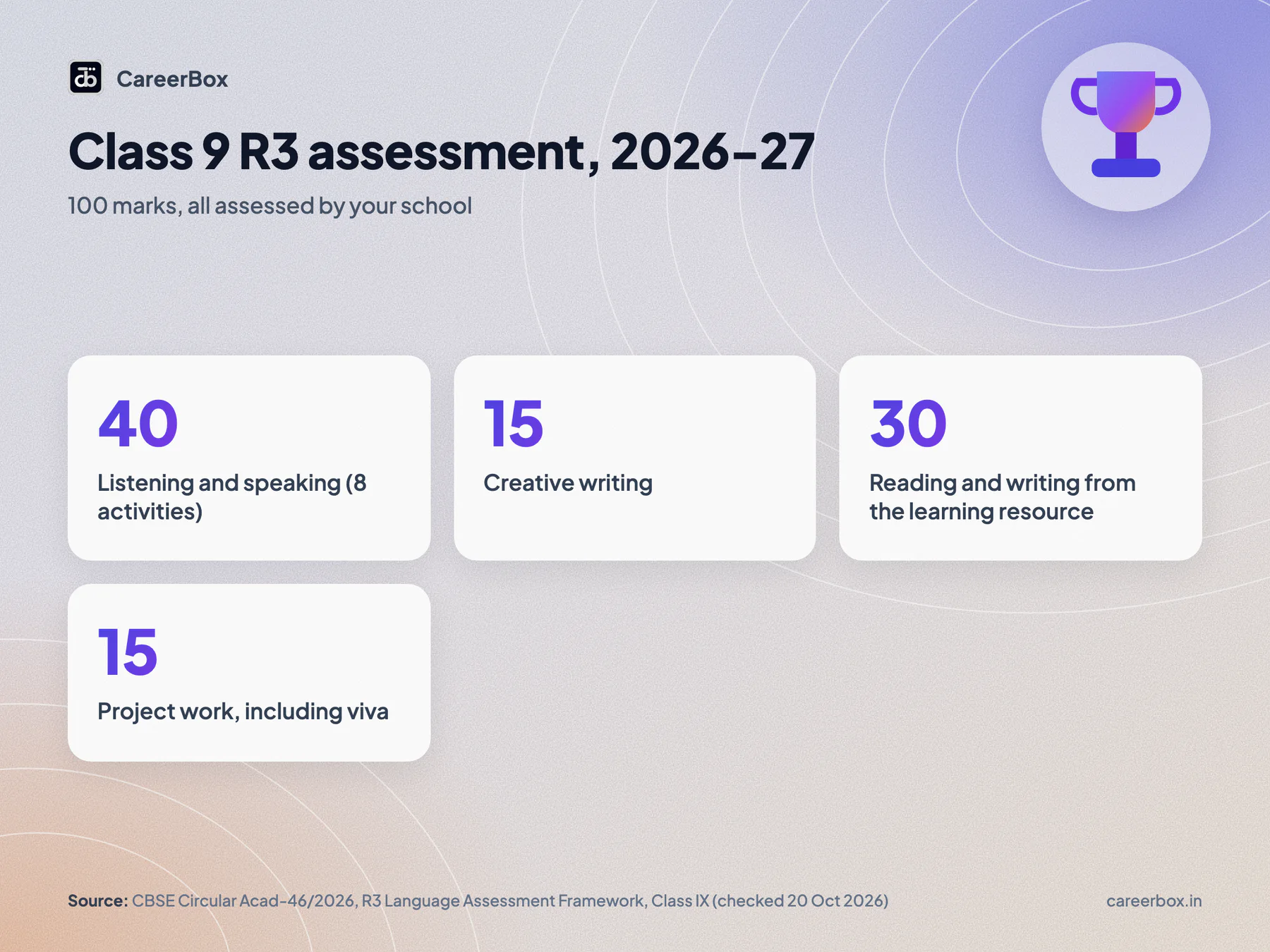
How Class 9 R3 is marked (Acad-46/2026): 100 marks, all school-based. Listening and speaking carry 40 (eight activities of 5 marks), creative writing 15, reading and writing from the NCERT learning resource 30, and a project with a viva 15.
If you do not clear R3 in Class 9: you are still promoted to Class 10 for 2027-28, but you must clear the Class 9 R3 assessment while in Class 10.
Three-language policy for Class 10: two different answers
- Class 10 in 2026-27 (2027 boards): no change. Acad-49/2026 says this batch "will continue with the old system of two languages" and "no third language is required". When your school files your board details, R3 should not appear; our report on the CBSE 2027 boards LOC deadline explains how to check your subjects. The 2027 sample papers follow the same two-language pattern.
- Class 10 in 2027-28 (the current Class 9): no CBSE board exam in R3. But you must clear R3 "in the school-based assessment in Class X for the award of the CBSE Secondary School Examination Pass Certificate". If you fall short, the school reassesses you before the Class 10 result. R3 performance appears on the CBSE certificate.
Class 6, 7 and 8: what changed, and what the Supreme Court said
Under Acad-49/2026, students now in Classes 7 and 8 study three languages up to Class 10. Those who had already started two foreign languages add one Indian language. R3 is assessed only by the school, and there is no R3 board exam when they reach Class 10.
For Class 6 in 2026-27, CBSE's July guidelines said this batch and later ones "shall take the Board examination of R3" in Class 10.
That is the point the Supreme Court changed. Nineteen petitioners filed W.P.(C) No. 694/2026, Yashica Bhandari Jain & Ors. v. Union of India & Ors. on 22 May 2026, against the Union of India, CBSE and NCERT. Notice was issued on 27 May 2026, and more petitions have since been tagged with it.
On 28 September 2026, a bench of the Chief Justice and Justices Joymalya Bagchi and V. Mohana recorded the Solicitor General's statement that "98-99% of the schools have been provided adequate facilities" for the policy and "only 1.2% schools are yet to provide such facilities". The court then directed: "the students, who are in 6th standard, may be granted the same exemption as has been granted to the students of the 7th standard."
In plain terms, going by what CBSE granted Class 7: the current Class 6 still studies R3, but it is assessed by the school, and the court's order places this batch with Class 7, which has no R3 board exam in Class 10. This is an interim order. The court gave four weeks for affidavits and two weeks for replies, and listed the case for 19 November 2026. On 20 October 2026, CBSE's circulars page showed no new circular on the order yet, so follow your school's instructions. Our news report on the order has the background.
Which languages count as Indian languages (Bhartiya Bhashas)?
CBSE's examples of Bhartiya Bhashas are Hindi, Sanskrit, Tamil, Telugu, Kannada, Malayalam, Marathi, Bengali, Punjabi, Gujarati, Odia and Assamese. Its examples of non-native languages are English, French, German, Arabic and Spanish.
English is not counted as an Indian language under this scheme. That is why a student with English and French needs to add an Indian language.
NCERT and CBSE are making R3 textbooks in the 22 scheduled languages of the Constitution. Acad-33/2026 lists the Class 6 R3 books being prepared in Assamese, Bengali, Bodo, Dogri, Gujarati, Kannada, Kashmiri, Konkani, Maithili, Malayalam, Manipuri, Marathi, Nepali, Odia, Punjabi, Santhali, Sindhi, Tamil and Telugu. Schools can also offer an Indian language outside that list, using SCERT or state materials.
Exemptions and special cases
- Children with Special Needs: relaxations, including exemption from the second and/or third language where applicable, as per the RPwD Act, 2016.
- CBSE schools outside India: fully exempt from taking an Indian language as R3.
- Foreign students returning to India: exempt from studying an Indian language as R3.
- Families moving to another state: the student may keep the R3 studied in Classes 6 to 8.
Three-language policy in Gujarat
We found no Gujarat education department document on the CBSE R3 scheme itself. What Gujarat has on record is its own law on Gujarati. The Gujarat Compulsory Teaching and Learning of Gujarati Language Act, 2023 (Gujarat Act No. 4 of 2023, published in the Gujarat Government Gazette on 3 March 2023) says:
- Gujarati "shall be taught as a compulsory language in all schools in the State as an additional language".
- It covers Classes 1 to 8 in government, private, aided and minority schools, and other schools in Gujarat that "have affiliation with any Board", which takes in CBSE schools.
- Schools not teaching Gujarati were to introduce it from Class 1 in 2023-24 and extend it to Class 8 in phases.
- Students domiciled outside Gujarat can be exempted by their school on a written request from a parent.
- Schools that break the rule face penalties of ₹50,000, then ₹1 lakh, then ₹2 lakh.
The Act comes into force on a date the state notifies, so ask your school how it applies. For a CBSE student in Gujarat, Gujarati counts as one of your two Indian languages. Gujarat board students follow GSEB's own scheme; see our GSHSEB 2026-27 calendar report.
Frequently asked questions
Is the three-language policy compulsory for CBSE Class 9 in 2026-27?
Yes. From 1 July 2026, every CBSE Class 9 student studies three languages, at least two of them Indian. R3 is marked only by your school, out of 100.
Will Class 10 students in 2026-27 have to study a third language?
No. CBSE says the 2026-27 Class 10 batch stays on two languages and no third language is required.
Is there a board exam for the third language (R3)?
Not for students now in Classes 7, 8 and 9. For Class 6, CBSE had planned an R3 board exam in Class 10, but the Supreme Court's 28 September 2026 order gives them the same exemption as Class 7, pending the case.
What did the Supreme Court say about the three-language policy?
In W.P.(C) 694/2026, on 28 September 2026, it directed that Class 6 students "may be granted the same exemption" as Class 7. It has not ruled on the policy itself. The next hearing is on 19 November 2026.
Is English counted as an Indian language?
No. CBSE lists English with French, German, Arabic and Spanish as non-native languages. It can be one of your three only if the other two are Indian, or as a fourth language.
Is Gujarati compulsory in CBSE schools in Gujarat?
Gujarat's 2023 Act makes Gujarati a compulsory additional language in Classes 1 to 8 in all schools in the state, whatever their board. Students domiciled outside Gujarat can seek an exemption through their school.
Planning beyond Class 10? Our career guidance for Class 10 and 12 students is a good next read.
Sources
All checked on 20 October 2026.
- Ministry of Education, National Education Policy 2020, paras 4.11 to 4.21 (NCERT copy): ncert.nic.in/pdf/nep/NEP_2020.pdf
- NCERT, National Curriculum Framework for School Education 2023: ncert.nic.in/pdf/NCFSE-2023-August_2023.pdf
- CBSE Circular Acad-17/2026, Introduction of R3 in Class VI (9 April 2026): cbseacademic.nic.in/web_material/Circulars/2026/17_Circular_2026.pdf
- CBSE Circular Acad-25/2026, Compliance with introduction of R3 in Class VI (4 May 2026): cbseacademic.nic.in/web_material/Circulars/2026/25_Circular_2026.pdf
- CBSE Circular Acad-33/2026, Scheme of studies for languages in Classes IX and X (15 May 2026): cbseacademic.nic.in/web_material/Circulars/2026/33_Circular_2026.pdf
- CBSE press release on the three-language policy (29 June 2026): cbse.gov.in/cbsenew/documents/Press_Release_Three_lang_29062026.pdf
- CBSE Circular Acad-46/2026, R3 Language Assessment Framework for Class IX (2 July 2026): cbseacademic.nic.in/web_material/Circulars/2026/46_Circular_2026.pdf
- CBSE Circular Acad-49/2026, Guidelines for the three-language scheme from 2026-27 (10 July 2026): cbseacademic.nic.in/web_material/Circulars/2026/49_Circular_2026.pdf
- Supreme Court of India, W.P.(C) 694/2026, record of proceedings, 28 September 2026: api.sci.gov.in/supremecourt/2026/32335/32335_2026_1_36_74440_Order_28-Sep-2026.pdf
- Supreme Court of India, W.P.(C) 694/2026, notice order of 27 May 2026: api.sci.gov.in/supremecourt/2026/32335/32335_2026_1_46_71617_Order_27-May-2026.pdf
- Gujarat Compulsory Teaching and Learning of Gujarati Language Act, 2023 (India Code): indiacode.nic.in/handle/123456789/19401?view_type=browse
Rules can change after the 19 November 2026 hearing or with a new CBSE circular. Confirm with your school before choosing or dropping a language.
More to read
All articles
UGC new rules 2026: equity regulations, Supreme Court stay, assistant professor rules and degrees
Oct 20, 202611 min read
CBSE board exam 2027: date sheet status, Class 10 two board exams, LOC, private forms and sample papers
Oct 20, 202613 min read
Canada student visa 2026 for Indian students: study permit cap, PAL, funds, GIC, fees, processing time
Oct 20, 202611 min read
JEE Main 2027: session 1 exam date, registration, fee, documents, eligibility, syllabus and pattern
Oct 20, 202612 min read
CUET PG 2027: exam date, registration, fee, eligibility, syllabus, pattern and participating universities
Oct 20, 202611 min read
US student visa 2026 new rules for Indians: F-1 fees in rupees, interview, social media, OPT and slot booking
Oct 20, 202611 min read