
NIFT 2027: exam date, how to apply, fees, eligibility, exam pattern, campuses and Gandhinagar seats
NIFT 2027 is on 10 January 2027 and applications close on 16 November 2026. Fee, age limit, GAT and CAT pattern, Situation Test, weightages, 5,076 seats on 20 campuses, Gandhinagar and a plan to prepare.
NIFTEE 2027 is the National Institute of Fashion Technology Entrance Examination, run by the National Testing Agency (NTA) for the 2027-28 session. NTA published its Information Bulletin and a public notice dated 16 October 2026, and NIFT published its Admissions Prospectus 2027 on 21 October 2026. Everything below comes from those three documents, read on 26 October 2026. NTA says dates are tentative and can change, so check the NTA NIFTEE page before you act.
Key takeaways
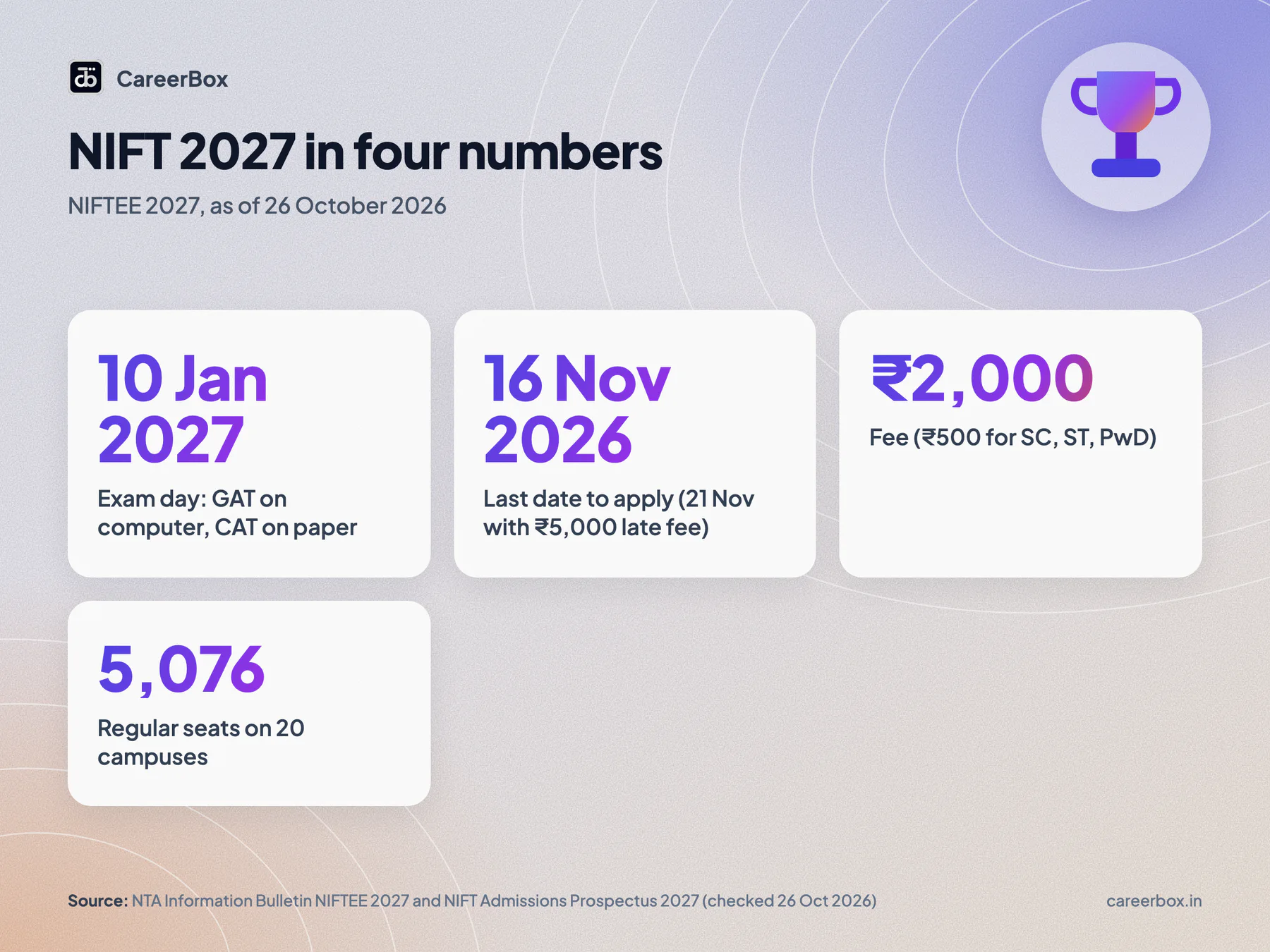
- Exam day: 10 January 2027. GAT on a computer, CAT on paper. Centre, date and shift are printed on the admit card.
- Last date to apply: 16 November 2026. With a late fee of ₹5,000 you can apply until 21 November 2026. Corrections: 22 to 25 November 2026.
- Fee: ₹2,000 (Open, EWS, OBC-NCL) or ₹500 (SC, ST, PwD) for one programme; ₹3,000 or ₹750 for two programmes.
- B.Des pattern: GAT of 100 questions in 120 minutes plus CAT of 3 questions in 180 minutes. Merit is GAT 30%, CAT 50%, Situation Test 20%.
- Negative marking: 0.25 mark off for every wrong GAT answer.
- Seats: 5,076 regular seats on 20 campuses in 2027, including 480 state-domicile seats. Gandhinagar has 38 regular seats in each of 7 programmes.
NIFT 2027 exam date and schedule
| Activity | Date (as of 26 October 2026) |
|---|---|
| Online registration opens | 16 October 2026 |
| Last date to apply with the normal fee | 16 November 2026 |
| Last date to apply with ₹5,000 late fee | 21 November 2026 |
| Correction window (online only) | 22 to 25 November 2026 |
| Advance city intimation slip | 21 December 2026 |
| Admit card download | 4 January 2027 |
| Entrance exam (GAT and CAT) | 10 January 2027 |
| Display of recorded responses and answer keys | To be announced on the NTA site |
| Stage 1 result | February/March 2027 |
| Situation Test (B.Des) or Personal Interview (PG) | March/April 2027 |
| Final result | First week of May 2027 |
| Seat allocation | May/June 2027 |
The bulletin lists the later dates as tentative. The prospectus adds that orientation for new UG and PG students of the 2027-28 session starts on 28 July 2027.
On exam day the B.Des GAT runs from 9:00 am to 11:00 am and the CAT from 3:00 pm to 6:00 pm. The B.F.Tech GAT runs from 9:00 am to 12:00 noon. Both papers are bilingual, in Hindi and English, and if the two versions differ the English version is final.
How to apply for NIFT 2027
You apply only online on the NTA NIFTEE portal. Forms sent any other way are not accepted. The bulletin lays out four steps:
- Register. The bulletin says registration is enabled through the MeriPehchaan single sign-on service. You choose a password and a security question, and you get an application number. Use your own mobile number and email ID, because NTA sends information only to those. One mobile number and one email can be used for one form only.
- Fill the form. Personal details, programme, four exam cities in order of preference, educational details and uploads. NTA's notice says Aadhaar-based e-KYC and a live photograph may be needed.
- Upload files. A recent colour passport photo (JPG or JPEG, 10 to 200 KB, face about 80% of the frame, white background), a signature (JPG or JPEG, 10 to 50 KB) and, if you claim PwD or PwBD status, a UDID card or disability certificate (PDF, 50 to 300 KB).
- Pay the fee and download the confirmation page. Your candidature is confirmed only after the fee is received. Keep a copy of the confirmation page.
File only one application. If you hold two application numbers and appear on both, NTA treats it as unfair means. The correction window lets you edit only the fields NTA enables, and after it closes no change is entertained. The prospectus says your category cannot be changed after the correction window closes.
You can pick a Gujarat city for the exam if your permanent or present address is in Gujarat: the Gujarat centres in the 2027 list are Ahmedabad/Gandhinagar, Rajkot, Surat and Vadodara. NTA says city choices are limited to the state of your permanent or present address.
NIFT 2027 application fee
| Category | One programme | Two programmes |
|---|---|---|
| Open, Open-EWS, OBC (NCL) | ₹2,000 | ₹3,000 |
| SC, ST, PwD/PwBD | ₹500 | ₹750 |
| NRI, Foreign National, OCI, PIO, SAARC (UG and PG) | ₹11,100 | not applicable |
"Two programmes" means B.F.Tech with B.Des, or M.F.M with M.Des, on a single form. Bank or gateway charges are extra and the fee is not refunded once paid, except for duplicate payments. Only candidates on the OBC (NCL) central list should choose OBC (NCL); a state-list OBC candidate not on the central list must choose General.
NIFT 2027 eligibility and age limit
Age (bachelor's programmes). The candidate must be less than 24 years old on 1 August 2027. Worked out from that rule, that means a date of birth after 1 August 2003. The limit is relaxed by 5 years for SC, ST, PwD and PwBD candidates. There is no age limit for M.Des, M.F.M and M.F.Tech.
B.Des (4 years). Class 12 (10+2) from any recognised board, or a NIOS Senior Secondary pass with at least five subjects, or a 3 or 4-year diploma recognised by AICTE or a state board after Class 10, or an AIU-recognised equivalent, or GCE A-level or IB.
B.F.Tech (4 years, Apparel Production). The same Class 12 routes but with Mathematics, or a 3 or 4-year engineering diploma after Class 10. A B.F.Tech applicant who has Mathematics can also take the CAT along with the GAT and be considered for B.Des. Two separate merit ranks are then made.
M.Des and M.F.M (2 years). Any undergraduate degree from an institute or university recognised by law in India, or a 3-year undergraduate diploma from NIFT or NID.
M.F.Tech (2 years). B.F.Tech from NIFT, or B.E./B.Tech from a recognised institution, or a 4-year B.F.Tech from a recognised institution.
If you are still sitting your qualifying exam, you can apply, but you must show proof of the pass at the time of seat allocation. The prospectus gives students whose result is pending provisional admission, with the final result due by 30 September 2027.
NIFT 2027 exam pattern: GAT, CAT, Situation Test and interview
NIFT admission has more than one stage. The entrance exam is Stage 1, and shortlisted candidates take a second test at a test centre.
| Programme | Stage 1 (10 January 2027) | Stage 2 |
|---|---|---|
| B.Des | GAT + CAT | Situation Test |
| B.F.Tech | GAT (Sections A and B) | None; GAT decides |
| M.Des | GAT (Section A) + CAT | Personal Interview |
| M.F.M | GAT (Sections A and B) | Personal Interview |
| M.F.Tech | GAT | Personal Interview |
GAT (General Ability Test)
The GAT is computer-based. Each question carries 1 mark, a wrong answer costs 0.25 mark and an unattempted question scores nothing. For B.Des, Section A has 100 questions in 120 minutes:
| Section A topic | Questions (B.Des) |
|---|---|
| Communication Ability and English Comprehension | 40 |
| Quantitative Ability | 20 |
| Analytical and Logical Ability | 15 |
| General Knowledge and Current Affairs | 25 |
B.F.Tech candidates also take Section B of 50 questions in 60 minutes: Quantitative Ability 15, Analytical and Logical Ability 15 and Case Study 20. NTA adds that the number of questions can vary by section and by year.
CAT (Creative Ability Test)
The CAT is a pen-and-paper test of 3 questions in 3 hours, taken by B.Des and M.Des candidates. NTA says it judges intuitive ability, power of observation in concept development and design ability, with weight on the creative and innovative use of colour and illustration. You get a physical question booklet with space for answers and bring your own colouring and drawing material. Do not write your name, a logo or a coaching centre's details anywhere on the answer sheet. The bulletin says such candidates are disqualified and their result is not declared. A scribe cannot be provided for the CAT.
Situation Test (B.Des)
Shortlisted B.Des candidates make a model from a given set of materials, and nothing extra is allowed. The Situation Test is marked out of 100: 3D model 50, write-up 20 and overall presentation 30. The write-up must be in English, since no marks are given for other languages. A jury evaluates it on the spot. You must appear in both the GAT and the CAT to be shortlisted for it.
Personal Interview (PG)
PG candidates are assessed on career orientation, aptness for the course, academic and co-curricular achievements, communication and general awareness, aptitude and creative and lateral thinking. The prospectus says shortlisted PG candidates attend the interview at New Delhi.
NIFT 2027 weightage and tie-break
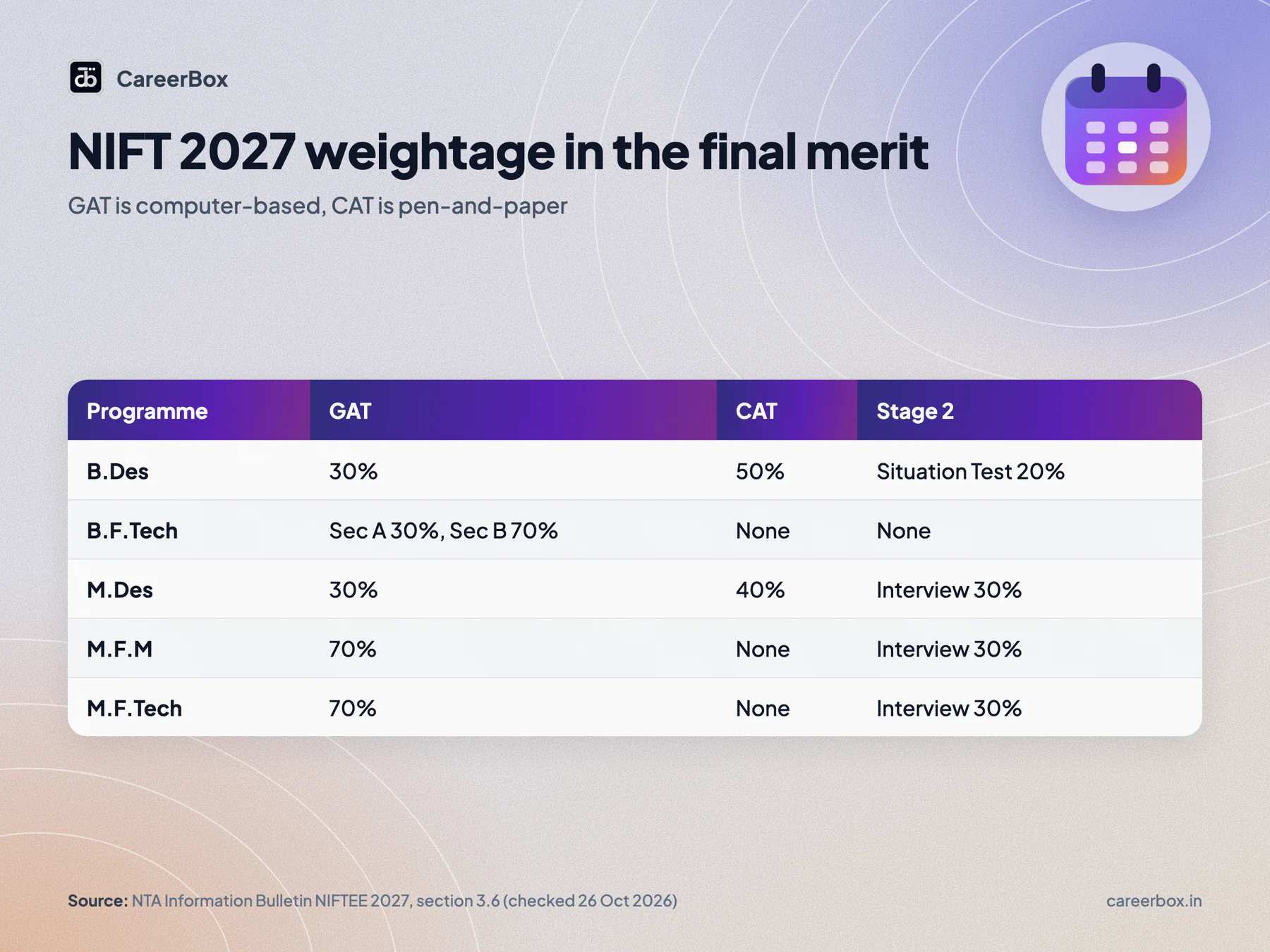
| Programme | Weightage in the final merit |
|---|---|
| B.Des | GAT 30%, CAT 50%, Situation Test 20% |
| B.F.Tech | GAT Section A 30%, Section B 70% |
| B.F.Tech applicant opting for B.Des | GAT Section A 30%, CAT 50%, Situation Test 20% |
| M.Des | GAT 30%, CAT 40%, Personal Interview 30% |
| M.F.M | GAT (Sections A and B) 70%, Personal Interview 30% |
| M.F.Tech | GAT 70%, Personal Interview 30% |
If two B.Des or M.Des candidates tie, NTA compares CAT marks first, then GAT marks, then the section scores in this order: Communication Ability and English Comprehension, Quantitative Ability, Analytical and Logical Ability, and General Knowledge and Current Affairs. For Stage 2, marks in the Situation Test or interview are preferred before these rules apply.
NIFT campuses and seats in 2027
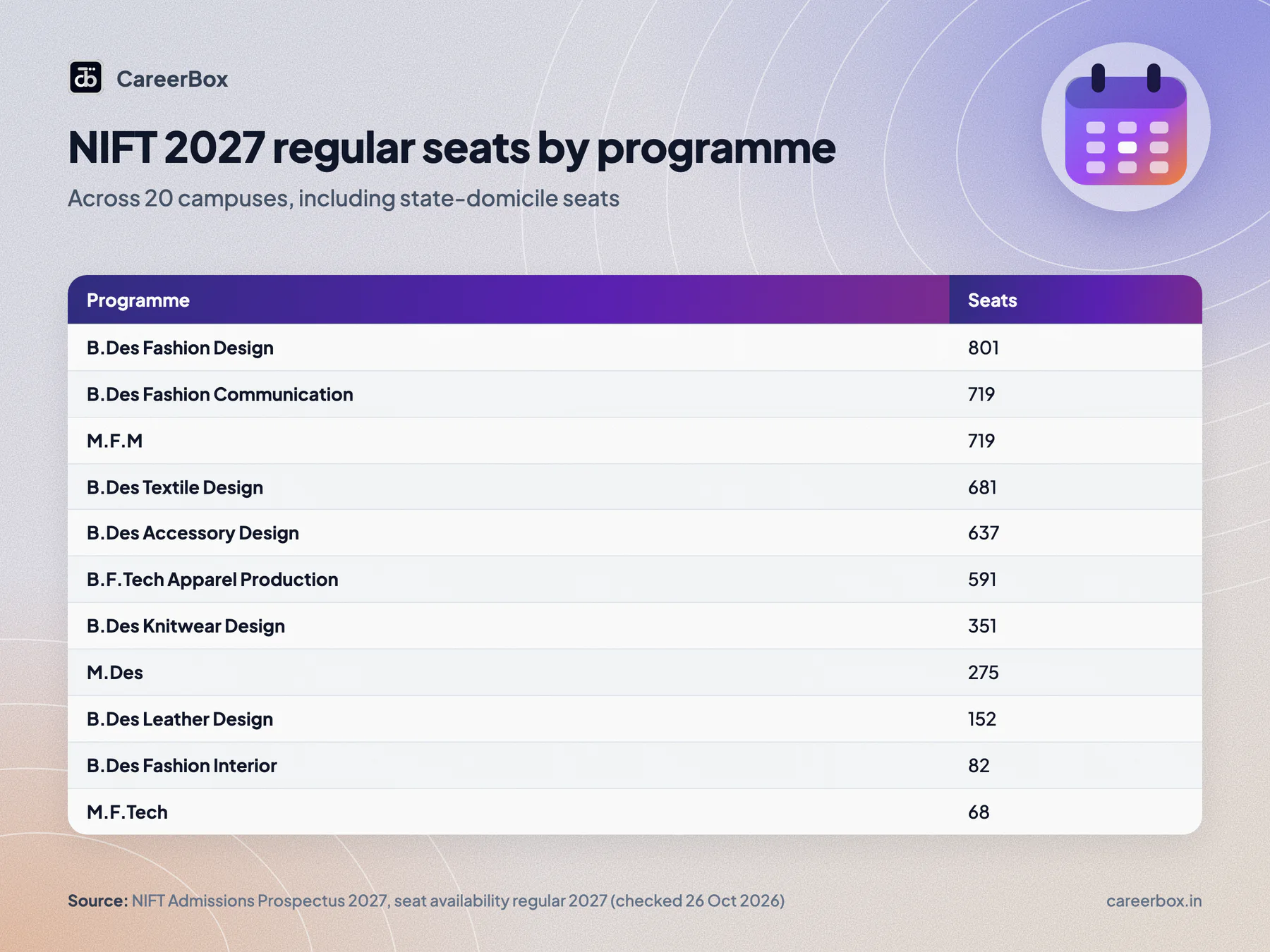
NIFT has 20 campuses: Bengaluru, Bhopal, Bhubaneswar, Chennai, Daman, Gandhinagar, Hyderabad, Jodhpur, Kangra, Kannur, Kolkata, Mumbai, Nava Raipur, New Delhi, Panchkula, Patna, Raebareli, Shillong, Srinagar and Varanasi. The prospectus lists 5,076 regular seats for 2027: 4,596 regular and 480 state-domicile seats. NIFT can increase or decrease seats at its discretion.
| Programme | Regular seats 2027 (incl. domicile) |
|---|---|
| B.Des: Fashion Design | 801 |
| B.Des: Fashion Communication | 719 |
| B.Des: Textile Design | 681 |
| B.Des: Accessory Design | 637 |
| B.Des: Knitwear Design | 351 |
| B.Des: Leather Design | 152 |
| B.Des: Fashion Interior | 82 |
| B.F.Tech (Apparel Production) | 591 |
| M.Des | 275 |
| M.F.M | 719 |
| M.F.Tech | 68 |
Not every campus runs every programme. Fashion Interior seats are at Nava Raipur and Varanasi only, Leather Design at Chennai, Kolkata, New Delhi and Raebareli, and M.F.Tech at Chennai and New Delhi. A separate set of tentative lateral-entry (NLEA) seats, 401 in all, is open to diploma holders.
NIFT Gandhinagar for Gujarat students
The Gandhinagar campus (GH-0 Road, behind Info City, near DAIICT, Gandhinagar 382007) has 38 regular seats in each of seven programmes, 266 in all:
- B.Des: Accessory Design, Fashion Communication, Fashion Design and Textile Design
- B.F.Tech: Apparel Production
- M.Des and M.F.M
Gandhinagar does not offer Knitwear, Leather or Fashion Interior. The seat table shows no state-domicile seats at Gandhinagar, so being a Gujarat resident does not by itself earn a preferential seat there. The campuses with domicile seats are Bhopal, Bhubaneswar, Daman, Jodhpur, Kangra, Kannur, Nava Raipur, Panchkula, Patna, Shillong, Srinagar and Varanasi. Gandhinagar also has 5 supernumerary NRI seats per programme for NRI, OCI and foreign candidates.
The exam itself is held in Ahmedabad/Gandhinagar, Rajkot, Surat and Vadodara, so Gujarat candidates should not need to travel out of state. Read more on the design stream page on CareerBox.
Reservation and state domicile
The prospectus gives these reservations: SC 15%, ST 7.5%, OBC (NCL) 27%, GEN-EWS 10%, plus 5% horizontal reservation for PwD (40% or more disability) across all categories. OBC (NCL) certificates must have been issued not earlier than 1 April 2026. SC and ST caste certificates must be in English or Hindi, or come with a certified translation.
State-domicile seats are preferential seats at specific campuses. Your domicile is the state in which your Class 12 school is located, with a certificate from that school. You choose domicile during registration, and the choice is final. No separate merit is declared for domicile candidates, and unfilled domicile seats are merged into the general categories in the spot round.
Fees after admission (non-NRI)
The prospectus gives first-year costs of ₹1,91,700 in semester 1 and ₹1,50,000 in semester 2, which is ₹3,41,700 for 2027-28. Semester 1 includes tuition of ₹1,50,000, a ₹10,000 library fee, ₹4,900 for mediclaim and student development, ₹4,900 for exams, a refundable security deposit of ₹12,600 and a one-time registration fee of ₹9,300. Tuition rises each year, to ₹1,58,000 per semester in 2028-29 and ₹1,66,000 in 2029-30. NIFT can revise fees in any year.
How to prepare from 26 October 2026 to 10 January 2027
You have 76 days to the exam, and 21 days left on the application window. This plan is our suggestion, built on the official pattern.
26 October to 16 November: apply first, then set a base.
- Finish the form before 16 November. Photo, signature and certificates take longer than you expect, and NTA treats your details as final once the correction window closes.
- Check your category and Class 12 details against your documents before you pay.
- Start GAT Section A practice: English comprehension (40 questions, the biggest block), then quantitative ability from the topics NTA lists.
17 November to 21 December: build both halves.
- Alternate days: GAT sections on one, CAT drawing on the next. The CAT is half of your B.Des merit, so it should get at least as much time as the GAT.
- Practise CAT answers with the real constraints: 3 questions in 3 hours, colour and illustration, no name or mark on the sheet.
- Keep up with current affairs for the 25-question GK block.
- B.F.Tech applicants: add case-study and Section B practice.
22 December to 3 January: timed papers.
- Take full 120-minute GATs on a computer. Wrong answers cost 0.25 mark, so practise skipping what you can't answer.
- Time 3-hour CAT sittings. The CAT paper is at 3:00 pm on the exam day, so practise after a morning paper.
4 to 9 January: logistics.
- Download the admit card on 4 January and check the centre, date and shift.
- Pack the print of the admit card with the self-declaration, two passport photos, an original photo ID, and drawing and colouring material for the CAT. Phones, calculators, bags, loose stationery and pens are not allowed inside.
- Reach early. The bulletin asks for 2 hours before the exam; the prospectus says at least 60 minutes. Aim for the earlier.
After 10 January: the recorded responses and provisional answer key are shown for about two to three days. You can challenge a GAT answer for ₹200 per question. Start practising model-making for the Situation Test while you wait for the Stage 1 result in February or March.
Frequently asked questions
What is the NIFT 2027 exam date?
10 January 2027. GAT is on a computer and CAT on paper. The admit card is due on 4 January 2027.
What is the last date to apply for NIFT 2027?
16 November 2026, or 21 November 2026 with a late fee of ₹5,000 on top of the application fee. Corrections open from 22 to 25 November.
What is the NIFT 2027 application fee?
₹2,000 for Open, EWS and OBC (NCL); ₹500 for SC, ST and PwD. Applying for two programmes costs ₹3,000 or ₹750.
What is the age limit for NIFT 2027?
For B.Des and B.F.Tech, under 24 years on 1 August 2027, relaxed by 5 years for SC, ST and PwD. There is no age limit for M.Des, M.F.M and M.F.Tech.
Can I apply for NIFT B.Des after Class 12 Commerce or Arts?
The bulletin asks for Class 12 from a recognised board for B.Des and sets no subject requirement. B.F.Tech needs Mathematics.
Is there negative marking in NIFT?
Yes, 0.25 mark per wrong GAT answer. Unattempted questions carry no penalty. The CAT, Situation Test and interview are evaluated by experts.
Is there an interview for B.Des?
No. B.Des shortlists take a Situation Test. The Personal Interview is for M.Des, M.F.M and M.F.Tech.
Can I apply for both B.Des and B.F.Tech?
Yes, on one form, if you have Mathematics. You then take the GAT Sections A and B and the CAT, and get two separate merit ranks. The fee is ₹3,000 (₹750 for SC, ST and PwD).
Is there a NIFT campus in Gujarat?
Yes, at Gandhinagar. It has 38 regular seats each in Accessory Design, Fashion Communication, Fashion Design, Textile Design, B.F.Tech Apparel Production, M.Des and M.F.M.
Which exam centres are there in Gujarat?
Ahmedabad/Gandhinagar, Rajkot, Surat and Vadodara.
How is NIFT different from NID and UCEED?
Each runs its own exam. Compare them on CareerBox: NIFT entrance, NID DAT and UCEED.
Where to go next
- Exam overview: NIFT entrance exam on CareerBox
- Explore the field: design stream on CareerBox
- Other design entrances: NID DAT and UCEED
- Latest updates: CareerBox News
Sources
All checked on 26 October 2026.
- National Testing Agency: Information Bulletin NIFTEE 2027: cdnbbsr.s3waas.gov.in/s388a839f2f6f1427879fc33ee4acf4f66/uploads/2026/10/202610161124929715.pdf
- National Testing Agency: Public Notice, 16 October 2026: cdnbbsr.s3waas.gov.in/s388a839f2f6f1427879fc33ee4acf4f66/uploads/2026/10/20261016429881227.pdf
- NIFT: Admissions Prospectus 2027: cdnbbsr.s3waas.gov.in/s388a839f2f6f1427879fc33ee4acf4f66/uploads/2026/10/20261021961583779.pdf
- NTA NIFTEE portal (applications, admit card, answer keys): exams.nta.nic.in/niftee
- NIFT: nift.ac.in
Dates and rules can change. Confirm them on exams.nta.nic.in/niftee and nift.ac.in before you act.
More to read
All articles
XAT 2027: exam date, last date to register, fee, pattern, marking scheme, XLRI selection and Gujarat test cities
Oct 26, 202616 min read
CAT percentile vs score: how raw, scaled and percentile scores work, and the minimum percentile each IIM asks for
Oct 24, 202616 min read
CAT 2026 answer key: release date, how to check your response, objection window and how to work out your raw score
Oct 24, 202612 min read
ACPC Gujarat BE/BTech admission 2026-27: dates, merit rule, seats, closing ranks and fees
Oct 24, 202614 min read
IIM placements 2025: median salary and share of graduates placed, from official NIRF data
Oct 23, 202615 min read
NIT placements 2025: median salary and share of graduates placed, from official NIRF data
Oct 22, 202614 min read