
Most in-demand degrees for Indian students: the jobs growing to 2030 and what students actually study
Data, AI, software, cybersecurity, fintech, green energy and healthcare lead the WEF Future of Jobs Report 2025. Here is how those roles map to Indian degrees, and how that compares with what students study according to AISHE 2021-22.

A degree is a three to five year bet, so it helps to look at two things side by side: what employers expect to hire for, and what students are picking. This guide does that with two official sources only, both read on 28 October 2026. One is the World Economic Forum's Future of Jobs Report 2025, a survey of more than 1,000 employers covering over 14 million workers. The other is the Ministry of Education's All India Survey on Higher Education (AISHE) 2021-22, the latest full count of who studies what in India.
Key takeaways
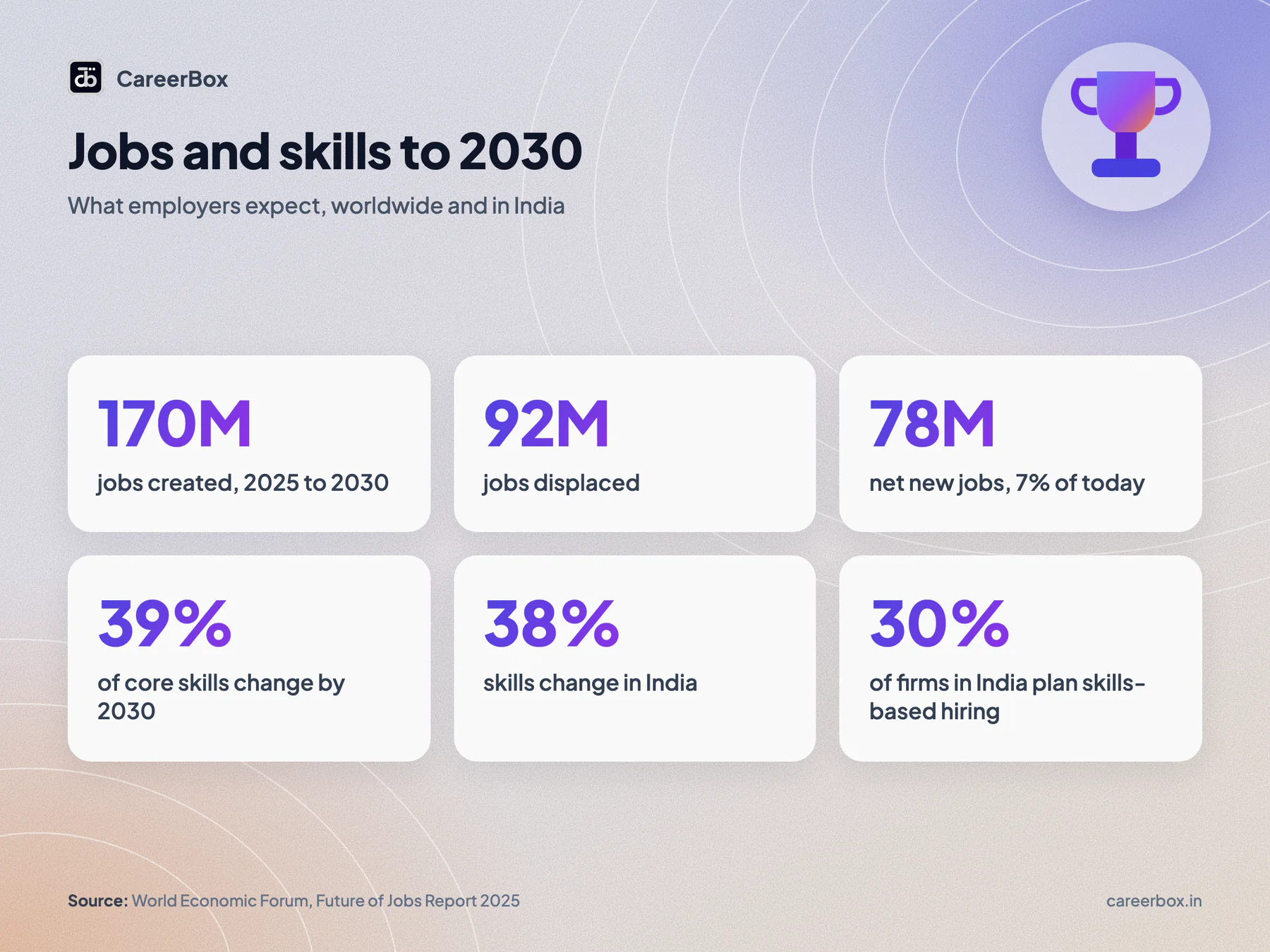
- Jobs will churn, not vanish. The WEF expects 170 million jobs to be created and 92 million displaced worldwide from 2025 to 2030, a net gain of 78 million, or 7% of formal jobs.
- Skills move faster than degrees. Employers expect 39% of workers' core skills to change by 2030. For India the figure is 38%.
- Technology roles grow fastest in percentage terms. Data, fintech, AI, software and security lead the list.
- Care, teaching and farming add the most jobs in sheer numbers. Nursing, social work, and higher and secondary education teachers are on the list of largest growing jobs.
- Indian enrolment is tilted to Arts. 34.2% of undergraduates study Arts, 14.8% Science, 13.3% Commerce and 11.8% Engineering and Technology (AISHE 2021-22).
What employers expect to hire for by 2030
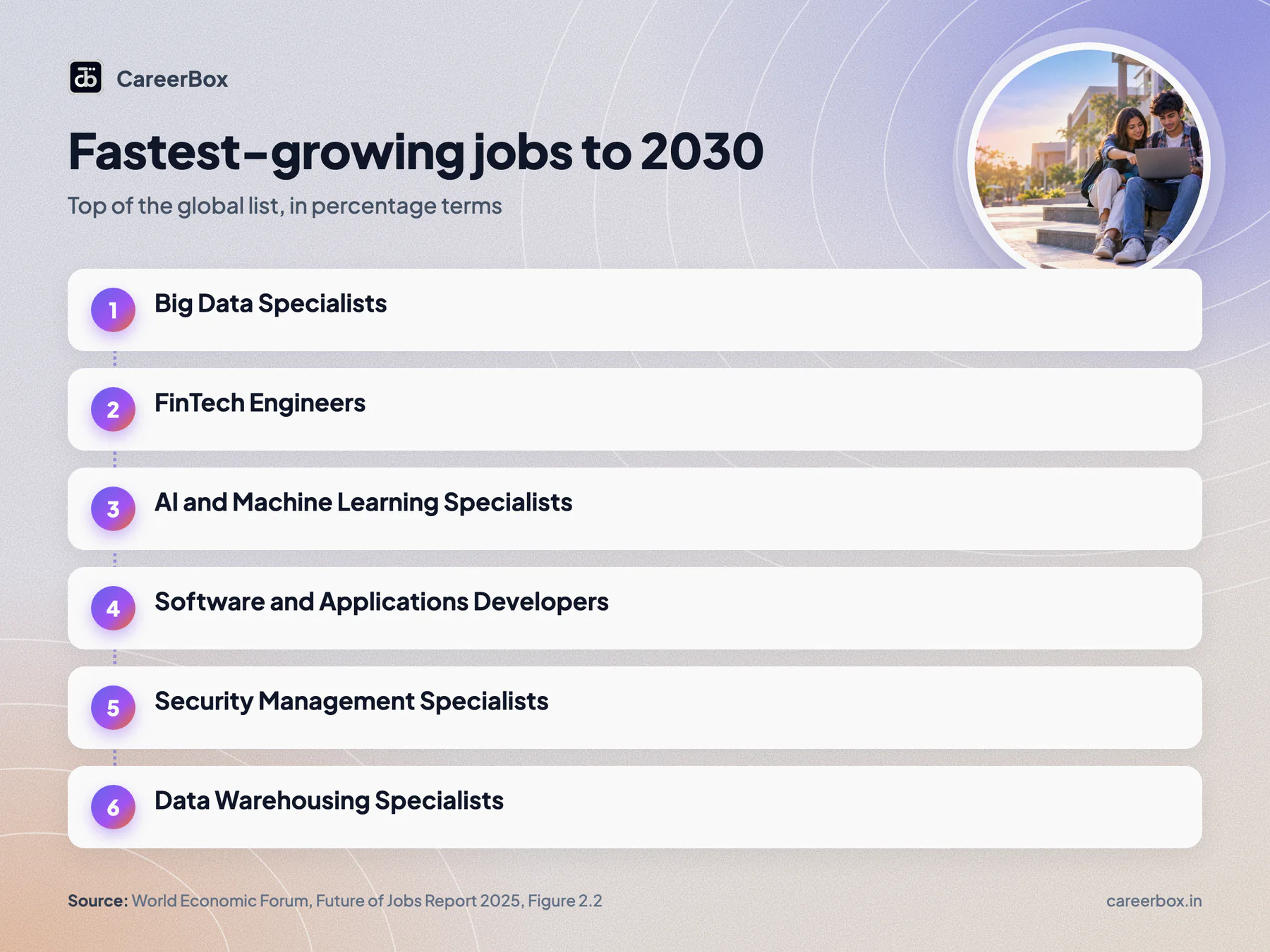
The WEF asked employers which roles will grow or shrink in their organisations between 2025 and 2030. The 15 fastest-growing jobs, in percentage terms, are:
- Big Data Specialists
- FinTech Engineers
- AI and Machine Learning Specialists
- Software and Applications Developers
- Security Management Specialists
- Data Warehousing Specialists
- Autonomous and Electric Vehicle Specialists
- UI and UX Designers
- Light Truck or Delivery Services Drivers
- Internet of Things Specialists
- Data Analysts and Scientists
- Environmental Engineers
- Information Security Analysts
- DevOps Engineers
- Renewable Energy Engineers
Three forces sit behind the list. Technology (AI, data and wider digital access) drives most of it. Security, both cyber and physical, grows partly because of geopolitical tension. The green transition pushes electric vehicle, environmental and renewable energy roles.
The fastest-shrinking roles are mostly clerical: postal clerks, bank tellers, data entry clerks, cashiers, administrative assistants, and accounting, bookkeeping and payroll clerks. Graphic designers and legal secretaries also feature on the declining list.
Biggest job creators in sheer numbers
Percentage growth favours small, new fields. In absolute numbers the WEF's list of largest growing jobs looks different: farmworkers, delivery drivers, software and applications developers, construction trades, shop salespersons, food processing workers, nursing professionals, general and operations managers, social work and counselling professionals, project managers, and university and secondary school teachers. For a student, that means healthcare, teaching, counselling and management remain large, steady employers alongside tech.
What Indian employers said
The report has a short note on India. Companies operating in India expect three trends to shape jobs by 2030: wider digital access, geopolitical tension, and climate mitigation. Their projected fastest-growing roles are Big Data Specialists, AI and Machine Learning Specialists, and Security Management Specialists.
Indian employers also plan to adopt some technologies faster than the global average. 35% expect semiconductors and computing technologies to transform their operations, and 21% expect the same of quantum and encryption. Two hiring signals matter for students:
- 30% of companies in India plan skills-based hiring by removing degree requirements, against 19% globally.
- 67% plan to tap more diverse talent pools, against 47% globally.
In short, Indian employers care about what you can do, not only the name of your degree. Projects, internships and certifications count.
The skills that will matter most
Employers ranked the skills they expect to grow in importance. AI and big data lead, followed by networks and cybersecurity and technological literacy. Next come creative thinking, resilience, flexibility and agility, and curiosity and lifelong learning. Leadership, talent management, analytical thinking and environmental stewardship complete the top ten.
The skill expected to lose the most ground is manual dexterity, endurance and precision. Reading, writing and maths stay important but see a small net decline as tools take over routine work.
What Indian students actually study
AISHE 2021-22 counted 4.33 crore students in higher education, up from 3.42 crore in 2014-15. The gross enrolment ratio for 18 to 23 year olds was 28.4. About 78.9% were in undergraduate courses and 12.1% in postgraduate ones. PhD enrolment rose to about 2.12 lakh.
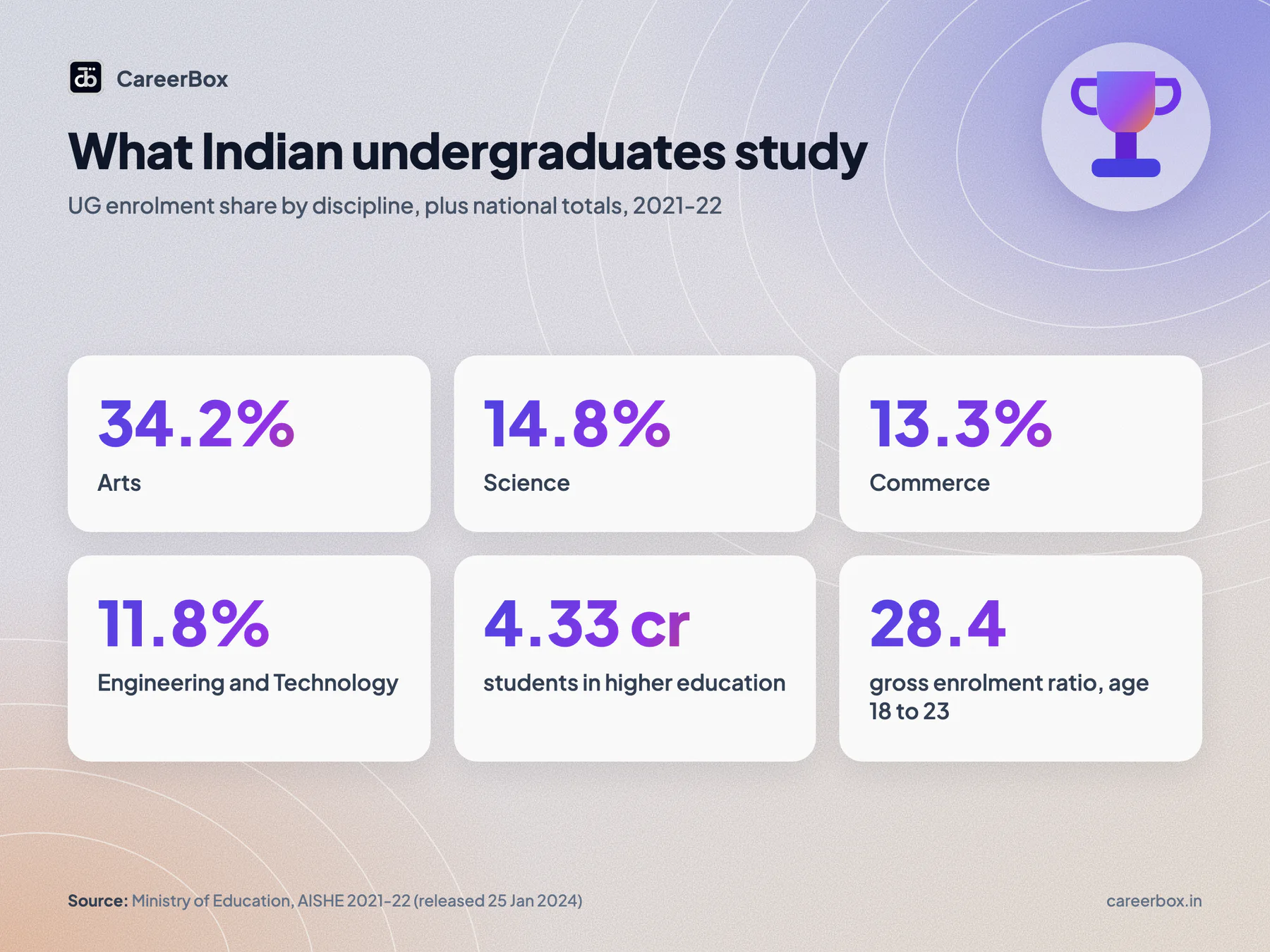
| Level | Largest disciplines (AISHE 2021-22) |
|---|---|
| Undergraduate | Arts 34.2%, Science 14.8%, Commerce 13.3%, Engineering and Technology 11.8% |
| Postgraduate | Social Science 21.1%, Science 14.7% |
Science draws 57.2 lakh students across UG, PG, MPhil and PhD, and women (29.8 lakh) outnumber men (27.4 lakh) there.
The gap. The roles growing fastest lean on maths, computing, data and engineering. These fields make up under a third of undergraduate enrolment. That gap is the opportunity. It also means an Arts or Commerce student who adds data, finance or digital skills stands out.
From fast-growing job to Indian degree
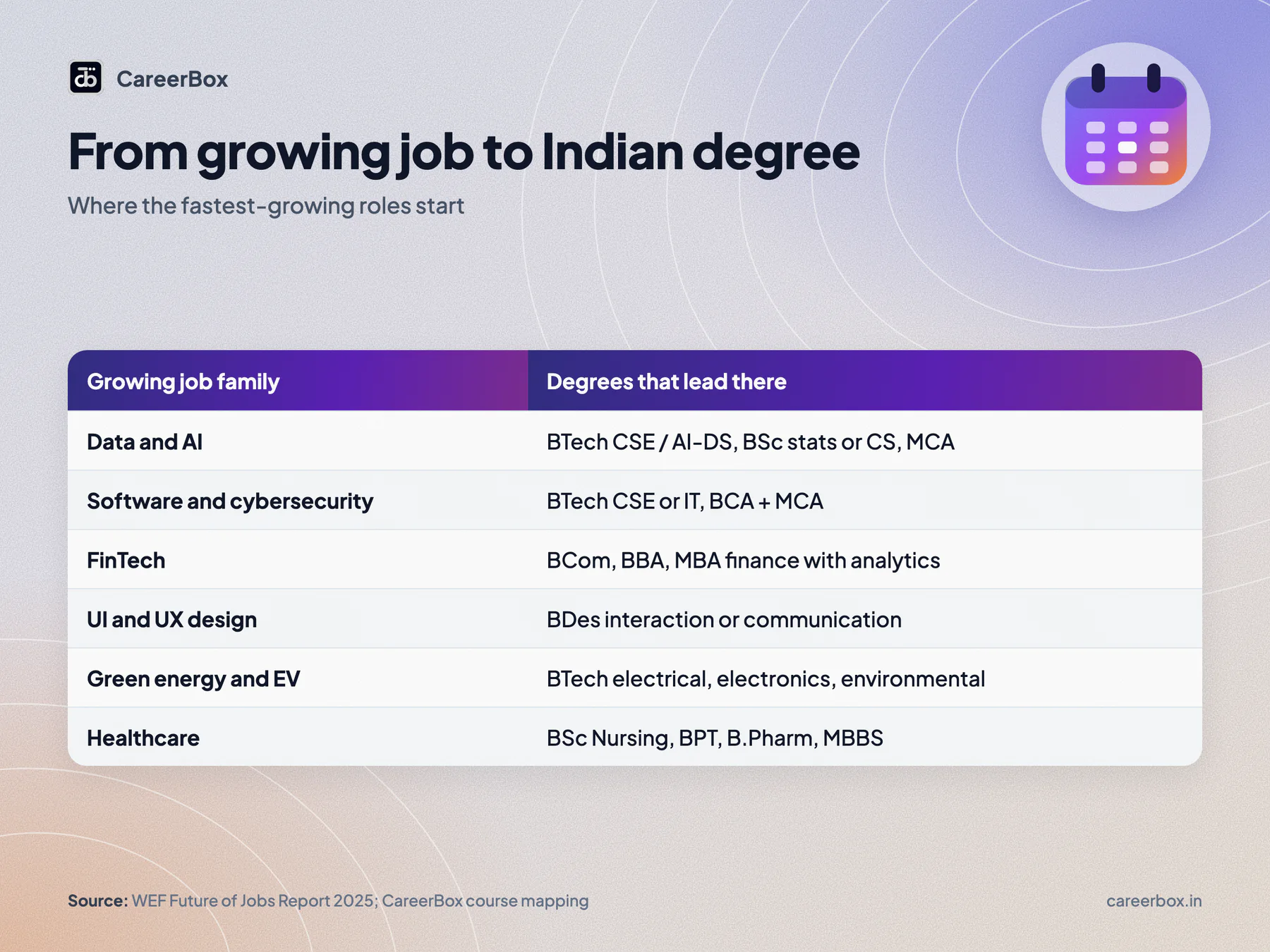
| Job family growing to 2030 | Degrees in India that lead there |
|---|---|
| Big data, data analysts and scientists, data warehousing | BTech/BE in CSE or AI and data science, BSc in maths, statistics or computer science, MCA, MSc |
| AI and machine learning | BTech/BE (CSE, AI and ML), MTech/ME, MSc in data science or computer science |
| Software developers, DevOps | BTech/BE (CSE, IT), BCA followed by MCA |
| Cybersecurity, information security | BTech/BE (CSE, cybersecurity), BCA or BSc with security certifications |
| FinTech | BTech/BE (CSE), BCom or BBA/BMS with finance and analytics, MBA in finance or business analytics |
| UI and UX design | BDes in interaction or communication design, see design colleges |
| EV, IoT, renewable energy, environmental engineering | BTech/BE in electrical, electronics, mechanical, environmental or energy engineering, diploma engineering for technician routes |
| Nursing and allied health | BSc Nursing, BPT, B.Pharm, MBBS |
| Teaching, counselling, social work | BA and MA followed by B.Ed, MSW, psychology |
| Agriculture and food processing | BSc Agriculture, food technology |
Degrees that stay strong in India
Beyond the WEF list, some Indian degrees hold steady demand because of how the economy and regulations work:
- Engineering and technology. Still the most direct route into the fastest-growing roles. Branch matters more than ever: CSE, AI and data science, electronics and electrical map most closely to the growth list. See engineering colleges.
- Medicine, nursing and pharmacy. Nursing professionals are among the largest job creators worldwide. India's licensing rules make these degrees hard to replace. See medical colleges and pharmacy colleges.
- Commerce and management. Routine accounting and bookkeeping clerk roles are on the declining list. Finance plus analytics is on the growing side. Pair a BCom, BBA or MBA with data tools and fintech exposure.
- Law. Legal secretaries and legal officials appear among the fastest-declining roles as document work is automated. A 3-year LLB or 5-year integrated LLB with a tech, corporate or policy focus keeps you on the right side. See law colleges.
- Arts and humanities. The largest share of Indian students, and the base for teaching, counselling and social work, which are big job creators. Add a data, digital or language skill to widen options.
- Studying abroad. The same roles grow abroad. Our guides on study abroad scholarships and studying in Germany cover cost and visas.
How to choose your degree
- Start from the work, not the degree name. Pick two or three job families from the lists above that suit you, then find the degrees that feed them.
- Check the branch and syllabus, not only the course. A BTech in CSE with AI electives and a BTech in a stagnant branch lead to very different jobs. Read the course list on the college page before you apply.
- Look for proof of skills. With 30% of Indian employers ready to drop degree requirements, internships, projects, a GitHub profile or a design portfolio matter as much as marks.
- Combine fields. Commerce with data analytics, biology with computing, design with psychology. The WEF's rising skills cut across disciplines.
- Plan for relearning. If 38% of core skills change by 2030, your degree is a start, not the finish. Pick colleges with strong industry links and short add-on courses.
- Compare colleges on outcomes. Use fees, placements and cutoffs. You can compare them on CareerBox.
Frequently asked questions
Which degree has the most demand in India?
By employer outlook, degrees that lead into data, AI, software and cybersecurity, such as BTech/BE in CSE or AI and data science, BCA plus MCA, and BSc in maths, statistics or computer science. Employers in India named Big Data, AI and Machine Learning, and Security Management Specialists as their fastest-growing roles in the WEF Future of Jobs Report 2025.
Which jobs are declining by 2030?
Mostly clerical jobs: postal clerks, bank tellers, data entry clerks, cashiers and ticket clerks, administrative assistants, and accounting, bookkeeping and payroll clerks. Graphic designers, legal secretaries and telemarketers are also on the WEF's declining list.
Is engineering still a good choice?
Yes, if the branch fits the growth roles. Engineering and technology make up 11.8% of undergraduate enrolment in India (AISHE 2021-22), while the fastest-growing jobs lean heavily on computing, data, electronics and energy.
Is an Arts degree a bad choice?
No. Arts is the largest discipline in India at 34.2% of undergraduates, and teaching, counselling and social work are among the largest job creators in the WEF report. Adding data, digital or language skills widens the options.
Which degree is best for an AI career?
A BTech/BE in CSE or AI and data science, or a BSc in maths, statistics or computer science followed by an MSc, MCA or MTech. Maths and programming matter more than the exact course title.
Do Indian companies still require a degree?
Most do, but the trend is shifting. 30% of companies operating in India plan skills-based hiring by removing degree requirements, against 19% globally, according to the WEF report.
How many students are in higher education in India?
About 4.33 crore in 2021-22, with a gross enrolment ratio of 28.4, according to AISHE 2021-22.
Where to go next
- Courses: BTech/BE, BCA, BSc, BCom, BDes, BSc Nursing
- Colleges by stream: engineering, medical, design, law
- Latest admission updates: CareerBox News
Sources
Both checked on 28 October 2026: the World Economic Forum Future of Jobs Report 2025 and the Ministry of Education's AISHE 2021-22 release (survey portal: aishe.gov.in).
Survey projections describe employer expectations, not guarantees. Check the course and college details before you apply.
More to read
All articles
GPSSB Gujarat Panchayat recruitment 2026: every post's status, result, merit list and cut-off
Oct 28, 202612 min read
GUJCET 2027: exam date status, form and fee, pattern, syllabus and how ACPC merit is calculated
Oct 28, 202612 min read
GATE score to PSU jobs and IIT M.Tech admission: how GATE 2027 scores are used, COAP, CCMT and cut-offs
Oct 28, 202612 min read
XAT 2027: exam date, last date to register, fee, pattern, marking scheme, XLRI selection and Gujarat test cities
Oct 26, 202616 min read
NIFT 2027: exam date, how to apply, fees, eligibility, exam pattern, campuses and Gandhinagar seats
Oct 26, 202616 min read
CAT percentile vs score: how raw, scaled and percentile scores work, and the minimum percentile each IIM asks for
Oct 24, 202616 min read