
PhD admission 2026: January 2027 session last dates, eligibility, UGC NET route and JRF fellowship
PhD admission for the January 2027 session: IISc, IIT Delhi, IIT Madras, IIT Kanpur and SVNIT dates, UGC 2022 eligibility (55% or 75%), the 70:30 rule, the NET route and the ₹37,000 JRF.

PhD admission in India is not one exam and one date. Each university or institute sets its own calendar, within a single set of UGC rules. This guide gives you the rules first, then the dated windows that are open on 22 October 2026, each read on the institute's own page or brochure.
Key takeaways
- Rules: the UGC (Minimum Standards and Procedure for Award of Ph.D. Degree) Regulations, 2022 apply to every university and college. No new PhD regulation has been issued since.
- Eligibility floor: master's with 55%, or a 4-year bachelor's with 75%. Reserved categories get a 5% relaxation. Individual institutes can ask for more.
- Two doors: a national fellowship score (NET, CSIR NET, GATE, CEED) with an interview, or the institution's own entrance test.
- Weightage: 70% entrance test and 30% interview/viva, as the regulations say. UGC NET score is used the same way for NET "PhD admission" qualifiers.
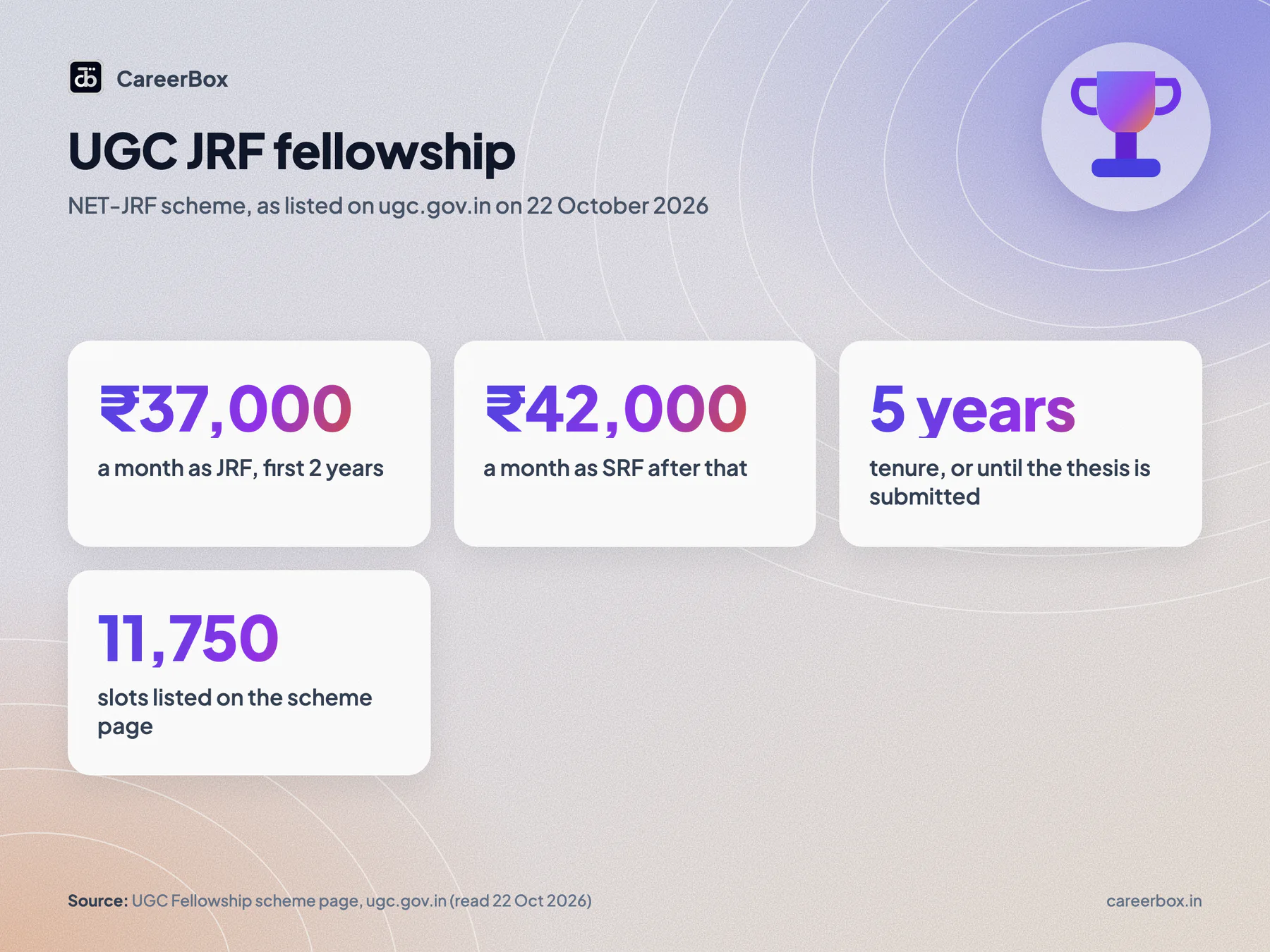
- Fellowship: JRF ₹37,000 a month for 2 years, then ₹42,000, per UGC's scheme page.
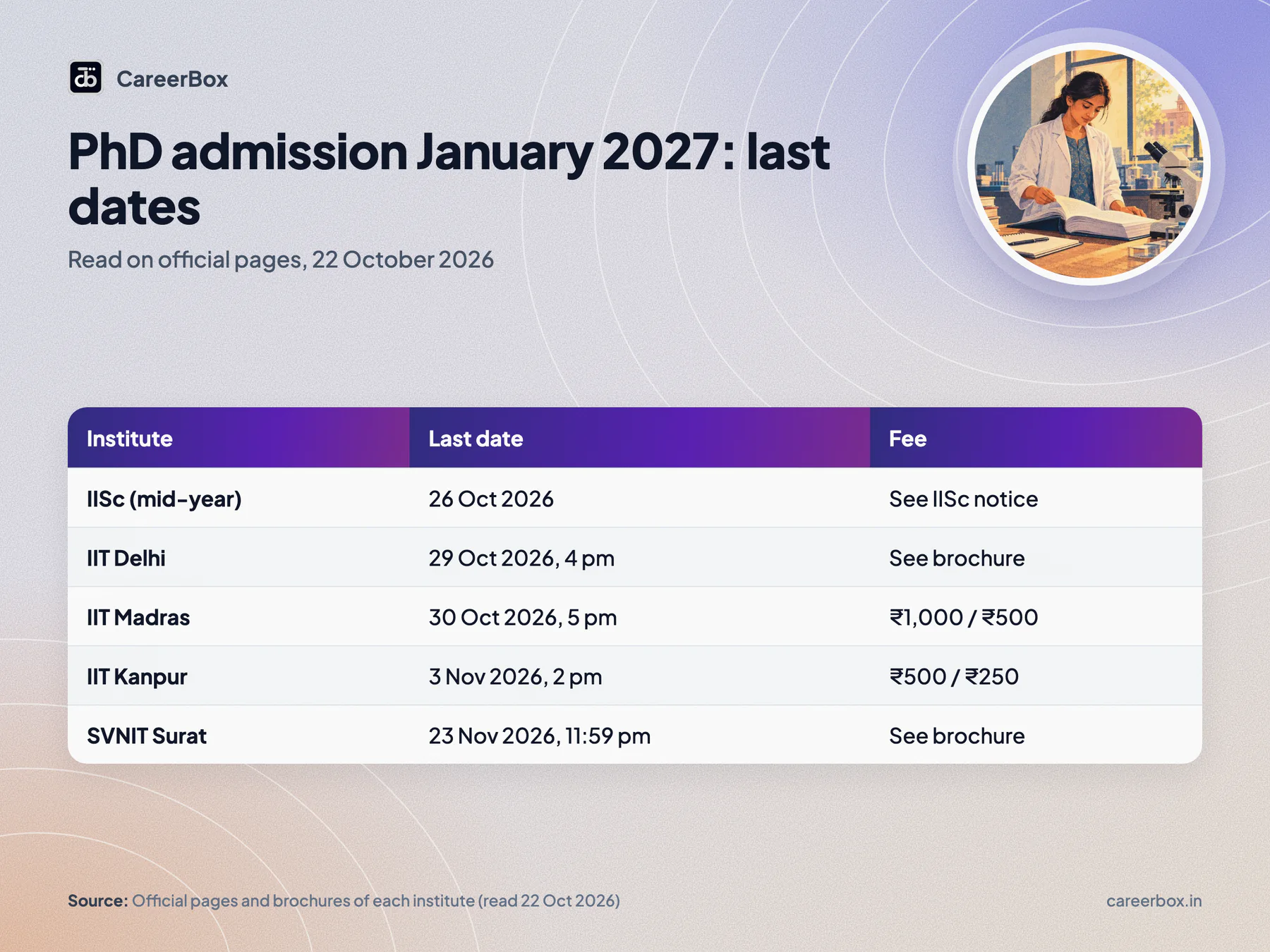
- Open now: IISc (to 26 October), IIT Delhi (29 October), IIT Madras (30 October), IIT Kanpur (3 November), SVNIT (23 November).
PhD admission 2026: who can apply under UGC rules
UGC's PhD Regulations, 2022 (published in the Gazette of India and on ugc.gov.in) list three ways in:
- Master's degree: a 1-year master's after a 4-year bachelor's, or a 2-year master's after a 3-year bachelor's, with at least 55% marks in aggregate or the equivalent grade.
- 4-year bachelor's degree: you can apply straight after it with at least 75% in aggregate.
- M.Phil.: with at least 55%. Note that Regulation 14 says institutions shall not offer M.Phil. any more.
SC, ST, OBC (non-creamy layer), differently-abled and EWS candidates, and other categories as UGC decides, get a 5% relaxation in these marks. A foreign qualification counts if it is from an accredited institution.
This is the minimum. Institutes can be stricter. SVNIT Surat, for example, asks for 60% (CGPA 6.0) in the master's for General, EWS and OBC-NCL candidates and 55% for SC, ST and PwD. Always read the brochure of the place you are applying to.
Two more rules from the same regulations:
- Duration: minimum 3 years including course work, maximum 6 years. Re-registration can add up to 2 years, so 8 in all. Women and PwD scholars with more than 40% disability can get 2 more, so 10 in all.
- No distance or online PhD: the regulations say no central or state institution shall run a PhD through distance or online mode. Part-time PhD is allowed, but you need a No Objection Certificate from your employer.
PhD admission through UGC NET: how the three categories work
If you want a PhD seat without sitting each university's own test, UGC NET is the usual route. NTA's information bulletin for UGC-NET December 2026 (read on 22 October 2026) sets out three result categories:
| Category | JRF | Assistant Professor | PhD admission |
|---|---|---|---|
| 1: JRF and Assistant Professor | Yes | Yes | Yes |
| 2: Assistant Professor and PhD admission | No | Yes | Yes |
| 3: PhD admission only | No | No | Yes |
What the bulletin says about each:
- JRF candidates are admitted to a PhD through an interview under the 2022 regulations. The JRF offer is valid for three years from the date of the JRF award letter.
- Category 2 and 3 candidates can use NET in place of a university's own entrance test. NET marks carry 70% weightage and the interview or viva carries 30%. Admission follows the combined merit.
- Validity: NET marks for PhD admission stay valid for one year from the date the result is declared.
- Registration time limit: you must meet the PhD requirements within two years (JRF) or one year (PhD admission only) of the NET result.
- Age: there is no upper age limit for NET for PhD admission.
- 4-year graduates: NET based on a 4-year degree makes you eligible for JRF and PhD, but not for Assistant Professor.
NTA's bulletin shows UGC NET December 2026 applications running until 28 October 2026. For the exam dates, fee and cut-offs, read our UGC NET December 2026 guide. For the science route, see our news on CSIR-UGC NET December 2026.
How an institution's own entrance test works
If you do not have a national fellowship score, the university can admit you through its own entrance test. The regulations fix the format:
- The syllabus is 50% research methodology and 50% subject-specific.
- You need 50% in the test to be called for the interview. SC, ST, OBC, differently-abled, EWS and other notified categories get a 5% relaxation.
- The final merit is 70% entrance test and 30% interview/viva.
- The institution must publish a prospectus on its website well in advance, with seats by subject, criteria and procedure.
Some IITs run their own written test or presentation instead. IIT Madras, for instance, says each department decides whether to hold a written test, and the cut-off is at the department's discretion.
JRF fellowship amount: what UGC pays
UGC's fellowship scheme page for NET-JRF (read on 22 October 2026) lists:
| Item | Amount |
|---|---|
| JRF, first 2 years | ₹37,000 a month |
| SRF, remaining period | ₹42,000 a month |
| Contingency, humanities and social sciences | ₹10,000 a year (JRF), ₹20,500 a year (SRF) |
| Contingency, sciences | ₹12,000 a year (JRF), ₹25,000 a year (SRF) |
| Tenure | 5 years or until the thesis is submitted, whichever is earlier |
The same page lists 11,750 slots. The fellowship is paid only after a university or institute registers you for a PhD. IIT Madras's brochure shows its own Institute fellowship at the same level: ₹37,000 a month for the first two years and ₹42,000 for the next three, plus HRA as per Government of India norms, for scholars on its Half-Time Research Assistantship (8 hours of departmental work a week).
PhD admission January 2027 session: windows open now
These are the calls I could read directly on official pages on 22 October 2026.
| Institute | Opens | Closes | Notes |
|---|---|---|---|
| IISc Bengaluru (mid-year PhD) | 6 October 2026 | 26 October 2026 | Per IISc's Office of International Relations |
| IIT Delhi (2nd semester 2026-27) | Portal open | 29 October 2026, 4 pm | PhD and MS (R); foreign nationals also 29 October |
| IIT Madras (January 2027) | 10 April 2026 | 30 October 2026, 5 pm | Fee ₹1,000 or ₹500; test and/or interview later |
| IIT Kanpur (January 2027) | 16 October 2026, 2 pm | 3 November 2026, 2 pm | Fee ₹500 or ₹250 |
| SVNIT Surat (Spring 2026-27) | 29 September 2026 | 23 November 2026, 11:59 pm | Tests on 9 and 10 December |
IIT Madras: its brochure (updated 10 September 2026) says applications received up to 30 October 2026 are considered for January 2027. The application fee is ₹1,000 for General, EWS and OBC-NCL men and transgender candidates, and ₹500 for women, SC, ST and PwD candidates. It is non-refundable. You must have qualified GATE or NET at least once to be a full-time Institute research scholar, and departments set their own extra criteria.
IIT Kanpur: applicants who expect to finish their programme by 4 January 2027 can apply for provisional admission. The fee is ₹500 for General, EWS, OBC and OBC-NCL, ₹250 for SC, ST and all DAP candidates, and nil for foreign nationals. A separate form is needed for each programme or department.
IIT Delhi: its PG admissions page lists 29 October 2026 as the last date for the PhD and MS (R) programme for the second semester of 2026-27, until 4 pm for national candidates. The fee and eligibility are in its information brochure, which I could not open, so read it before you apply.
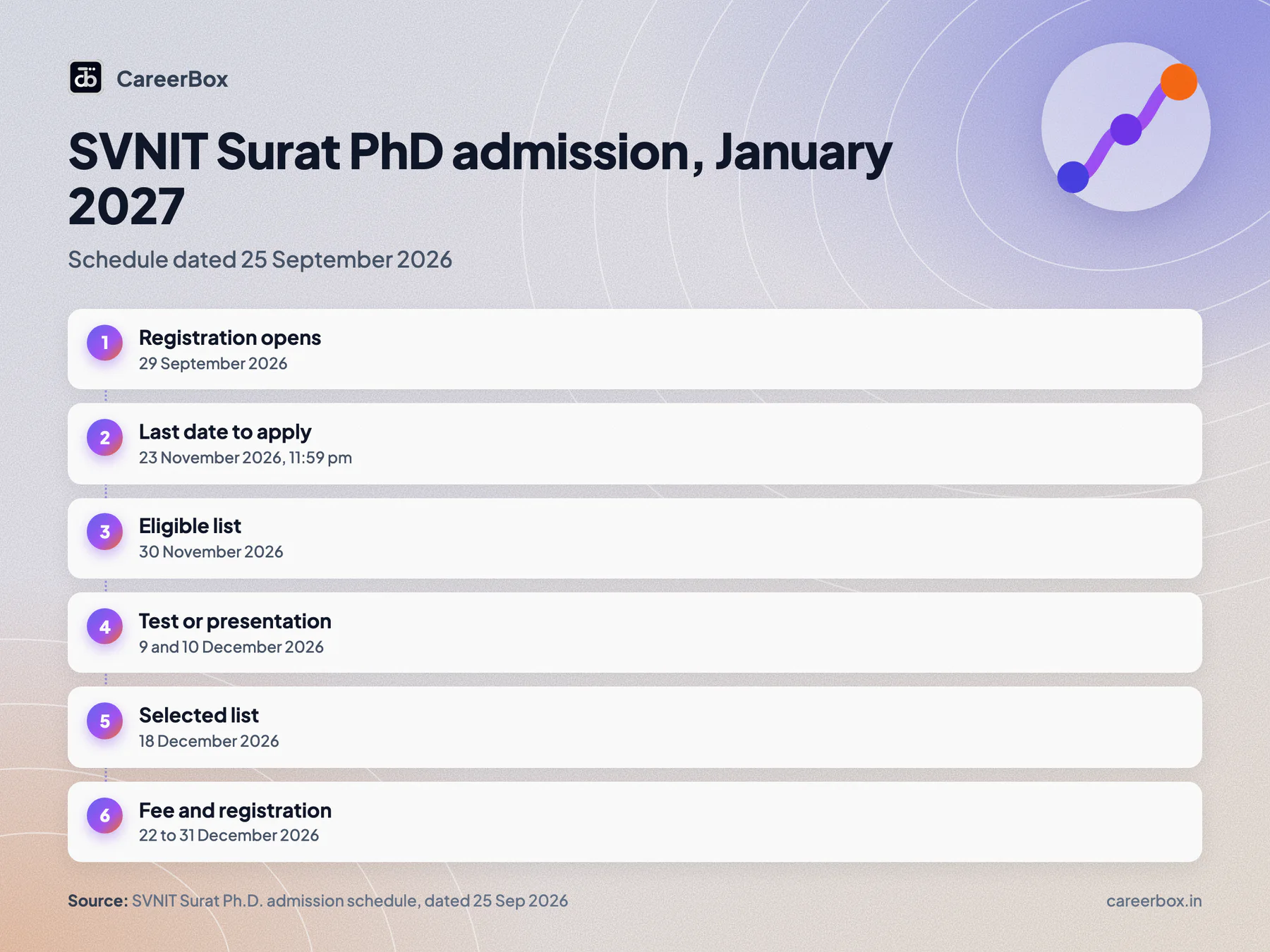
SVNIT Surat: its schedule, dated 25 September 2026, runs like this.
| Step | Date |
|---|---|
| Online registration and fee payment start | 29 September 2026 |
| Last date for online application | 23 November 2026, 11:59 pm |
| Eligible candidates' list | 30 November 2026 |
| Written test or presentation at the department | 9 December 2026 (9 am) for AI, Chemical, Civil, Electrical, Humanities and Mechanical; 10 December 2026 for the rest |
| Selected list | 18 December 2026 |
| Semester fee and registration | 22 to 31 December 2026 |
| Classes begin | 4 January 2027 |
PhD admission in Gujarat: what to check
Gujarat has several research universities, but not every one has a current call. On 22 October 2026, I read these official pages:
- SVNIT Surat has a live January 2027 call (above), and its brochure says full-time Institute research scholars in engineering, science, English and management should have qualified GATE or NET at least once.
- MSU Baroda lists its PhD admissions on a separate PhD admissions page, and its home page shows lists for the August to September 2026 intake. I did not find a January 2027 call there.
- Gujarat University, PDEU and Nirma: I could not find a 2026-27 January 2027 PhD call on their official sites on this date. Check their admission pages again in November.
- IIT Gandhinagar: its admissions page could not be read on this date. Check iitgn.ac.in/admissions/phd directly.
Money is a separate question. Gujarat's SHODH scheme pays ₹15,000 a month to full-time PhD scholars at the state's universities, but the 2026-27 window closed at 6 pm on 19 October 2026. Read our SHODH news for the documents step that ends on 30 October.
Central universities and other routes
For central universities, the national PhD entrance is often through CUET PG or the university's own test, and calls are posted individually. I did not find a January 2027 call that I could verify at Delhi University: its direct PhD route for four-year graduates closed on 16 September 2026 (read our Delhi University direct PhD news). Keep checking each university's admission page.
For rules beyond admission, such as UGC's other regulations in 2026, see our UGC new rules 2026 guide. To browse research programmes, see PhD in science and PhD in arts and humanities on CareerBox.
A simple plan for October 2026
- Check your marks against 55% (master's) or 75% (4-year bachelor's), with the 5% relaxation if it applies.
- Find your score route. Already have NET, JRF, GATE or CEED? Keep the scorecard ready. Without one, plan for the entrance tests above.
- Pick a supervisor. The regulations require each institution to publish its list of supervisors and the scholars each one has. Mail one or two before you apply.
- Apply before the dates in the table. One form per department.
- Prepare a short research proposal. Interviews and presentations carry 30% of the merit.
Frequently asked questions
What is the PhD admission 2026 last date?
There is no single date. For the January 2027 session, IISc closes on 26 October 2026, IIT Delhi on 29 October, IIT Madras on 30 October, IIT Kanpur on 3 November and SVNIT on 23 November.
Can I do a PhD after a 4-year bachelor's degree?
Yes. UGC's 2022 regulations allow it with at least 75% marks in aggregate, with a 5% relaxation for reserved categories. Institutes may set their own extra criteria.
Is NET compulsory for PhD admission?
No. The regulations allow admission through NET, CSIR NET, GATE or CEED with an interview, or through the institution's own entrance test. Some institutes need GATE or NET for fellowship-funded seats. IIT Madras and SVNIT both do for full-time Institute scholars.
How does the 70:30 rule work?
For admission by an institution's own entrance test, the final merit is 70% entrance test and 30% interview or viva. NTA's bulletin applies the same split to UGC NET category 2 and 3 qualifiers.
How long is a NET score valid for PhD admission?
NTA's bulletin says the marks for category 2 and 3 candidates are valid for one year from the date the NET result is declared. A JRF offer is valid for three years from the award letter.
How much is the JRF fellowship?
UGC's scheme page lists ₹37,000 a month for the first two years and ₹42,000 a month as SRF for the rest, with a yearly contingency grant of ₹10,000 or ₹12,000 for JRF depending on your field.
Can I do a PhD online or by distance?
No. The 2022 regulations say that no central or state institution shall conduct a PhD through distance or online mode. Part-time is allowed with an employer's No Objection Certificate.
How long does a PhD take?
At least 3 years, including course work, and at most 6 years. Re-registration can add up to 2 years, and women and PwD scholars can get 2 more.
Sources
All read on 22 October 2026.
- UGC: PhD Regulations, 2022 (Gazette): ugc.gov.in/pdfnews/0909572_Minimum-Standards-and-Procedure-for-Award-of-PhD-Degree.pdf
- UGC: Fellowship scheme page for NET-JRF: ugc.gov.in/Fellowship/stu_Fellowship1
- NTA: Information Bulletin, UGC-NET December 2026: cdnbbsr.s3waas.gov.in/s301eee509ee2f68dc6014898c309e86bf/uploads/2026/10/202610081852912625.pdf
- IIT Madras: research admission brochure, January 2027: research.iitm.ac.in/documents/Admission%20Brochure%20JAN%202027_V1.pdf
- IIT Kanpur: PG admissions, January 2027: iitk.ac.in/doaa/pgadmission
- IIT Delhi: PG admissions, 2nd semester 2026-27: academics.iitd.ac.in/pg-admissions
- SVNIT Surat: Ph.D. admission schedule, January 2027: svnit.ac.in/Data/admission/2027/phd/Schedule_PhD_admission_Even-2026-27_Display.pdf
- SVNIT Surat: Ph.D. information brochure, January 2027: svnit.ac.in/Data/admission/2027/phd/Ph.D%20information%20brochure_Jan%202027_Upload.pdf
- IISc Office of International Relations: oir.iisc.ac.in
Dates can change. Confirm them on each institute's own page before you pay a fee.
More to read
All articles
KVS recruitment 2026: NVS vacancies, CTET rule, salary, exam pattern and status
Oct 22, 202612 min read
ISRO recruitment 2026: Scientist SC, technician and apprentice notices, last date, salary, eligibility
Oct 22, 202611 min read
Government jobs 2026: 10th pass, 12th pass and graduate vacancies open now, with last dates
Oct 22, 202612 min read
Post Office Recruitment 2026: India Post GDS vacancies, Gujarat circle, eligibility, salary and merit list
Oct 22, 202611 min read
Post Matric Scholarship 2026-27: last date, income limit, amount, SC, OBC and how Gujarat students apply
Oct 22, 202613 min read
SSC CGL 2026: Tier 1 dates, 10,731 vacancies, Tier 2, salary, eligibility and result
Oct 22, 202613 min read