
Post Matric Scholarship 2026-27: last date, income limit, amount, SC, OBC and how Gujarat students apply
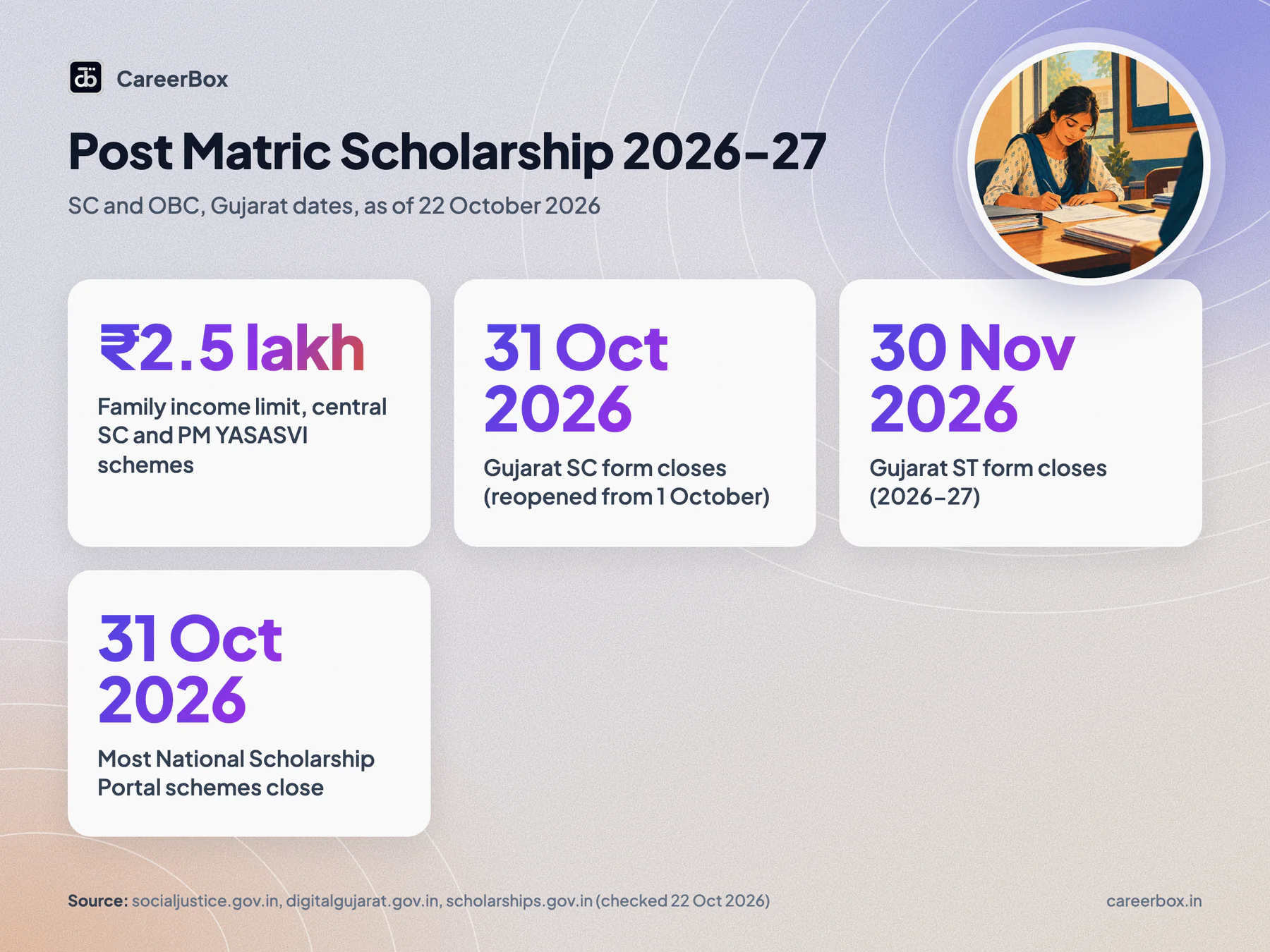
Post matric scholarship 2026-27 for SC and OBC students: the ₹2.5 lakh income limit, yearly amounts, Gujarat last dates (SC 31 October, ST 30 November 2026), OTR and how to apply.
Post-matric means any study after Class 10, from Class 11 and 12 to research. This guide is built only from government pages read on 22 October 2026: the Department of Social Justice and Empowerment, the National Scholarship Portal, and the Gujarat Government's Digital Gujarat and Gujarat State Scholarship Portal.
Key takeaways
- Two central schemes: the Post-Matric Scholarship for Scheduled Castes (PMS-SC) and the Post-Matric Scholarship under PM YASASVI for OBC, EBC and DNT students.
- Income limit: ₹2,50,000 a year from all sources, in the last financial year, for both.
- Where to apply: the state government chooses the awardees, so you apply on your state's portal. NSP's list of state schemes has no Gujarat entry on 22 October 2026.
- Gujarat dates (2026-27): SC reopened from 1 October to 31 October 2026. ST is open from 1 September to 30 November 2026. SEBC/OBC ran from 6 July to 30 September 2026.
- Payment: straight into your Aadhaar-linked bank account. In Gujarat's guideline, the Centre pays 60% and the State 40% under the central scheme.
- Not announced: the 2027-28 dates. Neither the Department nor Gujarat has published them.
What is the post matric scholarship?
A post-matric scholarship pays part of your fees and an allowance for living costs while you study after Class 10. The two big central schemes are run by the Ministry of Social Justice and Empowerment:
- PMS-SC: the Scheme of Post Matric Scholarships for Scheduled Castes, in force with effect from 2020-21. Its stated aim is to raise the share of SC students in higher education, with a focus on the poorest households.
- PM YASASVI (post-matric part): the umbrella PM YASASVI scheme for OBC, EBC and DNT students has five sub-schemes. One of them is the Post-Matric Scholarship, a centrally sponsored scheme.
Both guidelines say the scholarship is for study in India only, and that the State or UT where you are permanently settled selects the awardees. That is why you apply on a state portal.
Post matric scholarship eligibility
For SC students (PMS-SC), per the Department's scheme guideline:
- You are an Indian national belonging to a Scheduled Caste of your own State or UT.
- You have passed Class 10 or Higher Secondary, or a higher examination, from a recognised board or university.
- Your parents' or guardian's income from all sources is not more than ₹2,50,000 in the last financial year. The income certificate is needed only once, at admission, for courses that run more than a year.
- You do not hold another scholarship or stipend at the same time. You may choose whichever is better for you.
- You are not repeating a stage you have already completed, for example B.Com after B.A.
- Your college must have an AISHE or UDISE code.
For OBC, EBC and DNT students (PM YASASVI post-matric), per the PM YASASVI guideline: the same ₹2,50,000 income ceiling, for students studying at the post-matric or post-secondary stage. The guideline asks states to look first for the poorest households.
Minority students: on 22 October 2026 the National Scholarship Portal's list of central ministries has no Ministry of Minority Affairs entry. Check your state portal before assuming a minority post-matric scheme is open to you.
Students with disabilities: NSP lists a separate Post Matric Scholarship For Students With Disabilities (open from 25 July 2026 to 31 October 2026). NSP says disabled students must first log in to the UDID portal and give consent to share their UDID details, or they cannot submit the form.
Post matric scholarship amount
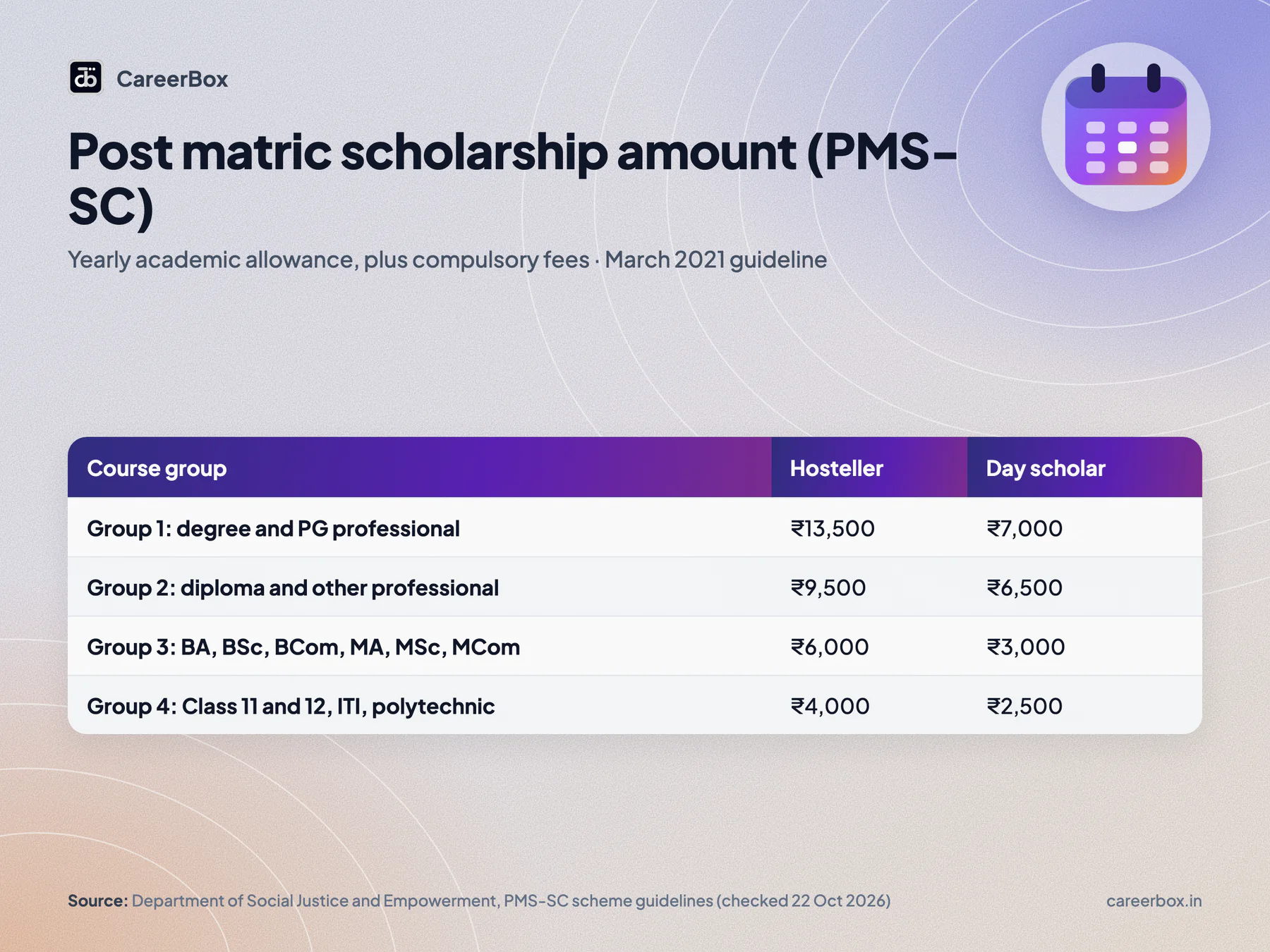
For PMS-SC, the Department's guideline pays two things: the compulsory non-refundable fees, including tuition fee as fixed by your State's fee committee, and a yearly academic allowance.
| Course group | Hostellers (a year) | Day scholars (a year) |
|---|---|---|
| Group 1: degree and PG professional courses | ₹13,500 | ₹7,000 |
| Group 2: other professional courses, diploma, certificate | ₹9,500 | ₹6,500 |
| Group 3: other graduate and PG courses (BA, BSc, BCom, MA, MSc, MCom) | ₹6,000 | ₹3,000 |
| Group 4: post-Class 10 non-degree courses (Class 11 and 12, ITI, polytechnic) | ₹4,000 | ₹2,500 |
Divyang students get ten percent extra. These figures are written in the March 2021 guideline as applicable from 2021-22. The guideline links the allowance to the Consumer Price Index for Industrial Workers, with revisions by separate order, so confirm the current figure on your state portal.
For PM YASASVI post-matric, the central guideline lists a yearly academic allowance plus tuition fee: Group 1 ₹10,000 plus ₹10,000 (₹20,000), Group 2 ₹8,000 plus ₹5,000 (₹13,000), Group 3 ₹6,000 plus ₹2,000 (₹8,000) and Group 4 ₹5,000 (no tuition component). That document is titled 2021-22 to 2025-26. Gujarat's 2026-27 SEBC guideline still lists the scheme with the same four slabs, so it continues in Gujarat this year.
Money does not go to your college. The scholarship is paid by direct benefit transfer to your bank account, preferably Aadhaar-linked. If you hold a Freeship Card, you are admitted without paying fees up front and must pay the college within 7 working days of the scholarship reaching you.
Post matric scholarship last date 2026
| Scheme or portal | Who | Last date | Status on 22 October 2026 |
|---|---|---|---|
| Gujarat, Digital Gujarat: post-matric, SC | SC students who remained | 31 October 2026 (reopened from 1 October) | Open |
| Gujarat, Digital Gujarat: post-matric, ST, 2026-27 | ST students | 30 November 2026 (from 1 September) | Open |
| Gujarat, Digital Gujarat: post-matric, ST, 2025-26 remaining students | ST students | 20 October 2026 | Closed |
| Gujarat, SC and SEBC guideline window | SC and SEBC students | 30 September 2026 (from 6 July) | Closed; SC reopened, no SEBC reopening listed |
| NSP: Post Matric for students with disabilities | Disabled students | 31 October 2026 | Open |
| NSP: Post Matric for wards of beedi, cine, IOMC and LSDM workers | Workers' wards | 31 October 2026 | Open |
On NSP, institute verification closes on 15 November 2026 and district, state or ministry officer verification on 30 November 2026. Our NSP scholarship guide has the full list of schemes.
The Digital Gujarat Latest Update page says the SC form was reopened "due to remaining students". If you filled the form earlier and were approved, you have nothing to do. Students who got a scholarship in 2025-26 find their 2026-27 form already waiting in "Renewal" mode, per the Gujarat guideline.
Next year's dates are not published. Gujarat's 2026-27 SC window began on 6 July 2026, so watch digitalgujarat.gov.in from around June 2027, not before.
How to apply for the post matric scholarship in Gujarat
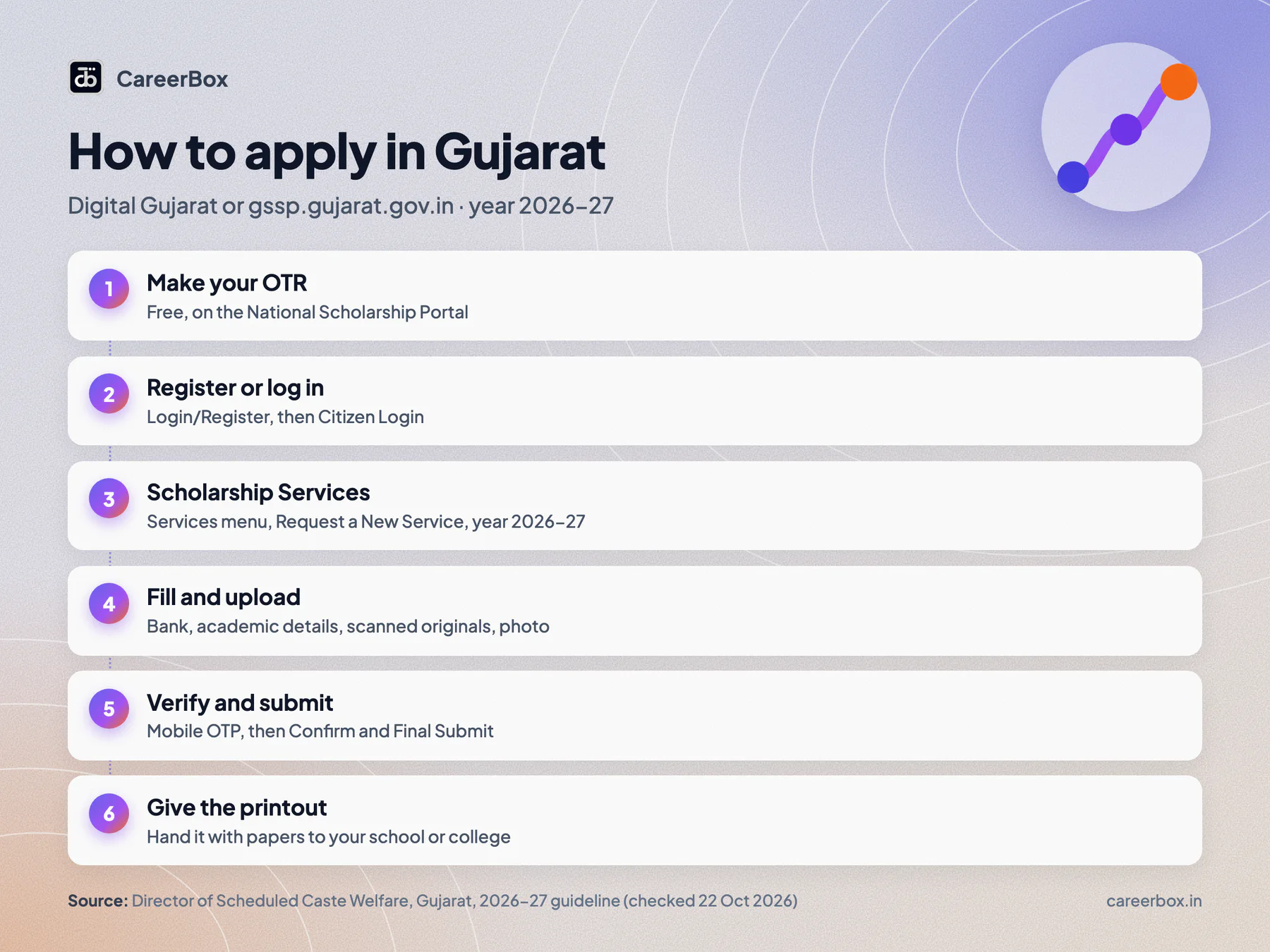
Gujarat students apply on Digital Gujarat. Its Scholarship Services menu leads to the Gujarat State Scholarship Portal at gssp.gujarat.gov.in, and a Digital Gujarat notice of 17 August 2026 says to use GSSP if scholarship services will not open. Steps from the Director of Scheduled Caste Welfare's 2026-27 guideline:
- Make your OTR. The guideline says the central scheme needs an OTR number generated on the National Scholarship Portal, which you enter on the Digital Gujarat form. OTR is free and valid for your whole academic career, per NSP's OTR FAQ.
- Register or log in. On Digital Gujarat choose Login/Register, then Citizen Login. New students use New Registration with their own mobile number and email ID. Students registered in earlier years log in with their old ID and need not register again.
- Open the right menu. After login go to Services, then Scholarship Services. Applying anywhere else is not accepted.
- Request a new service. Choose the year 2026-27 and pick your scheme under the Director of Scheduled Caste Welfare heading. Renewal students click Renewal instead.
- Fill the form and upload scans. Registration, bank, academic and disability details, with original documents scanned.
- Verify and submit. Upload a recent passport-size photo, verify your mobile number by OTP, and press Confirm and Final Submit.
- Print and submit to your college. Take a printout and attach the supporting papers to it, then hand it to your school or college, which verifies it online.
For the central scheme, the guideline also says your Aadhaar-based biometric eKYC must show "Yes" in the ration card database, and your Aadhaar must be linked to your bank account.
Which Gujarat scheme should you pick?
Gujarat's SC guideline lists these post-matric options for 2026-27:
- BCK-6.1, Post Matric Scholarship for SC students (GOI): the central scheme, income up to ₹2,50,000.
- BCK-5, SC girls, state scheme: for girls with family income above ₹2,50,000, no upper income limit.
- BCK-5A, SC boys, state scheme: for boys with family income from ₹2,50,000 to ₹6,00,000.
Students with a Freeship Card must choose the Freeship Card version of the scheme. Those without one apply in the plain version.
For OBC students, the 2026-27 SEBC guideline lists PM YASASVI Post Matric (GOI) for OBC, EBC and DNT students with income up to ₹2,50,000. Its state post-matric scheme covers girls above that income with no upper limit and boys between ₹2,50,000 and ₹6,00,000. The guideline notes that students at or below ₹2,50,000 should fill the PM YASASVI form. Which one you pick decides who pays, so choose the one that matches your income.
More in our Digital Gujarat scholarship guide and our report on the Gujarat reopening.
Documents needed
From the Gujarat 2026-27 SC guideline:
- Caste certificate and the guardian's income certificate, both issued by the competent authority. If the father has died, his death certificate; salaried parents add Form 16.
- Marksheets from Class 10 onward, year by year.
- First page of the bank passbook with account number, IFSC and branch, or a cancelled cheque.
- Fee receipt for the year (not needed with a Freeship Card).
- Hostel certificate if you live in a hostel, and a disability certificate if relevant.
- Passport-size photo, Aadhaar number and ration card number.
Post matric scholarship status check
On Digital Gujarat, log in with your mobile number, go to Services and Scholarship Services, and pick the year in the drop-down to see applications you filed. The guideline says previous years from 2017-18 are visible there. Once you submit, you can also withdraw the form yourself if your institute has not acted on it, correct it and send it again.
On the National Scholarship Portal, the home page has Application Status and Track Your Payment links for schemes run there.
Frequently asked questions
What is the post matric scholarship last date for 2026?
In Gujarat, the SC form is open until 31 October 2026 and the ST form until 30 November 2026. The SEBC window closed on 30 September 2026. On NSP, most schemes close on 31 October 2026.
What is the income limit for the post matric scholarship?
₹2,50,000 a year from all sources for both the SC central scheme and PM YASASVI post-matric. Gujarat's state schemes cover SC and SEBC boys from ₹2,50,000 to ₹6,00,000 and girls above ₹2,50,000.
How much is the post matric scholarship amount?
Under the Department's SC guideline, a yearly allowance of ₹2,500 to ₹13,500 depending on course group and hostel or day-scholar status, plus compulsory fees. PM YASASVI post-matric pays ₹5,000 to ₹20,000 a year in total across its four groups.
Can I apply for the Post Matric Scholarship on the National Scholarship Portal?
Not for Gujarat. The Department says the State selects awardees, and NSP's state list has no Gujarat entry. Gujarat students make an OTR on NSP and then apply on Digital Gujarat.
Is the post matric scholarship for SC students and OBC students the same scheme?
No. SC students come under PMS-SC and OBC, EBC and DNT students under PM YASASVI. Both have a ₹2,50,000 income limit.
Do I need an OTR number?
For Gujarat's central scheme, yes. The guideline asks you to generate it on NSP and enter it on the Digital Gujarat form. OTR is free.
Can I get two scholarships together?
Not under PMS-SC. The guideline says a scholarship holder cannot hold another scholarship or stipend and may choose the better one. On NSP, you may apply for one merit-based and one or more welfare-based schemes in 2026-27.
When will the 2027-28 form open?
No date is published. Gujarat's 2026-27 SC window opened on 6 July 2026.
Sources
All checked on 22 October 2026.
- National Scholarship Portal home page: scholarships.gov.in
- NSP, Schemes On NSP (2026-27 dates): scholarships.gov.in/All-Scholarships
- NSP, OTR FAQ v1.4: scholarships.gov.in/public/FAQ/OTR%20FAQ%20v1.4.pdf
- Department of Social Justice and Empowerment, Post-Matric Scholarship for SC students: socialjustice.gov.in/schemes/25
- PMS-SC scheme guidelines (March 2021): socialjustice.gov.in/writereaddata/UploadFile/PMS_for_SCs_Scheme_Guidelines.pdf
- Department of Social Justice and Empowerment, PM YASASVI: socialjustice.gov.in/schemes/101
- PM YASASVI scheme guidelines (2021-22 to 2025-26): socialjustice.gov.in/public/ckeditor/upload/65661651839791.pdf
- Department of Social Justice and Empowerment, Top Class Education in College for OBC, EBC and DNT students: socialjustice.gov.in/schemes/110
- Digital Gujarat: digitalgujarat.gov.in
- Digital Gujarat Latest Update: digitalgujarat.gov.in/LinkPages/LatestUpdate.aspx
- Gujarat State Scholarship Portal: gssp.gujarat.gov.in
- Director of Scheduled Caste Welfare, Gujarat, guideline for SC students 2026-27: gssp.gujarat.gov.in/LoginApp/DownLoad/Guideline%20for%20SC%20Students%20%28DGP%29%202026-27.pdf
- Gujarat SEBC post-matric guideline 2026-27: gssp.gujarat.gov.in/LoginApp/DownLoad/DCW_Guidiline_26-27.pdf
Dates and amounts can change. Confirm them on digitalgujarat.gov.in, gssp.gujarat.gov.in or scholarships.gov.in before you apply. For other Gujarat aid see our MYSY guide and the NMMS guide.
More to read
All articles
Government jobs 2026: 10th pass, 12th pass and graduate vacancies open now, with last dates
Oct 22, 202612 min read
Post Office Recruitment 2026: India Post GDS vacancies, Gujarat circle, eligibility, salary and merit list
Oct 22, 202611 min read
SSC CGL 2026: Tier 1 dates, 10,731 vacancies, Tier 2, salary, eligibility and result
Oct 22, 202613 min read
SBI PO 2026: 1,500 vacancies, dates, eligibility, salary and admit card
Oct 21, 202612 min read
GPSC calendar 2026: advertisement dates, GAS exam status, interview weeks and results
Oct 21, 202612 min read
Gujarat Police Bharti 2026: LRD, PSI, eligibility, physical test, exam pattern, salary and OJAS apply
Oct 21, 202613 min read