
IIT placements 2025: median salary and share of graduates placed, from official NIRF data
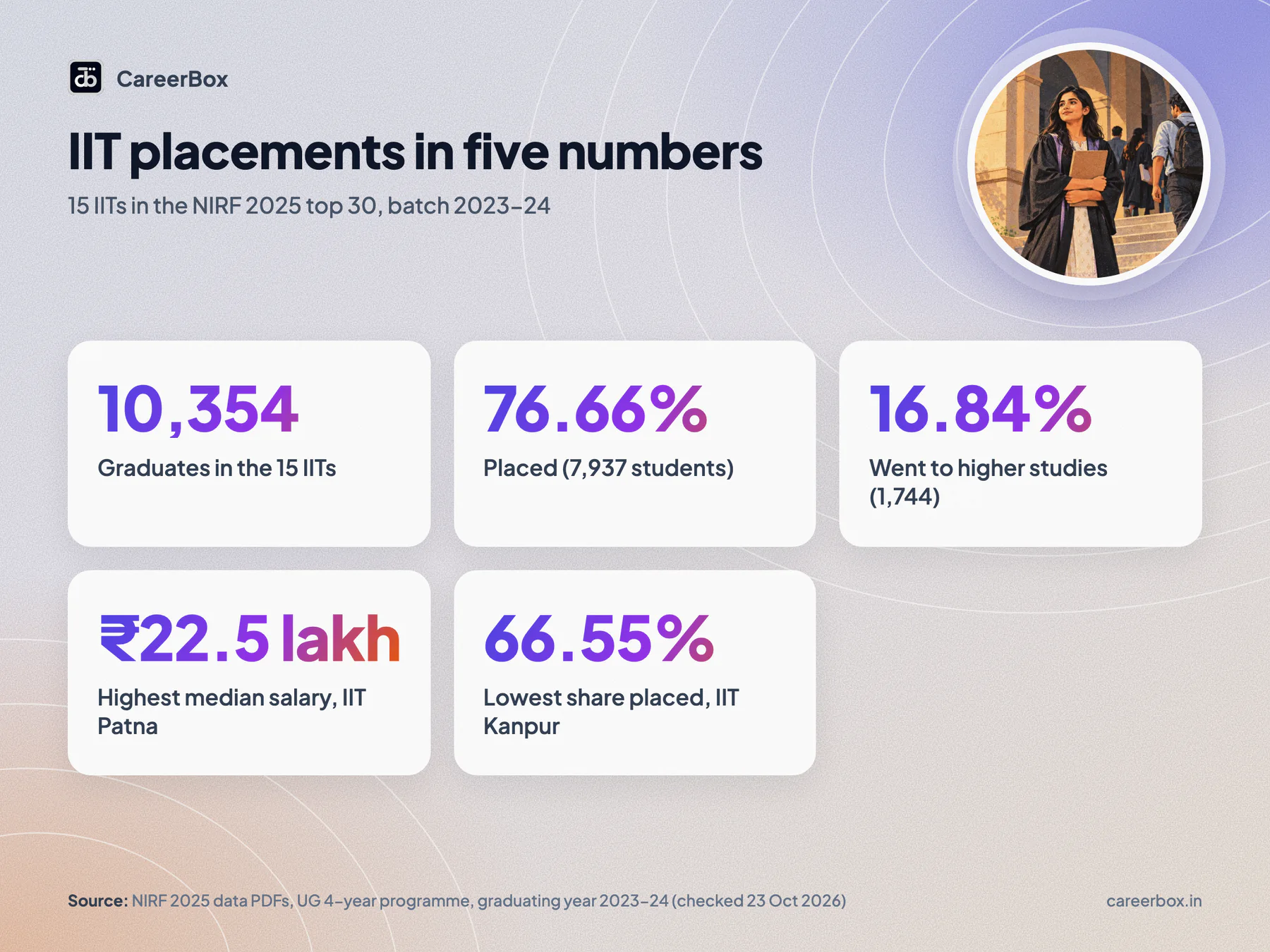
Median salary, graduates placed and students going for higher studies at 22 IITs, read from each institute's own NIRF 2025 PDF for the 2023-24 batch, with the share placed worked out.

Many "100% placement" lines you see online divide by a smaller number than NIRF does. This article puts the official numbers in one table, shows how to work out the same shares yourself, and links every figure to the institute's own NIRF PDF. All facts are from NIRF 2025, graduating batch 2023-24, read on 23 October 2026.
Key takeaways
- Data source: each IIT's own NIRF 2025 data PDF, table "Placement & higher studies for previous 3 years", row for graduating year 2023-24, UG 4-year programme. See the NIRF 2025 Engineering ranking page.
- Share placed here means students placed divided by students graduating. Students who went to higher studies stay in the denominator.
- Median salary is the median of the placed graduates only, in rupees a year.
- Roorkee and Bombay: placed plus higher studies adds up to exactly all graduates (769 + 333 = 1,102 and 731 + 259 = 990).
- Newer IITs report lower medians. Of the seven lower-listed IITs in the second table, the median ranges from ₹11 lakh to ₹16.97 lakh.
- NIRF 2026: nirfindia.org did not list a 2026 ranking on 23 October 2026, so 2025 is the latest official edition.
IIT placements 2025: median salary and share placed, institute by institute
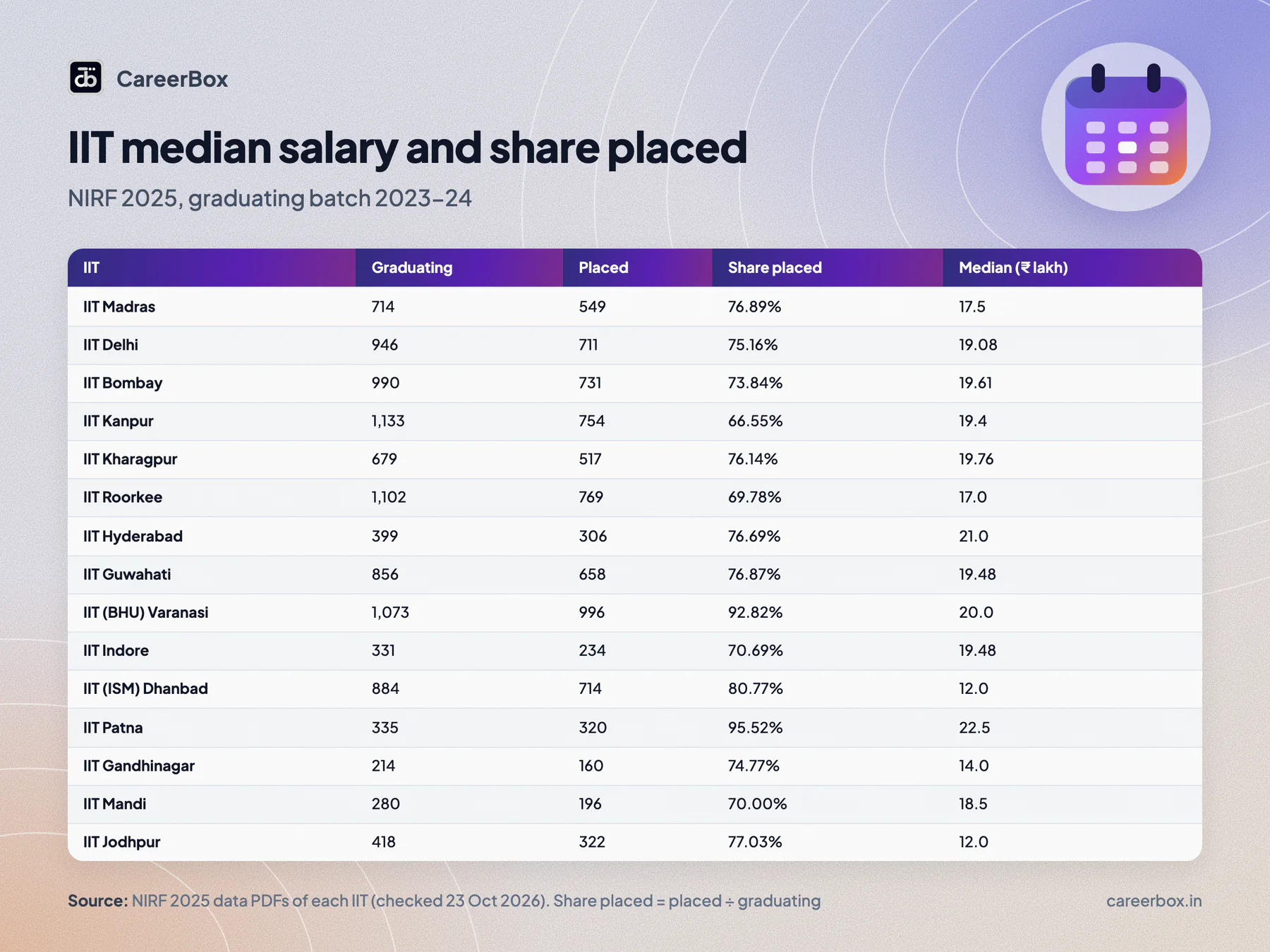
Fifteen IITs sit in the first 30 places on the NIRF 2025 Engineering ranking page. The table follows the order of that page. Graduating, placed, higher studies and median are copied from each institute's NIRF PDF; share placed is our division (placed ÷ graduating).
| Institute | Graduating | Placed | Higher studies | Share placed | Median salary (₹ lakh a year) |
|---|---|---|---|---|---|
| IIT Madras | 714 | 549 | 153 | 76.89% | 17.5 |
| IIT Delhi | 946 | 711 | 49 | 75.16% | 19.08 |
| IIT Bombay | 990 | 731 | 259 | 73.84% | 19.61 |
| IIT Kanpur | 1,133 | 754 | 283 | 66.55% | 19.4 |
| IIT Kharagpur | 679 | 517 | 83 | 76.14% | 19.76 |
| IIT Roorkee | 1,102 | 769 | 333 | 69.78% | 17.0 |
| IIT Hyderabad | 399 | 306 | 37 | 76.69% | 21.0 |
| IIT Guwahati | 856 | 658 | 179 | 76.87% | 19.48 |
| IIT (BHU) Varanasi | 1,073 | 996 | 75 | 92.82% | 20.0 |
| IIT Indore | 331 | 234 | 27 | 70.69% | 19.48 |
| IIT (ISM) Dhanbad | 884 | 714 | 33 | 80.77% | 12.0 |
| IIT Patna | 335 | 320 | 15 | 95.52% | 22.5 |
| IIT Gandhinagar | 214 | 160 | 51 | 74.77% | 14.0 |
| IIT Mandi | 280 | 196 | 73 | 70.00% | 18.5 |
| IIT Jodhpur | 418 | 322 | 94 | 77.03% | 12.0 |
Each row links to that IIT's page on CareerBox; the NIRF PDFs are listed under "Official sources".
Which IIT has the highest median salary?
IIT Patna reports ₹22.5 lakh, the highest in the group, and also the highest share placed at 320 of 335 graduates (95.52%). IIT Hyderabad follows at ₹21 lakh, then IIT (BHU) Varanasi at ₹20 lakh, with 996 of 1,073 graduates placed (92.82%).
The classic names sit close together: IIT Kharagpur ₹19.76 lakh, IIT Bombay ₹19.61 lakh, IIT Guwahati and IIT Indore ₹19.48 lakh, IIT Kanpur ₹19.4 lakh, IIT Delhi ₹19.08 lakh. IIT Madras reports ₹17.5 lakh and IIT Roorkee ₹17 lakh.
At the lower end, IIT (ISM) Dhanbad and IIT Jodhpur report ₹12 lakh. For Gujarat students, IIT Gandhinagar reports ₹14 lakh, with 160 of 214 graduates placed (74.77%) and 51 in higher studies.
A median is the middle value. At IIT Patna, half of the 320 placed graduates were reported to earn more than ₹22.5 lakh and half less. The median says nothing about the top packages that get into news headlines.
Which IIT places the highest share of its graduates?
Share placed runs from 66.55% (Kanpur) to 95.52% (Patna) across the 15. The next highest after Patna and BHU Varanasi are IIT (ISM) Dhanbad at 80.77% and IIT Jodhpur at 77.03%.
The low shares at IIT Kanpur (66.55%), IIT Roorkee (69.78%) and IIT Mandi (70.00%) are mostly higher studies, not unplaced students. The next section shows why.
Why "share placed" is not the "100% placement" you see elsewhere
Three plain reasons, all visible in the NIRF table itself.
1. Higher studies are counted as graduates. NIRF asks each institute for the number of students graduating, the number placed, and the number selected for higher studies. A student who joins an M.Tech, an MS abroad or a PhD is a graduate but not "placed". If you divide placed by graduating, that student lowers the share.
2. A "100% placed" line can use a smaller base. If you remove the higher-studies students from the denominator, the share rises. This is our arithmetic, not a NIRF figure:
| Institute | Graduating | Higher studies | Placed | Placed ÷ graduating | Placed ÷ (graduating minus higher studies) |
|---|---|---|---|---|---|
| IIT Roorkee | 1,102 | 333 | 769 | 69.78% | 100.0% |
| IIT Bombay | 990 | 259 | 731 | 73.84% | 100.0% |
| IIT Patna | 335 | 15 | 320 | 95.52% | 100.0% |
| IIT Madras | 714 | 153 | 549 | 76.89% | 97.9% |
| IIT Kanpur | 1,133 | 283 | 754 | 66.55% | 88.7% |
| IIT Delhi | 946 | 49 | 711 | 75.16% | 79.3% |
For Roorkee, Bombay and Patna, every graduate who did not go for higher studies was placed. That is how a "100% placed" line can be true on its own terms and still sit beside a 69.78% share in the NIRF table. Delhi shows the opposite: only 49 chose higher studies, so most of the gap to 100% is graduates the table does not count as placed.
3. NIRF counts graduates, not the admitted batch. The count is of students who graduated in the minimum stipulated time, for the 4-year programme. Students who took longer, and students admitted but not graduated, are outside it. A figure built on some other base, such as students who registered for placement, will not match the NIRF share.
Neither figure is wrong. They answer different questions. For a parent asking "what happens to a graduate here", the NIRF share, together with the higher-studies column, is the more complete answer.
IITs listed lower on the NIRF 2025 Engineering page
The same table for seven more IITs, listed below the first 30 on the same page.
| Institute | Graduating | Placed | Higher studies | Share placed | Median salary (₹ lakh a year) |
|---|---|---|---|---|---|
| IIT Ropar | 321 | 220 | 63 | 68.54% | 16.97 |
| IIT Bhubaneswar | 321 | 254 | 41 | 79.13% | 14.0 |
| IIT Jammu | 178 | 113 | 19 | 63.48% | 11.695 |
| IIT Tirupati | 205 | 114 | 72 | 55.61% | 11.0 |
| IIT Palakkad | 156 | 105 | 16 | 67.31% | 12.0 |
| IIT Bhilai | 162 | 116 | 14 | 71.60% | 12.0 |
| IIT Dharwad | 154 | 95 | 39 | 61.69% | 11.62 |
IIT Tirupati's low share (55.61%) comes with the highest higher-studies share in this table: 72 of 205 graduates (35.12%). Smaller and newer IITs also graduate fewer students, so one or two placements move the percentage a lot.
How to read the NIRF table yourself
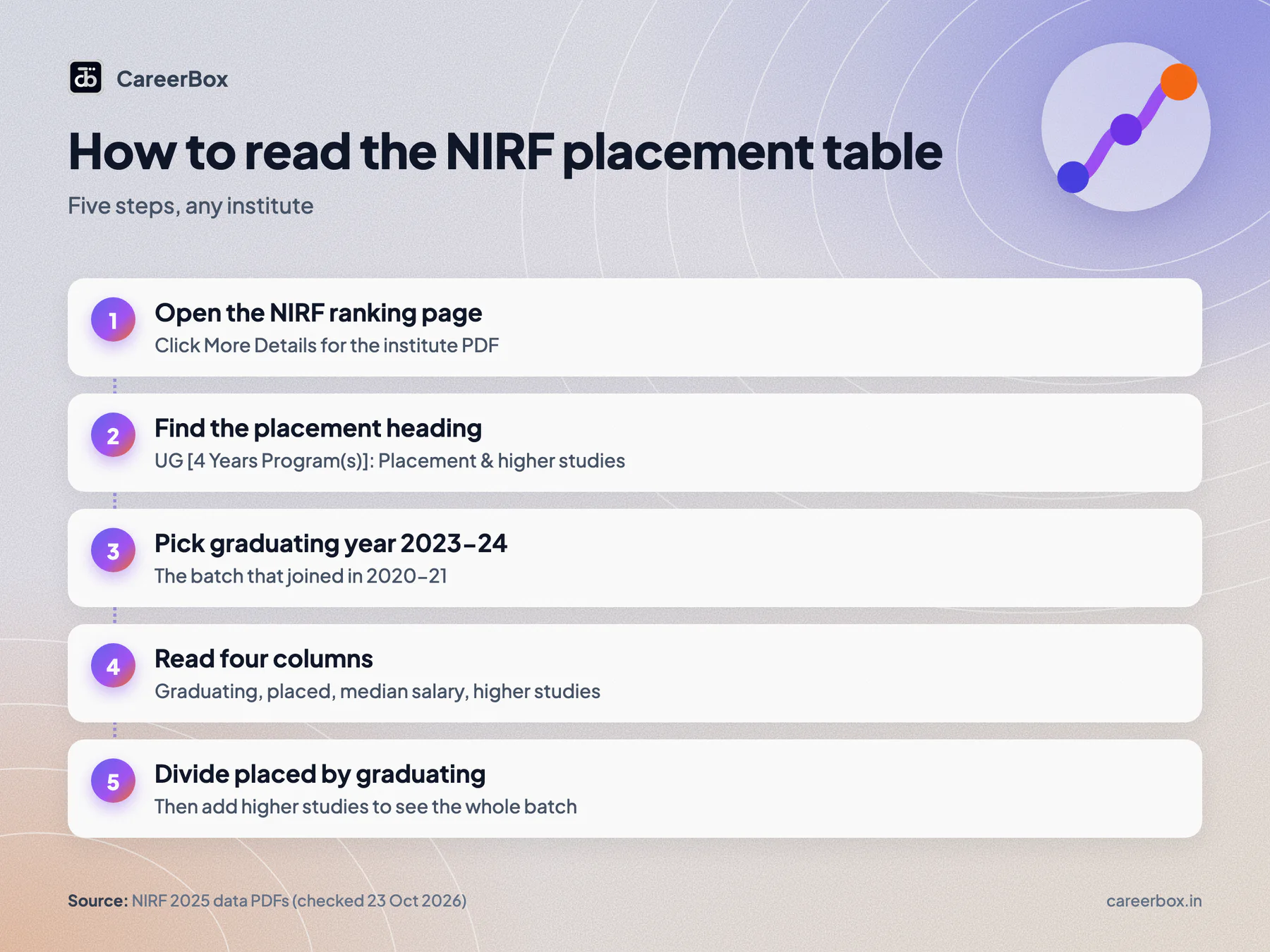
- Open the NIRF 2025 Engineering ranking page and click the institute's "More Details" link to get its data PDF.
- Scroll to "Placement & Higher Studies" and find the heading "UG [4 Years Program(s)]: Placement & higher studies for previous 3 years".
- Pick the row whose graduating year is 2023-24. Note the admission year printed in the first column belongs to the batch that joined four years earlier (2020-21).
- Read four columns: students graduating in minimum stipulated time, students placed, median salary of placed graduates per annum (in rupees), and students selected for higher studies.
- Divide placed by graduating. Then add placed and higher studies to see how much of the batch is accounted for.
The PDFs also carry a PG (2-year) table and a PhD table. This article uses only the 4-year UG row.
What these figures do not tell you
- They are submitted by the institutes. NIRF publishes the data each institute provides in its own PDF. We did not audit them.
- One batch only. This is graduating year 2023-24. The same PDFs carry 2021-22 and 2022-23, and a single year can swing, especially at small IITs.
- No branch split. A single median covers every branch of the institute. NIRF does not split this table by branch, so we cannot give branch-wise figures from it.
- Median is not average, and not the top offer. It also covers only placed graduates.
- Salary is as reported. The column is the median annual salary in rupees. It is not a promise for your batch.
- Not a ranking of IITs. Do not choose between two IITs on one column. Look at share placed, higher studies and median together, then at the branch you can actually get.
If you are still deciding on admission, our guides to JEE Advanced 2027 and JEE Main 2027 cover the exam side.
Frequently asked questions
What is the average package at IITs in NIRF 2025?
NIRF reports the median, not the average, of placed graduates. For the 15 IITs in the top 30 it ranges from ₹12 lakh (IIT Dhanbad, IIT Jodhpur) to ₹22.5 lakh (IIT Patna) a year for the 2023-24 batch.
Which IIT has the best placements?
On NIRF 2025 numbers, IIT Patna has the highest median (₹22.5 lakh) and the highest share placed (95.52%) among the 15 IITs in the top 30. IIT (BHU) Varanasi is next on share placed (92.82%), and IIT Hyderabad is next on median (₹21 lakh). The batch is small at Patna (335 graduates), so look at it alongside the bigger campuses.
Why is the placement percentage below 100% at IIT Bombay and IIT Kanpur?
Because the share placed divides by all graduates. At IIT Bombay, 731 of 990 graduates were placed (73.84%) and 259 went to higher studies, which together account for all 990. At IIT Kanpur, 754 of 1,133 were placed (66.55%) and 283 chose higher studies.
Is the NIRF median salary the same as the highest package?
No. The median is the middle salary among placed graduates. The highest package is one offer, usually far above it.
Which batch do these numbers cover?
Graduating year 2023-24, as submitted for NIRF 2025. NIRF 2026 was not published on nirfindia.org as of 23 October 2026.
Do the figures include M.Tech and PhD students?
No. We used the UG 4-year programme row only. The PDFs have separate PG and PhD tables.
Where do I find an IIT's NIRF PDF?
Open the NIRF 2025 Engineering ranking page, click "More Details" next to the institute, and open the PDF. The direct links we used are listed below.
Can I cite this table?
Yes. Please cite the NIRF 2025 data PDF of the institute concerned, and say that "share placed" is calculated as placed ÷ graduating.
Official sources
- NIRF 2025 Engineering ranking page: nirfindia.org/Rankings/2025/EngineeringRanking.html
- NIRF home page (list of ranking years): nirfindia.org
- Institute data PDFs, NIRF 2025, Engineering, read on 23 October 2026:
- IIT Madras: nirfindia.org/nirfpdfcdn/2025/pdf/Engineering/IR-E-U-0456.pdf
- IIT Delhi: nirfindia.org/nirfpdfcdn/2025/pdf/Engineering/IR-E-I-1074.pdf
- IIT Bombay: nirfindia.org/nirfpdfcdn/2025/pdf/Engineering/IR-E-U-0306.pdf
- IIT Kanpur: nirfindia.org/nirfpdfcdn/2025/pdf/Engineering/IR-E-I-1075.pdf
- IIT Kharagpur: nirfindia.org/nirfpdfcdn/2025/pdf/Engineering/IR-E-U-0573.pdf
- IIT Roorkee: nirfindia.org/nirfpdfcdn/2025/pdf/Engineering/IR-E-U-0560.pdf
- IIT Hyderabad: nirfindia.org/nirfpdfcdn/2025/pdf/Engineering/IR-E-U-0013.pdf
- IIT Guwahati: nirfindia.org/nirfpdfcdn/2025/pdf/Engineering/IR-E-U-0053.pdf
- IIT (BHU) Varanasi: nirfindia.org/nirfpdfcdn/2025/pdf/Engineering/IR-E-U-0701.pdf
- IIT Indore: nirfindia.org/nirfpdfcdn/2025/pdf/Engineering/IR-E-U-0273.pdf
- IIT (ISM) Dhanbad: nirfindia.org/nirfpdfcdn/2025/pdf/Engineering/IR-E-U-0205.pdf
- IIT Patna: nirfindia.org/nirfpdfcdn/2025/pdf/Engineering/IR-E-U-0064.pdf
- IIT Gandhinagar: nirfindia.org/nirfpdfcdn/2025/pdf/Engineering/IR-E-U-0139.pdf
- IIT Mandi: nirfindia.org/nirfpdfcdn/2025/pdf/Engineering/IR-E-U-0184.pdf
- IIT Jodhpur: nirfindia.org/nirfpdfcdn/2025/pdf/Engineering/IR-E-U-0395.pdf
- IIT Ropar: nirfindia.org/nirfpdfcdn/2025/pdf/Engineering/IR-E-U-0378.pdf
- IIT Bhubaneswar: nirfindia.org/nirfpdfcdn/2025/pdf/Engineering/IR-E-U-0355.pdf
- IIT Jammu: nirfindia.org/nirfpdfcdn/2025/pdf/Engineering/IR-E-U-0906.pdf
- IIT Tirupati: nirfindia.org/nirfpdfcdn/2025/pdf/Engineering/IR-E-U-0844.pdf
- IIT Palakkad: nirfindia.org/nirfpdfcdn/2025/pdf/Engineering/IR-E-U-0878.pdf
- IIT Bhilai: nirfindia.org/nirfpdfcdn/2025/pdf/Engineering/IR-E-U-0946.pdf
- IIT Dharwad: nirfindia.org/nirfpdfcdn/2025/pdf/Engineering/IR-E-U-0899.pdf
Placement data is submitted by institutes and can be revised. Confirm on nirfindia.org and the institute's own placement page before you decide.
Sources
- NIRF 2025: Engineering ranking (checked 23 October 2026)
- NIRF: home page (ranking years listed) (checked 23 October 2026)
- NIRF 2025 data PDF: IIT Madras (IR-E-U-0456) (checked 23 October 2026)
- NIRF 2025 data PDF: IIT Delhi (IR-E-I-1074) (checked 23 October 2026)
- NIRF 2025 data PDF: IIT Bombay (IR-E-U-0306) (checked 23 October 2026)
- NIRF 2025 data PDF: IIT Kanpur (IR-E-I-1075) (checked 23 October 2026)
- NIRF 2025 data PDF: IIT Kharagpur (IR-E-U-0573) (checked 23 October 2026)
- NIRF 2025 data PDF: IIT Roorkee (IR-E-U-0560) (checked 23 October 2026)
- NIRF 2025 data PDF: IIT Hyderabad (IR-E-U-0013) (checked 23 October 2026)
- NIRF 2025 data PDF: IIT Guwahati (IR-E-U-0053) (checked 23 October 2026)
- NIRF 2025 data PDF: IIT (BHU) Varanasi (IR-E-U-0701) (checked 23 October 2026)
- NIRF 2025 data PDF: IIT Indore (IR-E-U-0273) (checked 23 October 2026)
- NIRF 2025 data PDF: IIT (ISM) Dhanbad (IR-E-U-0205) (checked 23 October 2026)
- NIRF 2025 data PDF: IIT Patna (IR-E-U-0064) (checked 23 October 2026)
- NIRF 2025 data PDF: IIT Gandhinagar (IR-E-U-0139) (checked 23 October 2026)
- NIRF 2025 data PDF: IIT Mandi (IR-E-U-0184) (checked 23 October 2026)
- NIRF 2025 data PDF: IIT Jodhpur (IR-E-U-0395) (checked 23 October 2026)
- NIRF 2025 data PDF: IIT Ropar (IR-E-U-0378) (checked 23 October 2026)
- NIRF 2025 data PDF: IIT Bhubaneswar (IR-E-U-0355) (checked 23 October 2026)
- NIRF 2025 data PDF: IIT Jammu (IR-E-U-0906) (checked 23 October 2026)
- NIRF 2025 data PDF: IIT Tirupati (IR-E-U-0844) (checked 23 October 2026)
- NIRF 2025 data PDF: IIT Palakkad (IR-E-U-0878) (checked 23 October 2026)
- NIRF 2025 data PDF: IIT Bhilai (IR-E-U-0946) (checked 23 October 2026)
- NIRF 2025 data PDF: IIT Dharwad (IR-E-U-0899) (checked 23 October 2026)
More to read
All articles
NIT placements 2025: median salary and share of graduates placed, from official NIRF data
Oct 22, 202614 min read
Tata scholarship 2026-27: Means Grant, Pankh, J N Tata, last date, amount and eligibility
Oct 22, 202612 min read
JEE Advanced 2027: exam date, organising IIT, eligibility, attempts, syllabus and cutoff from JEE Main
Oct 22, 202611 min read
Reliance Foundation Scholarship 2026-27: eligibility, amount, last date and aptitude test
Oct 22, 202612 min read
RBI Assistant 2026: vacancies, Ahmedabad posts, salary, eligibility and exam pattern
Oct 22, 202612 min read
PhD admission 2026: January 2027 session last dates, eligibility, UGC NET route and JRF fellowship
Oct 22, 202613 min read